
Views: 220 Author: WAIGAOQIAO Publish Time: 2026-04-08 Origin: Site
Content Menu
● Understanding the Essence of Retail Display Design
● The Science of Ergonomics and User Experience
● Selecting Raw Materials for Industrial Strength
● The Precision Fabrication Process
● Surface Treatment and Aesthetic Finishing
● Ensuring Stability and Safety on the Retail Floor
● The Role of OEM Partnerships in Retail Success
● Maximizing Retail Space and Inventory Density
● Quality Control and Sustainable Manufacturing
● Future Trends in Retail Display Solutions
In the dynamic world of retail, the presentation of merchandise is as crucial as the product itself. For fashion brands, wholesale distributors, and boutique owners, the clothing rack is not merely a piece of furniture; it is a vital tool for visual storytelling, inventory management, and maximizing sales floor efficiency. As experts in the garment rack industry, WAIGAOQIAO specializes in providing top-tier OEM services, bridging the gap between innovative design and industrial-grade manufacturing. This guide explores the intricate journey of transforming raw metal into high-performance retail display solutions.

Before a single piece of metal is cut, the conceptual phase determines the ultimate success of a clothing rack. Retailers require more than just a place to hang garments; they need fixtures that harmonize with their store aesthetic while serving a specific functional purpose.
Design begins with understanding the retail environment. High-end boutiques often seek sleek, minimalist structures that emphasize the exclusivity of the clothing. In contrast, large-scale retail chains prioritize durability, high-volume capacity, and ease of assembly. Our design process at WAIGAOQIAO involves collaborative requirement analysis, where we evaluate the store's layout, the weight of the intended merchandise, and the brand identity.
Engineering drawings are then produced to translate these requirements into technical specifications. These blueprints define the load-bearing requirements, dimensions, material thickness, and structural integrity. A critical component of this phase is the selection of a unified family of fixtures. Consistency in finish, height, and arm type across a store's display systems creates a cohesive visual experience that guides customers through the shopping space seamlessly.
Retail display design extends beyond the visual; it is deeply rooted in ergonomics. How a customer interacts with a rack can significantly influence their purchasing decision. If a rack is too high, customers cannot reach the top garments easily. If it is too low, the store feels cluttered and disorganized.
The height of the horizontal rail is a key ergonomic consideration. We typically design racks that fall within the average reaching range of the target demographic. Furthermore, the spacing between garments is essential for a premium shopping experience. If rails are over-crowded, customers struggle to browse effectively, often leading to frustration. By designing racks with optimal width and height, we help retailers create a browsing environment where every piece of apparel is accessible, visible, and presented at its best.
The durability of a clothing rack is directly linked to the raw materials chosen. Metal racks are the industry standard for retail due to their superior strength-to-weight ratio and versatility in finish.
Steel is the most common material due to its cost-effectiveness and robust load-bearing capabilities. For standard retail use, mild steel provides a reliable base. When superior corrosion resistance is required, particularly for displays in humid environments or areas with heavy traffic, stainless steel or galvanized steel is preferred.
The profile of the metal—whether it is tubular, square, or flat bar—is selected based on the desired aesthetic and load requirements. Tubular steel is highly versatile, offering high strength while allowing for smooth, rounded edges that prevent damage to garments. Square profiles provide a more modern, industrial aesthetic and are excellent for rigid, modular frame constructions. Beyond the shape, the wall thickness of the steel tube is a critical factor in determining the overall weight capacity of the rack, allowing us to engineer fixtures for everything from lightweight t-shirts to heavy winter coats.
The manufacturing journey is a highly controlled sequence of precision processes. Once the raw material is procured, it undergoes a series of transformations.
Cutting and Shaping: Using advanced machinery such as laser cutters or industrial saws, raw metal lengths are cut to precise dimensions. For complex shapes or bent frames, CNC tube bending machines ensure accuracy, allowing for consistent radii in curved designs. This precision ensures that components fit together perfectly during final assembly, preventing structural weaknesses.
Welding and Assembly: This stage is where the structural backbone of the rack is formed. Expert welders join the components using methods like MIG or TIG welding to ensure high-strength, durable joints. The precision of the welding process is paramount; a clean weld not only ensures safety and stability but also enhances the final appearance of the product. At WAIGAOQIAO, we utilize advanced fixtures and jigs to hold components in place, ensuring perfect alignment during the welding process.
Grinding and Deburring: After welding, joints are meticulously ground down to create a smooth, seamless surface. This is particularly important for high-end retail environments where customers will touch the racks. Removing sharp edges or weld spatter is a non-negotiable quality control step that protects both the merchandise and the retail staff.
The final aesthetic and protective layer is achieved through finishing. Powder coating is the preferred method for retail fixtures, as it creates a durable, thick, and uniform layer that is resistant to chips, scratches, and fading. It also allows for an extensive range of colors and textures, from matte black for an industrial look to brushed chrome or gold for a premium feel.
The pretreatment process before coating—often involving degreasing and sandblasting—is what ensures the paint adheres for years of heavy use. Electropolishing or plating is used when a highly reflective, metallic finish is required. For brands wanting to emphasize sustainability, we also offer eco-friendly finishing options that utilize lower volatile organic compounds, aligning with the modern global focus on sustainable retail operations.
A retail display rack that wobbles or fails under the weight of clothing is a liability. Stability is non-negotiable. During the manufacturing process, we incorporate features that ensure the rack remains secure.
Base Design: The base of the rack determines its center of gravity. For free-standing units, wide, weighted bases or cross-braced designs are used to prevent tipping. When designing for rolling racks, industrial-grade, lockable casters are essential. These casters must be rated for the expected load capacity, ensuring smooth mobility without compromising the unit's static stability. We also test our casters on various floor surfaces to ensure they do not leave marks or cause damage to retail store flooring.
Vertical Alignment: Precision in the vertical supports is critical. Any slight deviation from the vertical axis can cause uneven stress distribution, leading to premature failure. Regular quality checks during production ensure that every upright is perfectly perpendicular to the base.
Weight Distribution and Testing: Every new design undergoes rigorous testing. We evaluate how the weight of the garments is distributed across the horizontal rails and how the structure responds to dynamic loads, such as customers browsing through inventory. By conducting these stress tests, we can provide retailers with accurate load ratings, ensuring they never overload their fixtures. This dedication to safety protects the brand's image and mitigates risks in high-traffic retail spaces.
Collaborating with a dedicated OEM partner like WAIGAOQIAO offers significant advantages for brands and wholesalers. By outsourcing the manufacturing process, retailers can focus on their core competencies—branding, merchandising, and customer service—while relying on our expertise to deliver high-quality, reliable fixtures.
Our process begins with active communication. We bridge the gap between initial design sketches and final retail-ready products. We understand the nuances of global supply chain management, ensuring that products are manufactured to international standards and delivered on time. Furthermore, as an OEM, we provide scalability. Whether a client is a single boutique owner needing ten custom racks or a major retail chain requiring thousands of units for a store rollout, we adjust our production capacity to meet those needs without sacrificing quality.
The versatility of metal clothing racks allows for an infinite variety of configurations, tailored to optimize retail floor space.
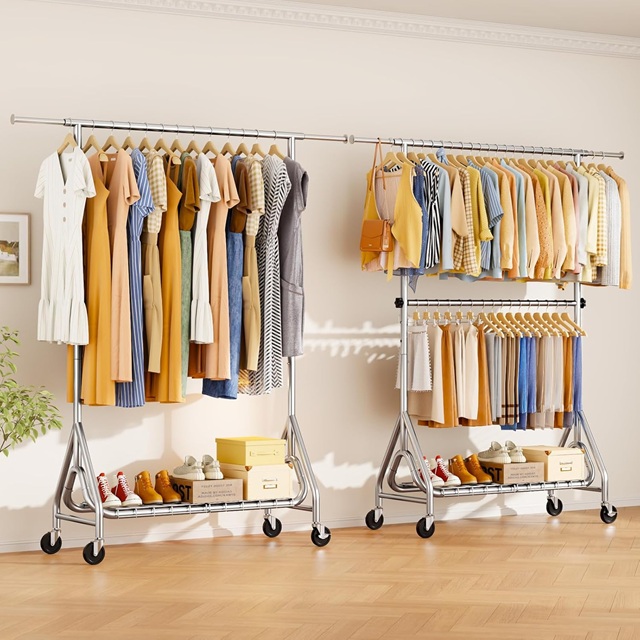
Single-Rail Bars: These are the workhorses of the retail floor, perfect for linear displays, seasonal collections, or clearance sections. Their simple design allows for high-density hanging, making them ideal for space-constrained environments.
Multi-Directional Racks: Two-way and four-way racks are designed to maximize floor space usage. By branching out from a central pole, they create a multi-directional display that draws customer attention from all angles. These are highly effective for highlighting new arrivals or themed collections.
Modular Wall Systems: Modern retail design increasingly favors flexibility. Modular systems, which combine shelves, rails, and face-outs, allow retailers to reconfigure their wall displays as inventory changes. This adaptability is key to maintaining a fresh, engaging store environment without the expense of replacing fixtures. By utilizing wall space effectively, retailers can free up floor space, creating a more open and inviting shopping atmosphere.
At WAIGAOQIAO, quality is embedded in every stage. Our quality assurance team implements strict protocols, from inspecting raw steel batches upon arrival to performing final visual and functional inspections before packing. We believe that a high-quality product is one that stands the test of time, reducing the need for constant replacement and thereby contributing to more sustainable retail practices.
By investing in efficient manufacturing processes and waste reduction strategies, we minimize our environmental footprint. Using recyclable metals like steel and employing long-lasting finishes ensures that our racks remain in use for as long as possible, providing value to our clients while respecting environmental responsibilities.
The retail industry is constantly evolving, and with it, the design of display fixtures. We are seeing a move toward smart retail, where fixtures might integrate lighting or digital screens to provide product information. As an OEM manufacturer, we are keeping a close eye on these trends, ready to incorporate new technologies into our metal fabrication processes.
Another trend is the emphasis on "phygital" retail, where the physical store experience is tightly integrated with digital inventory management. Our rack designs now consider how they can better support omni-channel fulfillment, with some models designed specifically to accommodate "buy-online-pick-up-in-store" workflows. By staying at the intersection of traditional craftsmanship and forward-thinking innovation, we ensure our partners are always equipped for the future of retail.
The manufacturing of retail metal clothing racks is a sophisticated blend of engineering, material science, and design intuition. For Chinese companies providing OEM services, the focus remains on delivering high-quality, durable, and aesthetically appealing fixtures that empower retailers to showcase their merchandise effectively. By adhering to rigorous manufacturing standards—from conceptual design and material selection to precise fabrication and stability testing—we create the foundations upon which successful retail experiences are built. As the industry continues to evolve, our commitment to innovation and craftsmanship ensures that retail display solutions remain at the forefront of store design, driving both visual appeal and commercial success.
1. What are the key factors to consider when selecting metal for retail clothing racks?
The choice of metal depends on the required load capacity, the aesthetic of the retail environment, and environmental factors. Steel is the standard for durability and cost. For premium, modern looks, stainless steel or specialized finishes like chrome are preferred. It is essential to ensure the material gauge is sufficient for the weight of the clothing to be displayed.
2. How can I ensure the stability and safety of custom-made clothing display racks?
Stability is achieved through proper base design, high-quality, balanced welding, and the use of industrial-grade, lockable casters for mobile units. During the design phase, manufacturers should conduct load-bearing tests to verify that the rack can handle the intended inventory weight without tipping or structural deformation.
3. What is the advantage of using powder coating for retail fixtures?
Powder coating provides a highly durable, thick, and consistent finish that is superior to standard paint. It is resistant to chipping, scratching, and fading, which is crucial for retail fixtures that undergo frequent interaction. It also allows for a wide variety of colors and textures to match specific brand requirements.
4. Can you provide custom designs that align with a brand's specific store aesthetic?
Yes, as an OEM partner, we specialize in tailoring product designs, dimensions, and finishes to meet unique requirements. We work closely with our clients' designers to ensure that the racks fit the space perfectly and reinforce the brand's visual identity.
5. How do modular display systems differ from traditional free-standing racks?
Modular systems, such as wall-mounted rails and shelf units, offer greater flexibility and space optimization. They allow retailers to rearrange the display configuration as inventory changes, whereas traditional free-standing racks are more static. Modular systems are ideal for stores that need to refresh their displays frequent.


