
Views: 170 Author: waigaoqiao Publish Time: 2026-09-09 Origin: Site
Content Menu
● Why Material Selection Determines Display Hanger Performance
● Common Materials for Custom Metal Display Hangers
>> Low-carbon steel wire for economical retail fixtures
>> Stainless steel for corrosion resistance and premium appearance
>> Tubular and sheet-metal constructions
● How Geometry Influences Load-Bearing Capacity
>> The importance of the mounting point
>> Why the center of gravity matters
● Finish Options for Retail Display Hangers
>> Zinc plating
>> Surface safety is part of finish quality
● Load-Bearing Standards: What Buyers Should Actually Request
● A Practical OEM Testing Process for Custom Hangers
>> Step 1: Define the product and fixture
>> Step 2: Select the preliminary material and design
>> Step 3: Produce an engineering sample
>> Step 4: Conduct functional testing
>> Step 5: Record acceptance criteria
>> Step 6: Approve a golden sample
● New Insight: The Best Hanger Is Not Always the Strongest One
● Common Purchasing Mistakes to Avoid
>> Testing only an empty hanger
>> Treating all finishes as interchangeable
>> Failing to control repeat production
● Why Choose Waigaoqiao for Custom OEM Display Hangers?
>> 1. What is a custom metal display hanger?
>> 2. Which material is best for retail display hangers?
>> 3. How do I determine the required load capacity?
>> 4. Are powder-coated hangers corrosion-resistant?
>> 5. Can Waigaoqiao customize the hanger dimensions?
>> 6. What information should I provide for a quotation?
>> 7. Is a sample necessary before mass production?
Custom metal display hangers are essential components in retail merchandising systems. They hold products, support planogram consistency, and influence how easily shoppers interact with merchandise. For overseas brand owners, wholesalers, and manufacturers, selecting the right metal display hanger manufacturer involves more than comparing unit prices. Material grade, wire diameter, geometry, welding quality, surface finish, mounting compatibility, and load testing all affect long-term performance.
At Waigaoqiao, we provide OEM manufacturing services for international customers seeking custom retail display fixtures, metal display hooks, pegboard hangers, slatwall accessories, and wire merchandising components. This guide explains the technical factors buyers should evaluate before approving a custom order.

A display hanger must resist several types of stress during its service life:
- Static load: The weight of products hanging continuously.
- Bending stress: Force applied when products are removed or pushed sideways.
- Impact load: Sudden force caused by restocking or customer handling.
- Cyclic loading: Repeated loading and unloading over many retail cycles.
- Environmental exposure: Humidity, cleaning chemicals, abrasion, and temperature changes.
A hanger that performs well under a static load may still fail after repeated use. For this reason, buyers should evaluate working load, deflection, deformation, and failure behavior, rather than relying on appearance alone.
ASTM's metals standards cover material specifications and test methods for steel rods, wire, stainless steel, and related products. However, a general material standard does not automatically provide a safe working load for a finished retail hanger. The final rating depends on the complete design, manufacturing process, mounting system, and test method. [astm](https://regional.astm.org/industry/metals)
Low-carbon steel is widely used for wire display products because it offers a practical balance of cost, formability, weldability, and strength.
It is suitable for:
- Pegboard hooks
- Wire baskets
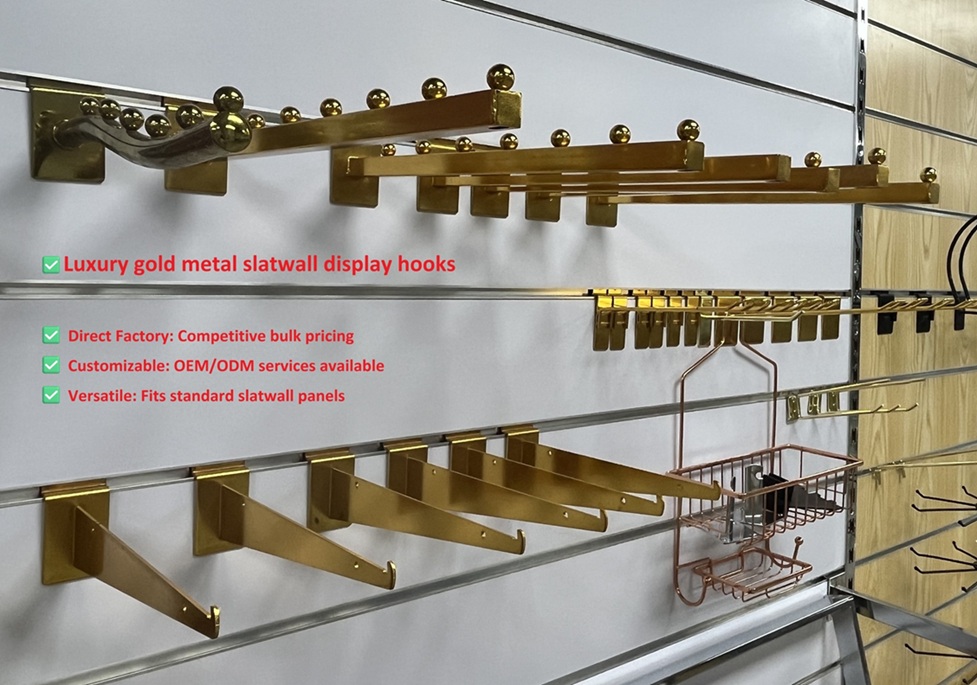
- Slatwall hangers
- Retail shelf accessories
- Lightweight product displays
- Custom merchandising racks
The exact performance depends on wire diameter, steel grade, bend radius, weld quality, and finish. A thicker wire is not automatically the best choice. The design should match the intended product weight and fixture system.
Stainless steel may be appropriate when the display fixture will face:
- High humidity
- Frequent cleaning
- Outdoor or semi-outdoor exposure
- Food-related environments
- Premium visual requirements
- Long service-life expectations
Stainless steel generally costs more than ordinary carbon steel, but it may reduce corrosion-related replacement in demanding environments. The buyer should specify the required grade and surface finish rather than simply requesting "stainless steel."
Some custom metal display hangers use tube, flat bar, or formed sheet metal instead of solid wire. These options may provide:
- Greater structural stiffness
- Larger product contact areas
- Integrated branding surfaces
- Custom mounting brackets
- More complex geometries
The correct construction depends on the product, retail fixture, packaging, and required visual effect.
Material strength is only one part of the engineering equation. Hanger geometry often determines how efficiently the material carries force.
Important design variables include:
- Wire diameter
- Projection length
- Bend angle
- Mounting depth
- Front-stop design
- Weld location
- Support spacing
- Product center of gravity
A long hanger creates more leverage at the mounting point. If the projection increases while the wire diameter remains unchanged, deflection may increase significantly.
The hanger is only as strong as its connection to the fixture. A well-made hook may still perform poorly if it is installed in an incompatible pegboard, slatwall channel, shelf, or bracket.
Buyers should confirm:
- Hole or slot dimensions
- Board thickness
- Mounting-tab shape
- Insertion depth
- Anti-rotation features
- Clearance between adjacent hangers
- Maximum product projection
This is why a custom retail display hanger should be designed around the complete merchandising environment, not produced as an isolated component.
Products with uneven weight distribution can create twisting forces. A package that hangs far forward may place more stress on the hook than a product with the same total weight positioned close to the mounting point.
During sample approval, test the actual merchandise whenever possible. Product drawings and nominal weights are useful, but they do not always reveal how the package behaves on the hanger.
The finish affects appearance, corrosion resistance, friction, cleanability, and brand consistency.
Powder coating is commonly selected for black, white, and custom-color fixtures. It can provide:
- A consistent visual finish
- Good coverage on formed metal
- Multiple color options
- A durable commercial appearance
The buyer should clarify coating thickness, color standard, edge coverage, adhesion expectations, and packaging protection. Sharp bends and weld areas require particular attention because coating consistency may vary in difficult geometries.
Zinc plating provides a metallic appearance and can improve corrosion resistance compared with untreated carbon steel. It is often considered for functional components where a bright or silver finish is preferred.
The required level of corrosion resistance depends on the environment and applicable customer specifications. Buyers should request the relevant plating details rather than treating all zinc finishes as equivalent.
Chrome plating may be selected for a bright, premium appearance. It is visually effective in many retail environments, but the complete coating system and substrate preparation matter. Scratches, exposed edges, and poor pretreatment can reduce practical durability.
Stainless steel may be polished, brushed, or left with a functional mill finish depending on the application. The finish should be selected according to the desired appearance, cleaning requirements, and exposure conditions.
A retail hanger should not have:
- Sharp wire ends
- Dangerous burrs
- Rough weld projections
- Flaking coating
- Exposed corrosion
- Surfaces that snag packaging
Finish approval should therefore include both visual inspection and hands-on handling.
There is no universal load rating for every custom retail display hanger. A reliable specification should define the test conditions clearly.
Ask the manufacturer to document:
- Product or test weight
- Load position
- Loading duration
- Deflection measurement
- Permanent deformation
- Number of loading cycles
- Mounting fixture used
- Acceptance criteria
- Failure mode
A useful distinction is the difference between test load and working load. The test load is used to evaluate performance under defined conditions. The working load is the recommended operational limit and should include an appropriate safety margin determined by the responsible engineering team.
Do not publish a load-bearing number unless it is supported by a traceable test record. ASTM provides standards covering steel materials and testing, but the correct standard depends on the product and application. ASTM standards for metals include classifications, specifications, and test methods for steel wire and related materials. [astm](https://regional.astm.org/industry/metals)
For a new custom metal display hanger, Waigaoqiao and the buyer can use a structured approval process.
Provide product dimensions, package weight, hanging-hole information, fixture drawings, finish requirements, and intended retail environment.
Choose wire, tube, sheet metal, or stainless steel based on the required appearance and application. Confirm projection length, mounting style, and front-stop requirements.
The first sample should be reviewed with the actual fixture and merchandise. Check fit, stability, product removal, packaging clearance, and visual alignment.
Test the hanger under realistic conditions. Include static loading and, where relevant, repeated loading and customer-handling simulation.
Agree in writing on allowable deflection, permanent deformation, coating condition, weld appearance, dimensional tolerances, and packaging quality.
Keep an approved reference sample or controlled drawing for future production. This helps reduce variation during repeat orders.
Over-specifying a hanger can increase material usage, shipping weight, and production cost without improving the retail experience.
The best design should be fit for purpose. It should:
- Carry the required load safely
- Remain stable during normal use
- Allow easy product removal
- Match the fixture system
- Meet appearance requirements
- Use material efficiently
- Pack and ship economically
For example, a lightweight product may not require a heavy steel hook. Conversely, a compact but dense product may need a stronger mounting structure than its dimensions suggest.
This is where OEM engineering creates value. A factory that understands forming, welding, finishing, packaging, and retail use can help optimize the entire component instead of simply increasing wire thickness.
The lowest quotation may exclude testing, custom packaging, finish controls, or engineering support. Compare the total cost of ownership, not only the unit price.
An empty fixture can look stable while failing under real merchandise. Always test with the intended product and mounting system.
Retail fixtures are handled repeatedly. Include cyclic loading or practical repeated-use evaluation when the product is frequently removed and replenished.
Black powder coating, zinc plating, chrome plating, and stainless steel each have different properties. Choose according to environment, appearance, and service expectations.
Approve drawings, samples, dimensions, finish standards, packaging details, and inspection criteria before mass production.
Waigaoqiao supports overseas brand owners, wholesalers, and manufacturers with OEM retail display fixture production. Our value should be evaluated through the complete development process:
- Specification review
- Custom design communication
- Prototype and sample approval
- Material and finish selection
- Production consistency
- Quality inspection
- Export packaging
- Repeat-order support
A successful custom project starts with accurate information. When requesting a quotation, provide product weight, fixture type, dimensions, target quantity, finish, packaging requirements, and destination market.
Ready to develop a custom metal display hanger? Contact Waigaoqiao with your product drawings, fixture specifications, and target load. We can help review the design and prepare an OEM solution for your retail program.
A custom metal display hanger is a purpose-designed retail fixture component made to hold specific products on pegboards, slatwalls, shelves, racks, or other merchandising systems.
Low-carbon steel is often suitable for economical indoor applications. Stainless steel may be preferable for corrosion resistance, demanding environments, or premium visual requirements. The correct choice depends on load, environment, appearance, and budget.
Define the actual product weight, center of gravity, projection length, mounting system, and handling conditions. Then validate the design through a documented test using the actual merchandise and fixture.
Powder coating can improve surface protection, but performance depends on pretreatment, coating quality, thickness, edge coverage, damage, and environmental exposure. It should not be treated as a universal corrosion guarantee.
Yes. OEM customization may include wire diameter, projection length, mounting style, bend geometry, front stops, label holders, finish, color, packaging, and private-label requirements, subject to technical review.
Provide drawings or photos, fixture type, product dimensions, product weight, estimated order quantity, finish, color, packaging requirements, destination, and any existing quality standards.
Yes. A sample confirms fit, appearance, product handling, load behavior, and packaging before the buyer commits to a larger order.
1. ASTM International, "ASTM Metals Standards." This source explains that ASTM metals standards cover classifications, specifications, test methods, and engineering use of alloyed and plain-carbon steel rods and wire, including coated and uncoated wire products.
https://regional.astm.org/industry/metals
2. ASTM International, "New ASTM Steel Wire and Welded Wire Reinforcement Standard Is Approved." This source demonstrates ASTM's role in developing standards for steel wire and welded-wire products.
https://www.astm.org/news/press-releases/new-astm-steel-wire-and-welded-wire-reinforcement-standard-approved
3. ISO, "ISO 17660-2:2006 — Welding of reinforcing steel." This source illustrates how ISO welding standards define requirements for specific welded-joint applications; the applicable standard for a retail hanger must be determined according to the product and use case.
https://www.iso.org/obp/ui/en#!iso:std:41195:en
4. Waigaoqiao product and manufacturing information. Company capabilities, OEM services, material options, production controls, and customer comments should be supported by Waigaoqiao's verified internal records, approved product pages, inspection documents, and authorized customer testimonials before publication.


