
Views: 178 Author: waigaoqiao Publish Time: 2026-10-06 Origin: Site
Content Menu
● What Are Metal Pegboard Hooks?
● Why Retail Buyers Source Custom Pegboard Hooks
● How to Choose the Right Pegboard Hook for Your Product
>> 1. Confirm the pegboard hole size and spacing
>> 2. Measure the packaged merchandise
>> 3. Select hook length based on display needs
>> 4. Choose a design that suits the product
● Metal, Material, and Finish: What to Specify
● Custom Pegboard Hooks and Load Testing
● A Sample-Approval Process for OEM Buyers
● Quality Control for Pegboard Hook Production
● Pegboard Hooks, Slatwall Hooks, and Display Brackets
● Building a Clear OEM Request for Quotation
● Common Sourcing Mistakes to Avoid
>> What should I measure before ordering custom metal Pegboard Hooks?
>> Are Pegboard Hooks universal?
>> Can a manufacturer customize hook length and color?
>> Are double-wire hooks stronger than single-wire hooks?
>> What information helps an OEM supplier provide an accurate quote?
>> How should I verify a load claim?
Retail Display Hooks help retailers present products clearly, use display space efficiently, and make merchandise easy to browse. For brands, wholesalers, and manufacturers sourcing custom metal pegboard hooks, choosing a supplier involves more than selecting a hook shape. The board's hole pattern, product packaging, hook dimensions, finish, and intended use all need to work together.
Waigaoqiao is a China-based factory specializing in retail display fixtures and OEM services for international brands, wholesalers, and manufacturers. This guide explains how to specify Pegboard Hooks for retail applications, what to confirm before placing a bulk order, and how related products such as Slatwall Hooks and Display Brackets fit into a wider fixture program.
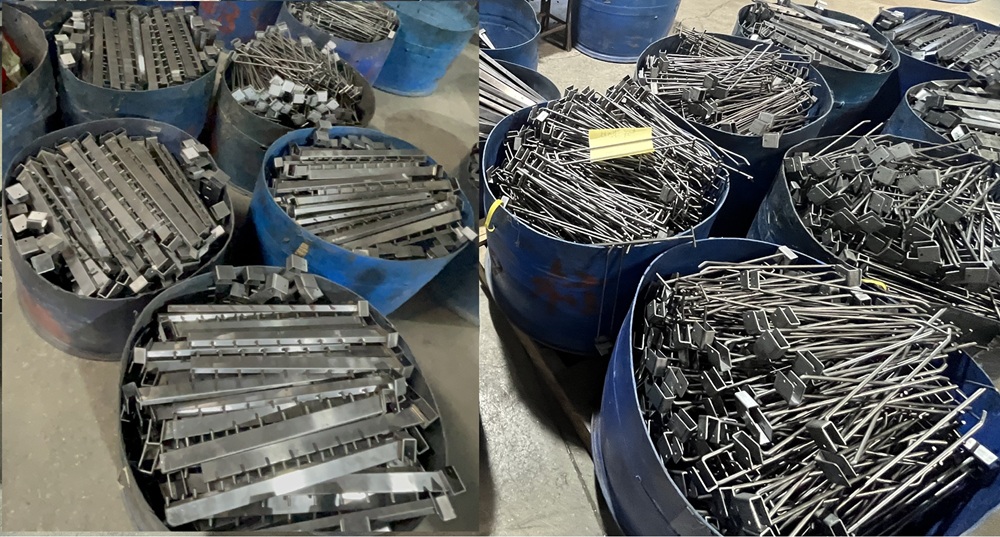
Metal Pegboard Hooks are display accessories that engage with holes in a pegboard panel to support hanging products. Retailers use them for packaged merchandise, small accessories, and other goods designed with a hang hole or tab.
The term "pegboard hook" covers many designs, including single-wire hooks, double-wire hooks, hooks with price-label holders, and heavier-gauge or custom-shaped options. The right choice depends on the board, the product, and the display task. Hook dimensions and board compatibility should be confirmed rather than assumed. For example, one retail hook listing specifies compatibility with pegboard featuring 1-inch on-center spacing and 0.25-inch holes, illustrating why buyers should verify the exact board dimensions before ordering. [clipstrip](https://www.clipstrip.com/pegboard-slatwall-hooks-for-retail-displays-white-abs-plastic-2-10)
A standard hook may suit a straightforward application, but OEM buyers often need products tailored to a brand's packaging, fixtures, or retail program. Customization may address:
- Hook length to suit package depth and the number of products displayed.
- Wire or material specification to match the intended application.
- Mounting geometry for the target board and hole pattern.
- Finish and color to coordinate with a retailer's fixture system.
- Tip or retaining features to support product handling.
- Label holders or other attachments where required by the merchandising plan.
Manufacturers in the category describe customization of dimensions, color, and material as options for certain pegboard hook products. Actual capabilities vary by supplier and design, so confirm the available options during the RFQ and sample stages. [trolleymfg](https://www.trolleymfg.com/pegboard-display-hooks)
Start with the exact panel specification. Measure or obtain documentation for:
- Hole diameter
- Hole spacing, including whether it is on-center
- Panel thickness
- Material and construction
- Any required offset, backing, or mounting clearance
A hook that appears to fit may still sit loosely, project at the wrong angle, or fail to engage correctly. If the panel is already installed, provide a sample or clear measurements to the supplier.
Measure the package—not just the product. Record its depth, width, hang-hole size and position, and approximate loaded weight. Packaging headers, folded edges, and offset holes can affect how merchandise sits on a hook.
For assortments with different SKUs, identify the largest and heaviest items. A single hook design may not provide the best presentation for every package.
The hook should provide enough usable arm length for the intended number of units while leaving sufficient access for shoppers. A longer hook can increase product capacity, but it can also make the display project farther from the board and create crowding.
As an initial planning estimate, buyers can compare package depth with the desired number of items, then validate the proposed length using an actual sample. Treat this as a fit check, not a load-capacity calculation.
Common design considerations include:
- Single-wire or single-prong hooks: For merchandise with a suitable hang hole that sits stably on one support.
- Double-wire hooks: For packages with compatible two-point hanging features.
- Hooks with label holders: For applications where price or product information must sit near the merchandise.
- Custom-shaped hooks: For specialized package geometry or fixture layouts.
These descriptions do not establish performance by themselves. Confirm the exact design with drawings, samples, and application-specific testing where needed.
Do not rely on a product title such as "heavy-duty metal hook" as a complete specification. State the required material, wire diameter or section, finish, color, and visible-quality expectations in the purchase brief.
The appropriate specification depends on the hook's purpose, its environment, the board, and the intended product load. If corrosion resistance or a particular appearance is important, identify that requirement and ask the supplier to propose a finish for review. Avoid claims about lifespan or capacity unless they are supported by evidence for the actual product and use conditions.
Before approving production, confirm:
- Material and dimensions against the drawing or approved sample
- Finish and color against a stated reference
- Hook geometry including bends, tip, and mounting end
- Compatibility with the intended board
- Packaging that protects hooks from bending or surface damage

A hook's performance depends on more than its material or thickness. The hook, board, backing, installation, and merchandise act as a system. A capacity claim that does not identify these conditions may be misleading.
When requesting Load Testing, ask the supplier to document:
- The hook design and material tested
- Board type, hole pattern, and panel support
- How the sample was installed
- Load amount and position
- Test duration or repetition, if applicable
- Acceptance criteria and observed failure or deformation
Do not assume a thicker-looking hook or double-prong design has a particular capacity. Test results should apply to the specific design and fixture configuration being purchased.
A practical sample process can catch fit and merchandising issues before mass production:
1. Share the application. Send the product packaging, board details, quantity per hook, and retail use case.
2. Review the drawing. Confirm dimensions, material, mounting geometry, finish, and any label-holder features.
3. Test the sample on the intended board. Check that it seats properly and stays in position during normal handling.
4. Load actual products. Evaluate product presentation, package stability, and ease of removal.
5. Review finish and packaging. Check the sample for appearance and protection during shipment.
6. Approve a reference sample. Keep the approved version and record any accepted changes before production.
This process is especially useful when a buyer is developing a new product range, adapting an existing fixture, or coordinating multiple SKUs. It also creates a shared basis for supplier and buyer quality checks.
Quality Control should link back to an approved drawing, specification, and sample. A plan may include:
- Dimensional checks: Length, wire diameter, bends, and mounting end.
- Fit checks: Engagement with the specified pegboard holes and panel thickness.
- Visual checks: Surface finish, color, burrs, and visible damage.
- Functional checks: Product hanging, access, and retention as specified.
- Packaging checks: Protection against deformation and scratches in transit.
- Documentation: Approved sample, inspection criteria, and any test records.
For repeat orders, confirm whether materials, dimensions, finishes, or packaging have changed. Documenting revisions helps avoid confusion between an approved sample and a later production batch.
A retail display program may use several accessory types, but they are designed for different fixture interfaces and merchandising needs.
- Pegboard Hooks: Engage with a pegboard's hole pattern.
- Slatwall Hooks: Fit slatwall grooves or compatible inserts.
- Display Brackets: Support shelves or other display components, depending on the fixture system.
Do not assume Pegboard Hooks and Slatwall Hooks are interchangeable. List the panel type and application for every requested product. If your program includes shelves as well as hanging merchandise, specify the bracket and shelf system separately.
A complete RFQ helps suppliers understand the product, estimate production requirements, and prepare appropriate samples. Include:
- Product name and intended retail application
- Board type, hole diameter, spacing, and panel thickness
- Dimensioned drawing or physical sample
- Product package dimensions and intended quantity per hook
- Material, wire diameter, color, and finish requirements
- Optional label holder, tip design, or custom feature
- Order quantity, packaging, and shipping requirements
- Required sample, inspection, or test documentation
If using photographs, pair them with measurements. Photos are useful for showing appearance and application, but they cannot establish exact dimensions or compatibility on their own.
Waigaoqiao provides OEM services for international brands, wholesalers, and manufacturers seeking retail display fixtures. Sharing the application and technical requirements early helps the supplier assess the design and prepare a more relevant sample.
- Ordering before confirming board compatibility: Hole size and spacing matter.
- Choosing hook length by appearance: Check package depth, quantity, and shopper access.
- Using vague material descriptions: Specify measurable dimensions and finish requirements.
- Treating "heavy-duty" as a verified rating: Request application-specific test details.
- Skipping sample approval: Test on the actual board with real products.
- Overlooking packaging: Hooks can be bent or scratched during transport if not protected.
- Using one design for every SKU: Different package sizes and hang holes may need different hooks.

Confirm the pegboard hole diameter, spacing, and thickness. Also measure the product package, hang hole, and the desired number of items per hook.
No. Board hole size, spacing, thickness, and hook geometry vary. Confirm compatibility with the exact pegboard system before ordering.
Customization may be available depending on the supplier and design. Include the requested dimensions and finish in your RFQ and confirm them on the approved sample.
Not necessarily. The number of wires alone does not determine capacity. Performance depends on the complete hook and board system and should be assessed for the intended application.
Provide a drawing or sample, pegboard specifications, product and package dimensions, material and finish requirements, order quantity, and any inspection or testing needs.
Ask for documentation that identifies the hook, board, installation, loading method, and acceptance criteria used in the test. Confirm that these match the configuration you plan to purchase.
- [Trolley Manufacturing: Pegboard Display Hooks](https://www.trolleymfg.com/pegboard-display-hooks) — Product information indicating that dimensions, material, and color customization may be available for a specific hook.
- [Clip Strip Corp.: Pegboard and Slatwall Hooks for Retail Displays](https://www.clipstrip.com/pegboard-slatwall-hooks-for-retail-displays-white-abs-plastic-2-10) — Example product listing that specifies hole size, spacing, material, and available lengths.
- [AGT Products: Display Hooks and Accessories](https://www.agtproducts.com/product-category/display-hooks-accessories) — Examples of display hook categories and pegboard/slatwall product types.


