
Views: 179 Author: waigaoqiao Publish Time: 2026-10-25 Origin: Site
Content Menu
● What is missing from a basic custom-versus-standard comparison?
● Standard Slatwall Hooks and Pegboard Hooks
● Custom Slatwall Hooks, Pegboard Hooks, and Upright Brackets
● A practical way to compare quotes
● 1. Are standard Retail Display Hooks always cheaper than custom hooks?
● 2. When should I choose custom Pegboard Hooks?
● 3. Can one hook fit both pegboard and slatwall?
● 4. What information should I send for an OEM quote?
● 5. How can I reduce delays on a custom retail fixture order?
● 6. How should suppliers document load testing?
Choosing between custom and standard Retail Display Hooks affects more than unit price. It can change fit, merchandising flexibility, sampling needs, production planning, and export packaging. For overseas brands, wholesalers, and manufacturers, the right choice depends on the display system, product requirements, order quantity, and how much the fixture needs to differ from an off-the-shelf design.
At Waigaoqiao, we support OEM buyers sourcing Slatwall Hooks, Pegboard Hooks, and retail shelving Upright Brackets. A practical sourcing approach is to start with the required interface and use case, then compare standard options against the cost and project impact of customization.

A simple comparison often focuses only on price and lead time. For retail fixtures, buyers also need to check:
- Compatibility: Does the hook fit the actual pegboard, slatwall, or upright profile?
- Merchandising function: Does it present the product as intended and support replenishment?
- Validation: What sample, fit check, or load test is required before approval?
- Total project cost: Are tooling, samples, packaging, freight, and rework risks included?
- Repeatability: Can the approved specification be used reliably for reorders?
These questions help buyers avoid comparing a generic product price with a fully specified OEM solution as if they were equivalent.
## Standard Retail Display Hooks: When an Existing Design Makes Sense
A standard hook is an existing design offered in set dimensions, materials, finishes, or configurations. It can be a practical choice when it fits the display system and performs the required merchandising job without modification.
Standard options may be worth evaluating when:
- The panel or fixture interface matches the available design.
- The required length, shape, finish, and features are already offered.
- The order is a trial, replacement, or relatively simple replenishment.
- The buyer wants to assess demand before investing in a custom design.
- The standard packaging is suitable for the intended distribution process.
A standard product can reduce the amount of development work, but it still needs a fit check. "Pegboard hook" and "slatwall hook" describe product categories, not a guarantee that every hook fits every panel. Confirm the interface with dimensions, drawings, or a sample before placing a production order. Retail product listings illustrate the range of designs and compatibility claims in the market, but each product's stated details apply to that product—not to all systems.[1](https://www.clipstrip.com/pegboard-slatwall-hooks-for-retail-displays-white-abs-plastic-2-10) [2](https://www.clipstrip.com/easy-remove-pegboard-slatwall-hooks-metal-display-hooks-for-retail-fixtures-2-to-8-lengths)
Standard Slatwall Hooks may be suitable when the hook's mounting profile, projection, retention, and finish meet the project requirements. Buyers should confirm the actual slot geometry and check that products hang at the intended angle and spacing.
Standard Pegboard Hooks should be checked against the panel's hole pattern, thickness, and mounting arrangement. The buyer should also specify whether a straight or angled hook, single or double prong, label holder, or retention feature is needed.
During sample evaluation, test the hook with the intended panel and representative merchandise. A hook that inserts successfully may still shift, interfere with nearby products, or make replenishment awkward.
## Custom Retail Display Hooks: When OEM Design Adds Value
Custom design is useful when an existing product does not meet a defined requirement. That requirement may relate to mounting geometry, product spacing, hook projection, finish, material, packaging, or a specialized merchandising function.
A custom Retail Display Hook may be worth exploring when:
- The project uses a non-standard panel or mounting interface.
- Product packaging requires a specific hook length, spacing, or orientation.
- A label holder, retaining feature, or other functional detail is needed.
- The brand requires a particular appearance or finish.
- The hook must work as part of a broader fixture program.
- Export packaging or carton identification needs to match the buyer's workflow.
Customization should solve a concrete problem. It is not automatically the better choice, and it does not by itself guarantee a better-performing product. Its value depends on whether the agreed design improves fit, product presentation, operating convenience, or other buyer-defined outcomes.
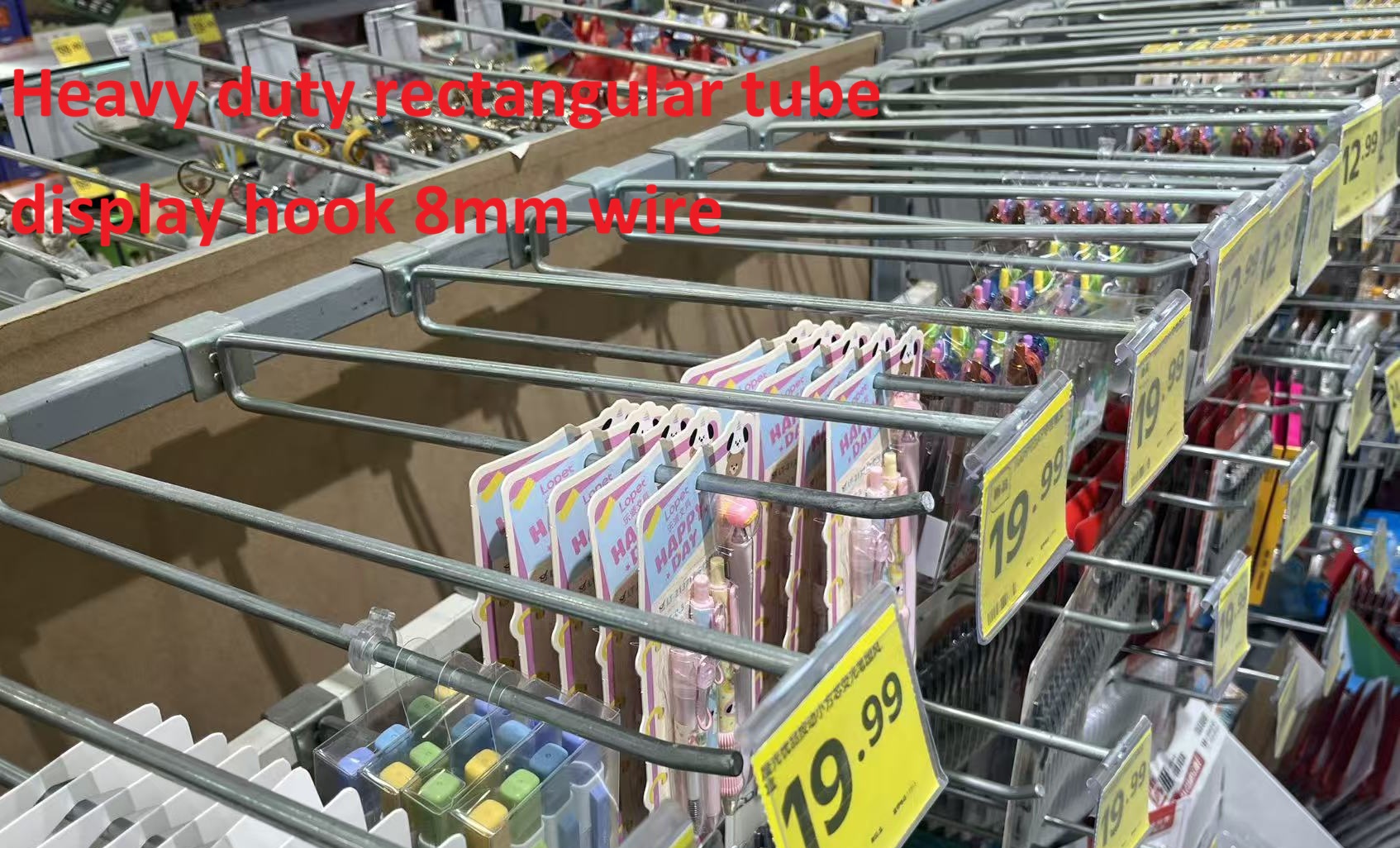
For custom Slatwall Hooks, provide the slot profile or a verified sample, required projection, product dimensions, and any retention needs.
For custom Pegboard Hooks, specify the hole pattern and panel thickness, alongside the desired hook form, length, number of prongs, and any label-holder requirements.
For retail shelving Upright Brackets, share the upright profile, engagement points, shelf depth, and the shelf or accessory the bracket will support. Brackets should not be assumed interchangeable based on appearance alone.
## Cost: Compare the Whole Project, Not Just the Unit Price
A standard product may appear less expensive because it uses an existing design. A custom project may involve additional development and validation steps. The relevant comparison is the total cost of obtaining an approved, usable product, not simply the quoted piece price.
Ask suppliers to clarify whether a quotation includes or excludes:
- Sampling or prototype costs
- Tooling or design-related charges, if applicable
- Inspection and testing requirements
- Unit packaging and export carton specifications
- Labeling, barcodes, or purchase-order references
- Freight and other shipment-related charges
- Costs associated with specification changes after approval
Do not assume every custom project requires new tooling or that every standard product is immediately available. Request a quote based on the actual design, quantity, finish, sample plan, and delivery requirements.
Give each supplier the same project brief and ask them to quote against it. Include the display system, dimensions, material and finish, quantity, sample requirements, packaging, destination, and target schedule. Then compare like for like.
If a supplier proposes a standard alternative, ask which requirements it meets and which it does not. If the alternative changes the interface, appearance, or use, evaluate it as a different specification rather than treating it as an equivalent product.
## Lead Time: Identify the Steps That Control the Schedule
Lead time depends on the specific product and order conditions. It may be influenced by sample development, design review, material availability, production planning, inspection, packaging approval, and shipment arrangements. Without a confirmed supplier schedule, avoid promising a universal turnaround time.
For standard hooks, ask whether the requested design, finish, and quantity are available for the project. For custom OEM manufacturing, agree on the sequence of design review, sample approval, production release, inspection, and packing.
To reduce avoidable delays:
1. Send complete drawings or interface measurements at inquiry.
2. Identify the intended panel or upright system.
3. Provide representative merchandise or accurate package dimensions.
4. Consolidate design feedback into one marked-up revision where possible.
5. Approve the final sample and specification in writing.
6. Confirm packaging and label requirements before production packing begins.
A clear approval process can prevent production from starting against an outdated drawing or an unverified sample.
## Flexibility: Decide What Needs to Change
Standard products offer convenience when the existing configuration works. Custom designs can offer more control over the features that matter to a particular brand or fixture program. Buyers should distinguish between must-have requirements and preferences that can be adjusted.
Consider separating requirements into three groups:
- Fit-critical: Mounting geometry, panel thickness, engagement, and clearances.
- Function-critical: Hook projection, product orientation, spacing, retention, and load-test conditions.
- Preference-based: Finish, cosmetic details, or packaging presentation that may have acceptable alternatives.
This prioritization helps suppliers propose alternatives without compromising the core use case. It also makes sample feedback more precise: identify the dimension or function that fails, rather than describing the product only as "not right."
## Custom Design and OEM Manufacturing: A Controlled Workflow
A disciplined OEM process turns a merchandising brief into a repeatable production specification.
1. Define the project: State product type, display system, target quantity, destination, and intended use.
2. Confirm the interface: Share drawings, measured dimensions, a panel sample, or an existing component.
3. Specify the product: Set hook length, wire diameter, bracket dimensions, material, finish, and required features.
4. Review the design: Check a drawing or prototype against product presentation and installation needs.
5. Evaluate a sample: Test fit and handling using the intended panel and representative merchandise.
6. Approve the production version: Record the drawing revision, sample identity, acceptance criteria, and packaging instructions.
7. Release and inspect: Align on production checks and the documentation required before shipment.
A photograph can help explain the merchandising context, but it should supplement—not replace—critical dimensions and interface information.
## Quality Control: Make the Approved Specification Inspectable
Quality control is most useful when inspection points are measurable and tied to the approved design. For Retail Display Hooks and upright brackets, buyers and manufacturers can agree on checks such as:
- Mounting geometry, length, wire diameter, and other critical dimensions
- Fit and engagement with the specified panel or upright
- Material, color, coating, and surface appearance
- Workmanship, sharp edges, deformation, or incomplete finishing
- Functional checks under agreed conditions
- Counts, protection, and identification in the packaging
Set inspection frequency and sampling expectations with the buyer. A useful project record includes the approved drawing revision, sample record, inspection checklist, packing specification, and carton-label format. These documents can also help control repeat orders.
## Load Testing: Agree on the Method Before Accepting a Claim
A load-test result is meaningful only in relation to its test setup. Before testing, agree on:
- The panel or upright and mounting method
- The hook or bracket configuration
- Where the load is applied and what load is used
- Test duration or handling cycle
- Acceptance criteria for movement, deformation, disengagement, or damage
- The records required to identify the sample and test conditions
Avoid comparing "load capacity" claims when suppliers use different fixtures, load placement, duration, or pass criteria. Do not publish a numerical capacity unless it is supported by documented testing for the relevant configuration. Where safety or regulatory requirements apply, specify the appropriate method and consider a suitably qualified testing provider.
## Export Packaging: Protect the Product and Simplify Receiving
A hook can be correctly manufactured and still arrive with damage or create extra warehouse work if its packaging is poorly specified. Hooks may scratch or tangle; longer parts may bend if inadequately supported; mixed components may be hard to count if not separated.
Define:
- Unit protection, bagging, or bundle quantity
- Separation to prevent abrasion and tangling
- Carton quantity and dimensions
- Part number, finish, quantity, and purchase-order reference
- Any stacking or handling limitations
- Whether the buyer requires packing photos or a sample review
Confirm the packaging method before the first full order is packed. The right approach depends on product geometry, shipping route, handling risks, and buyer instructions.
## Common Sourcing Mistakes to Avoid
- Choosing on price alone: Compare the full specification, validation, packaging, and delivery scope.
- Assuming "standard" means compatible: Confirm the actual interface with a drawing or sample.
- Customizing without a clear requirement: Identify what the change must improve.
- Accepting vague load claims: Ask for the test setup and documented result.
- Delaying packaging decisions: Confirm carton and label details before shipment.
- Leaving revisions informal: Record the approved version and acceptance criteria in writing.
## Frequently Asked Questions

Not necessarily. Compare the complete quotation, including any sampling, design, packaging, and shipment requirements. The unit price alone may not represent total project cost.
Consider customization when an existing hook does not meet the verified panel interface, product spacing, length, finish, or functional requirements. Confirm the need with a sample or drawing review.
Some products are designed for multiple systems, but compatibility depends on the specific mounting geometry. Check the relevant panel details and validate the fit before production approval.
Send the display-system type, drawing or sample, dimensions, material and finish, product package details, estimated quantity, destination, target schedule, and testing or packaging requirements.
Provide complete specifications early, consolidate feedback, approve a controlled sample, and confirm inspection and packaging requirements before production release.
Agree on the assembly, load placement, procedure, duration, pass criteria, and sample identification before testing. Request results tied to that exact configuration.
## Request an OEM Quote from Waigaoqiao
Choosing between standard and custom Retail Display Hooks starts with a clear brief. Send Waigaoqiao your drawing or sample, display-system details, target quantity, finish requirements, product package information, load-test expectations, and export destination.
Our team can review your requirements for Slatwall Hooks, Pegboard Hooks, retail shelving Upright Brackets, and related custom retail fixtures, then discuss the appropriate sample, quality-control, and packaging steps for your project.
Contact Waigaoqiao to discuss your OEM retail fixture requirements.
## References
1. Clip Strip Corp., [Pegboard & Slatwall Hooks for Retail Displays](https://www.clipstrip.com/pegboard-slatwall-hooks-for-retail-displays-white-abs-plastic-2-10). Product listing cited as an example of a specific hook design and product-category terminology.
2. Clip Strip Corp., [Easy Remove Pegboard and Slatwall Metal Hooks](https://www.clipstrip.com/easy-remove-pegboard-slatwall-hooks-metal-display-hooks-for-retail-fixtures-2-to-8-lengths). Product listing cited as an example of a metal hook product with stated lengths and design details.
3. Mills Display, [Plastic "U" Hang Sell 12 Station White](https://millsdisplay.co.nz/products/retail-display-accessories/hang-sells/plastic-u-hang-sell-12-station-white). Product page describing accessories for several display systems and custom manufacture options.
Source note: Product pages support only the product-specific examples attributed to them. They do not verify Waigaoqiao's factory capabilities, certifications, customer feedback, lead times, or test results. Confirm those details directly before making claims in published marketing material.


