
Views: 176 Author: waigaoqiao Publish Time: 2026-09-22 Origin: Site
Content Menu
● Why High-Traffic Stores Need Heavy-Duty Retail Display Hooks
● How to Define Heavy-Duty Hook Performance
● Slatwall Hooks for Busy Retail Environments
● Pegboard Hooks for Hardware Stores and Tool Departments
● Display Brackets for Shelves and Structural Retail Fixtures
● Choosing the Right Material and Construction
>> Carbon Steel
>> Wire and Sheet-Metal Construction
● Load Testing for High-Traffic Retail Display Hooks
>> Recommended Testing Sequence
● OEM Manufacturing and Custom Design
● Quality Control for Heavy-Duty Display Hooks
● How to Select the Right Heavy-Duty Hook
● CTA: Request a Custom Heavy-Duty Hook Review
>> 1. What makes a retail display hook heavy-duty?
>> 2. Are Pegboard Hooks or Slatwall Hooks stronger?
>> 3. How should I specify the load capacity?
>> 4. Can Waigaoqiao customize hook dimensions?
>> 5. Should the hook be tested with the actual retail panel?
>> 6. What information is needed for an OEM quotation?
>> 7. Why is load testing important for high-traffic stores?
In a high-traffic store, retail display hooks must withstand more than product weight. They are exposed to repeated customer handling, frequent replenishment, accidental pulling, vibration, and daily cleaning. For supermarkets, hardware stores, convenience retailers, and multi-location brands, the right hook must remain secure, visually consistent, and easy to use throughout its service life.
Waigaoqiao is a China-based OEM manufacturer of custom metal retail display hooks and retail display fixtures. We supply overseas brands, wholesalers, distributors, and fixture manufacturers with Slatwall Hooks, Pegboard Hooks, Display Brackets, custom design, load testing, and quality-controlled production.
Commercial retail shelving systems are generally selected according to store layout and load requirements, which means a hook should be evaluated as part of the complete display—not as an isolated metal component. [kitman](https://kitman.lv/en/retail-store-shelving-systems)
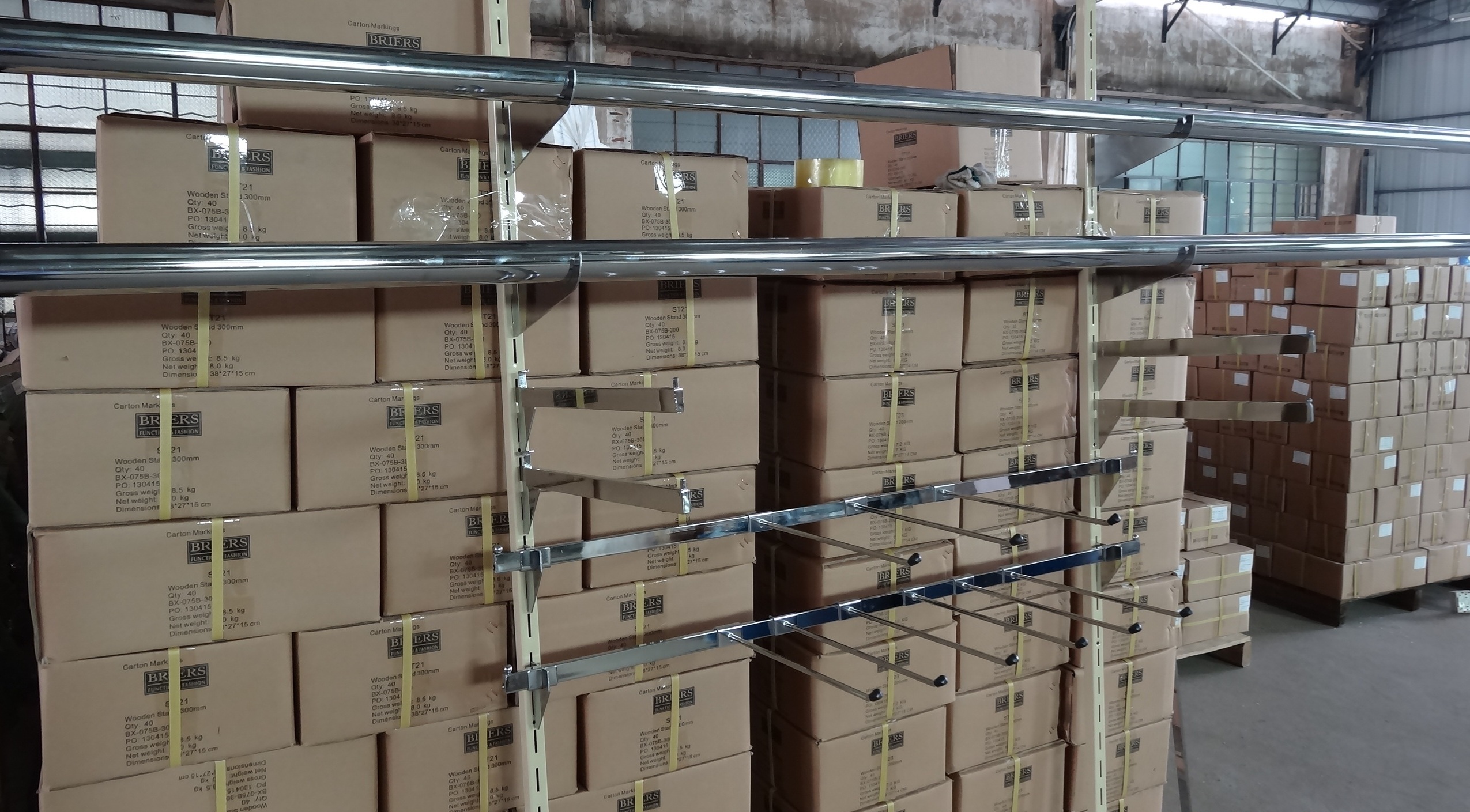
A low-traffic showroom and a busy supermarket create very different operating conditions. In a high-traffic environment, shoppers may remove several products at once, pull merchandise forward, or apply side pressure to adjacent hooks.
Store employees may also:
- Replenish products several times per day
- Temporarily overload a hook during restocking
- Move products between display positions
- Clean around the fixture
- Adjust planograms during promotions
- Replace damaged packaging quickly
These conditions create repeated mechanical stress, even when the individual product is relatively light.
A suitable heavy-duty retail display hook should provide:
- Stable mounting
- Adequate working load
- Controlled deflection
- Reliable welds or bends
- Smooth, safe product contact
- Consistent surface finish
- Fast installation and replenishment
- Compatibility with the fixture system
A stronger hook is not automatically a better hook. The design must match the product, panel, package, and store operation.
The phrase heavy-duty should be supported by measurable specifications. Before purchasing wholesale retail display hooks, ask the supplier to define the following:
- Working load: The recommended load for normal, repeated retail use.
- Test load: The load applied during validation.
- Loading position: Whether the load is near the panel or at the hook tip.
- Test duration: How long the hook must support the load.
- Deformation limit: The maximum acceptable bending or movement.
- Installation condition: The specific pegboard, slatwall, or bracket used.
- Failure criteria: What counts as a failed sample.
- Sample quantity: How many pieces are tested.
A hook that survives a short overload test may not be suitable for long-term use. The buyer should distinguish working load from failure load and should request a test report rather than relying only on a marketing claim.
Slatwall Hooks fit horizontal channels in slatwall panels. They are commonly used in hardware stores, supermarkets, apparel shops, electronics stores, and general merchandise retail.
Heavy-duty Slatwall Hooks may include:
- Single-prong hooks
- Double-prong hooks
- Reinforced base hooks
- Long-projection hooks
- Hooks with front stops
- Hooks with label holders
- Locking or anti-theft hooks
- Custom-color hooks for brand programs
The most important consideration is the relationship between the hook base and the slatwall insert. A hook can be made from strong steel but still tilt or disengage if the mounting geometry is not correct.
Before approving a Slatwall Hook, confirm:
1. Slatwall channel dimensions
2. Panel thickness and construction
3. Hook-entry direction
4. Base engagement
5. Required projection length
6. Product weight and package size
7. Whether the hook must resist rotation
8. Whether a label holder affects clearance
For a high-traffic supermarket display, a front stop or slightly raised hook angle may help prevent packages from sliding forward. For a hardware-store display, a double-prong design may improve stability for dense or irregular packages.
Pegboard Hooks are installed in perforated panels and are widely used for tools, fasteners, hand hardware, electrical accessories, garden products, automotive products, and household items.
Pegboard systems vary by market and supplier. Important variables include:
- Hole diameter
- Hole spacing
- Panel thickness
- Panel material
- Hook-back configuration
- Single- or double-wire construction
- Product stop
- Label-holder position
Some commercial pegboard products use a one-inch on-center format with quarter-inch holes, but buyers should verify the actual panel specification before ordering. [guatemaladigital](https://guatemaladigital.com/6-Pack-Slatwall-Hooks-Heavy-Duty-Utility-Hooks-Grid-Commercial-Grade-Metal-Black-Shelving-Assortment-Garage-Storage-OrganizerHanger-DisplayDisplay-Panel-HookRetail-and-Exhibition-Products(Color:Black-4.2mm-Tama%25C3%25B1o:20cm7.87%2522)/Producto/28409873) [justdial](https://www.justdial.com/jdmart/Pune/Display-Hook/jdm-1280912-ent-2-17715137)
Heavy-duty Pegboard Hooks for hardware stores should be selected according to the complete application. A compact package may be supported by a single hook, while long tools or dense blister packs may require a double-wire or reinforced design.
For reliable approval testing, evaluate:
- Hook fit
- Panel stability
- Product loading
- Front-tip deflection
- Side movement
- Repeated product removal
- Replenishment speed
A hook that performs well when tested alone may behave differently after installation on a thin or flexible pegboard panel.

Display Brackets support shelves, baskets, signs, arms, and other merchandising structures. In many high-traffic stores, brackets carry more structural responsibility than ordinary hanging hooks.
A custom bracket may require:
- Folded sheet-metal construction
- CNC bending
- Stamped components
- Reinforced welds
- Multiple fixing points
- Adjustable angles
- Concealed installation
- Powder coating or plating
- Custom load requirements
Bracket performance depends on the entire load path. This includes the bracket, fastener, panel, shelf, product arrangement, and installation method.
A load placed at the front edge of a shelf creates greater leverage than the same load placed near the wall. For this reason, material thickness alone is not a sufficient basis for defining capacity.
For heavy-duty retail display hooks, common material options include carbon steel, stainless steel, aluminum, and engineered plastic components.
Carbon steel is often selected for its strength, forming capability, and cost efficiency. It may be finished with:
- Powder coating
- Zinc plating
- Chrome plating
- E-coating
- Other protective treatments
Stainless steel may be suitable for humid environments, food-adjacent applications, or projects requiring a particular appearance. The grade and surface finish should be specified clearly.
Wire hooks are useful for lightweight to medium merchandise and efficient high-volume production. Sheet-metal hooks and brackets may provide greater structural rigidity or allow more complex mounting geometry.
The quality of bends and welds directly affects consistency. Sharp bends, incomplete welds, excessive spatter, or dimensional variation can cause installation and load problems.
A professional OEM process should control:
- Wire diameter
- Sheet thickness
- Bend angle
- Base dimensions
- Weld location
- Weld appearance
- Surface treatment
- Final dimensions
A practical load-testing program should reproduce the most demanding realistic condition.
1. Fit test
Install the hook on the actual panel or fixture.
2. Static load test
Apply the defined weight for the agreed period.
3. Front-tip load test
Place the load at the farthest realistic position from the mounting point.
4. Side-load test
Check whether the hook rotates, disengages, or damages the panel when lateral force is applied.
5. Repeated handling test
Remove and replace products to simulate retail replenishment.
6. Post-test inspection
Check for permanent bending, cracked welds, loose mounting, coating damage, and other defects.
The report should record:
- Product model
- Material and dimensions
- Fixture type
- Load amount
- Load position
- Test duration
- Number of samples
- Observed deformation
- Pass/fail result
- Photographs or measurement records
The test should be performed on the hook-and-fixture assembly, not only on the hook itself.
Global brands and fixture manufacturers often need more than an off-the-shelf hook. They may require a specific projection, label holder, locking feature, color, package configuration, or mounting base.
Waigaoqiao can support custom development for:
- Hook length
- Wire diameter
- Hook angle
- Base geometry
- Product stops
- Label holders
- Anti-slip features
- Locking mechanisms
- Custom finishes
- Logo components
- Retail-ready packaging
- Master-carton design
1. Application review: Confirm product dimensions, weight, fixture type, and store environment.
2. Technical review: Evaluate the mounting interface and load path.
3. Design development: Adjust hook geometry and material requirements.
4. Prototype production: Create samples for fit and handling checks.
5. Testing: Conduct load and installation validation.
6. Specification approval: Finalize drawings, tolerances, finish, packaging, and inspection standards.
7. Mass production: Apply incoming, in-process, and final quality control.
8. Pre-shipment verification: Check quantity, appearance, packaging, and approved samples.
Consistent quality is especially important when hooks are installed across hundreds or thousands of stores.
A practical quality-control plan may include:
- Incoming material inspection
- Wire or sheet-thickness measurement
- Dimensional inspection
- Mounting-fit inspection
- Bend-angle verification
- Weld inspection
- Surface-finish inspection
- Sample load testing
- Packaging inspection
- Final random inspection
For international B2B orders, buyers should request:
- Approved production drawings
- A signed reference sample
- Defined dimensional tolerances
- Surface-finish requirements
- Load-test criteria
- Inspection records
- Corrective-action procedures
A retained "golden sample" is useful for comparing repeat-production batches.
Use the following checklist before placing a wholesale order:
- Product: What is the maximum weight per hook?
- Package: Does the package have a compatible hang hole?
- Fixture: Is the system slatwall, pegboard, gridwall, or custom?
- Projection: How far will the product hang from the panel?
- Handling: Will customers pull products from different angles?
- Environment: Is the display exposed to humidity, cleaning chemicals, or outdoor conditions?
- Safety: Is a rounded tip, cap, stop, or lock required?
- Testing: Is the working load documented?
- Scalability: Can the supplier maintain quality during repeat orders?
- Packaging: Will hooks be protected during international transportation?
The lowest unit price does not always produce the lowest total cost. Display instability, product damage, store labor, and replacement orders can quickly exceed the initial purchase difference.
If you are sourcing heavy-duty retail display hooks for high-traffic stores, send Waigaoqiao the following information:
- Fixture type and panel dimensions
- Product photos or package drawings
- Product weight and quantity per hook
- Required hook length
- Target finish or color
- Estimated order volume
- Destination market
- Required testing or documentation
Our engineering team can review the application, recommend a suitable Slatwall Hook, Pegboard Hook, or Display Bracket, and develop a sample for approval.
Request a custom quotation and load-tested sample from Waigaoqiao today.
A heavy-duty retail display hook combines suitable material, adequate wire or sheet thickness, stable mounting geometry, reliable welds or bends, and a documented working load. It should also be tested under realistic retail conditions.
Neither system is automatically stronger. Performance depends on the hook design, material, projection, panel construction, mounting interface, and product load. The complete assembly should be tested.
State the maximum product weight, number of products, loading position, hook projection, test duration, acceptable deformation, and fixture type. Ask the supplier to distinguish between working load and failure load.
Yes. Custom options may include length, wire diameter, base geometry, hook angle, label holder, product stop, locking mechanism, surface finish, color, and packaging.
Yes. Testing only the hook can produce misleading results. The hook, panel, fastener, and merchandise should be evaluated as one system.
Provide fixture dimensions, product drawings or photographs, product weight, expected quantity, hook length, finish, packaging requirements, destination market, and testing expectations.
High-traffic stores expose hooks to repeated handling, side loads, replenishment stress, and accidental pulling. Load testing helps identify bending, rotation, disengagement, and other performance risks before mass production.
- KITman, "Shop Shelving Systems," covering modular retail shelving designed according to layout and load requirements: [KITman Retail Shelving Systems](https://kitman.lv/en/retail-store-shelving-systems)
- Justdial, "Display Hook," describing common pegboard hook use in retail environments: [Display Hook Information](https://www.justdial.com/jdmart/Pune/Display-Hook/jdm-1280912-ent-2-17715137)
- SI Retail, "Display Hooks," describing hooks used on pegboard, slatwall, metalboard, and mesh panels: [SI Retail Display Hooks](https://www.siretail.com/eshop/display-hooks)
- Clip Strip Corp., "Pegboard & Slatwall Hooks for Retail Displays," providing examples of hook use on retail panels and fixture systems: [Clip Strip Retail Display Hooks](https://www.clipstrip.com/pegboard-slatwall-hooks-for-retail-displays-white-abs-plastic-2-10)
- CZERS, "Heavy Duty Single Wire Hooks for Retail Displays," providing an example of heavy-duty hook construction and retail merchandising use: [Heavy-Duty Single Wire Hooks](https://www.szcers.com/heavy-duty-single-wire-hooks-for-retail-displays.html)
- CZERS, "Double Wire Hooks for Retail Grocery Displays," providing an example of steel hooks with chrome or powder-coated finishes: [Double Wire Grocery Display Hooks](https://www.szcers.com/double-wire-hooks-for-retail-grocery-displays.html)


