
Views: 176 Author: waigaoqiao Publish Time: 2026-09-22 Origin: Site
Content Menu
● Why Retail Display Hooks Matter in Modern Merchandising
● Slatwall Hooks for Flexible Retail Interiors
● Pegboard Hooks for High-Density Product Displays
● Display Brackets for Larger or Irregular Products
● Consider the Complete Load, Not Only Product Weight
● Evaluate Packaging Compatibility
● Plastic and ABS Display Hooks
● Supermarkets and Convenience Stores
● Hardware and Home-Improvement Stores
● Fashion, Accessories, and Lifestyle Stores
● Pop-Up Shops and Temporary Displays
● What Load Testing Should Include
● 1. What are retail display hooks used for?
● 2. What is the difference between slatwall hooks and pegboard hooks?
● 3. Are metal or plastic display hooks better?
● 4. How do I determine the required hook load capacity?
● 5. Can retail display hooks be customized?
● 6. Why is load testing important?
● 7. What information should I send when requesting a quotation?
Choosing the right retail display hooks affects more than product presentation. It influences shopper visibility, replenishment speed, fixture safety, and the perceived quality of a store. For retailers, wholesalers, and brand owners, the best hook is not necessarily the strongest or cheapest option. It is the hook that matches the display system, product weight, package format, traffic level, and merchandising objective.
In this guide, based on practical experience in OEM retail fixture manufacturing, I explain how to select slatwall hooks, pegboard hooks, and display brackets for different store environments. I will also cover load testing, quality control, custom design, and OEM manufacturing considerations so buyers can make more reliable sourcing decisions.
Retail display hooks are commonly used on pegboards, slatwalls, metal panels, wire displays, and temporary point-of-purchase fixtures. They are especially suitable for packaged products with hang-sell holes, including hardware, accessories, toys, stationery, electronics accessories, and convenience goods. [siretail](https://www.siretail.com/eshop/display-hooks) [harrisonproducts](https://www.harrisonproducts.com/merchandising-solutions/retail-display-hooks)

A well-designed hook can help a store:
- Increase product visibility by presenting merchandise vertically.
- Improve space utilization on walls and gondola ends.
- Simplify restocking because products remain organized in rows.
- Support visual merchandising through consistent spacing and alignment.
- Reduce fixture movement when the hook is correctly matched to the panel.
- Improve inventory control when labels and products are easy to scan.
However, poor hook selection can create practical problems. Hooks may sag, rotate, detach from the panel, damage packaging, or make products difficult to remove. In high-traffic stores, an unstable display may also create a safety risk.
## Step 1: Identify the Store Display System
Before selecting a retail display hook, confirm the type of fixture used in the store. Different systems require different mounting methods and dimensions.
Slatwall hooks attach to horizontal grooves in slatwall panels. They are widely used in apparel stores, hardware shops, pharmacies, home-improvement stores, and general retail environments.
Choose slatwall hooks when:
- The store uses slatwall panels with regular horizontal channels.
- Merchandising layouts change frequently.
- The retailer needs adjustable product positioning.
- Products are available in different package sizes.
- The display requires a clean, professional appearance.
Slatwall hooks are available in different lengths, diameters, finishes, and configurations. Common options include single-prong hooks, double-prong hooks, safety hooks, scanning hooks, and hooks with label holders.
For lightweight accessories, a simple single-prong hook may be sufficient. For heavier packaged products or high-traffic areas, a double-prong or locking design can provide better stability.
Pegboard hooks are designed for panels with regularly spaced holes. Many commercial pegboards use a 1-inch hole spacing with approximately 0.25-inch holes, although specifications should always be verified before ordering. [clipstrip](https://www.clipstrip.com/pegboard-slatwall-hooks-for-retail-displays-white-abs-plastic-2-10)
Pegboard hooks are suitable for:
- Hardware stores.
- Supermarkets.
- Tool and accessory displays.
- Craft and stationery departments.
- Small consumer goods.
- Temporary or semi-permanent retail displays.
A key advantage of pegboard hooks is high product density. Retailers can use the available wall area efficiently while keeping products visible and easy to browse.
For high-use environments, select hooks with:
- Dual rear prongs for better stability.
- Indented or locking bases to reduce movement.
- Rounded front ends to protect packaging and shoppers.
- Integrated label holders for prices or product codes.
- Anti-sag geometry for longer hook lengths.
Not every pegboard hook fits every pegboard. The buyer should confirm hole diameter, hole spacing, panel thickness, hook base dimensions, and the intended loading direction.
Display brackets are useful when products cannot be supported effectively by a narrow wire hook. They provide a wider support surface and are often used for boxed merchandise, tools, signage, accessories, and heavier retail packages.
Display brackets may be appropriate when:
- The product has no hang-sell hole.
- The package is wide or unstable.
- The display requires two-point support.
- The product must face forward rather than hang vertically.
- The fixture needs additional structural reinforcement.
Compared with a single hook, a bracket can distribute weight across a larger area. This may reduce package deformation and improve presentation. However, brackets generally occupy more visual and physical space, so they should be used selectively.
## Step 2: Match the Hook to Product Weight and Packaging
Product weight is one of the most important selection factors, but it is not the only one. The center of gravity, package shape, loading frequency, and hook length also influence performance.
A reliable specification should distinguish between:
- Working load: The recommended load during normal retail use.
- Proof load: A test load used to verify performance.
- Failure load: The point at which permanent deformation or breakage occurs.
Retail buyers should avoid treating the failure load as the acceptable operating capacity. A professional manufacturer should recommend a working load with an appropriate safety margin.
Longer hooks usually experience greater bending force because the product weight is farther from the mounting point. A hook that performs well at 100 mm may not perform identically at 250 mm, even when the material and wire diameter are the same.
The hook should fit the product packaging without causing damage. Check:
- Hang-hole diameter
- Hole position
- Package thickness
- Product weight
- Number of units per hook
- Required spacing between products
A narrow hook may not pass smoothly through a reinforced package hole. A thick hook may tear lightweight cardboard. A sharply finished tip can also damage blister packs or create a poor customer experience.
For high-volume displays, consider a front stop, safety cap, or anti-slide feature. These features can reduce accidental product displacement while keeping replenishment practical.
## Step 3: Select the Right Material and Finish
The material should reflect the store environment, expected load, required appearance, and target price.
Metal hooks are commonly made from steel or other suitable metal alloys. They are preferred for:
- Medium- and heavy-duty applications.
- Long-term store fixtures.
- High-frequency product handling.
- Industrial, hardware, and supermarket environments.
- Projects requiring a premium or durable appearance.
Common finishes include:
- Chrome plating for a bright commercial appearance.
- Zinc plating for general corrosion resistance.
- Powder coating for color options and surface durability.
- Black or white coating for brand and fixture coordination.
The finish should be evaluated for adhesion, scratch resistance, corrosion resistance, and consistency across production batches.
Plastic hooks can be useful for lightweight products, temporary displays, and cost-sensitive programs. ABS plastic hooks are used in pegboard, slatwall, corrugated displays, and compatible retail systems. [clipstrip](https://www.clipstrip.com/pegboard-slatwall-hooks-for-retail-displays-white-abs-plastic-2-10)
Plastic options may provide:
- Lower unit weight
- Color customization
- Good electrical insulation
- Quiet product handling
- Efficient injection-molding production
Plastic is not automatically a low-quality material. The important factors include polymer selection, wall thickness, rib design, molding accuracy, and performance testing. For heavier loads, a reinforced plastic design or metal core may be more appropriate.
## Step 4: Choose Hooks for Specific Store Environments
Different stores have different operational requirements. A hook for a quiet boutique should not automatically be used in a busy supermarket or hardware store.
These environments often require:
- Fast replenishment.
- High product visibility.
- Frequent customer contact.
- Easy price-label reading.
- Strong resistance to accidental movement.
For these stores, consider double-prong pegboard hooks, scanning hooks, locking bases, and integrated label holders. Products are often handled repeatedly, so stability and smooth edges are essential.
Hardware products may be relatively heavy, irregularly packaged, or sold in multi-unit packs. Recommended solutions may include:
- Heavy-duty pegboard hooks
- Longer steel hooks
- Double-prong designs
- Display brackets
- Safety or anti-theft hooks
The hook should be selected according to the actual product weight rather than appearance alone. A heavier hook is not always better if the panel itself cannot support the load.
These stores often prioritize visual consistency and finish quality. Suitable options may include:
- Black, white, brass, or chrome finishes
- Slim hooks
- Slatwall hooks with clean lines
- Custom brackets
- Hooks designed to minimize visual clutter
In these environments, color consistency and surface quality can directly affect the perceived value of the merchandise.
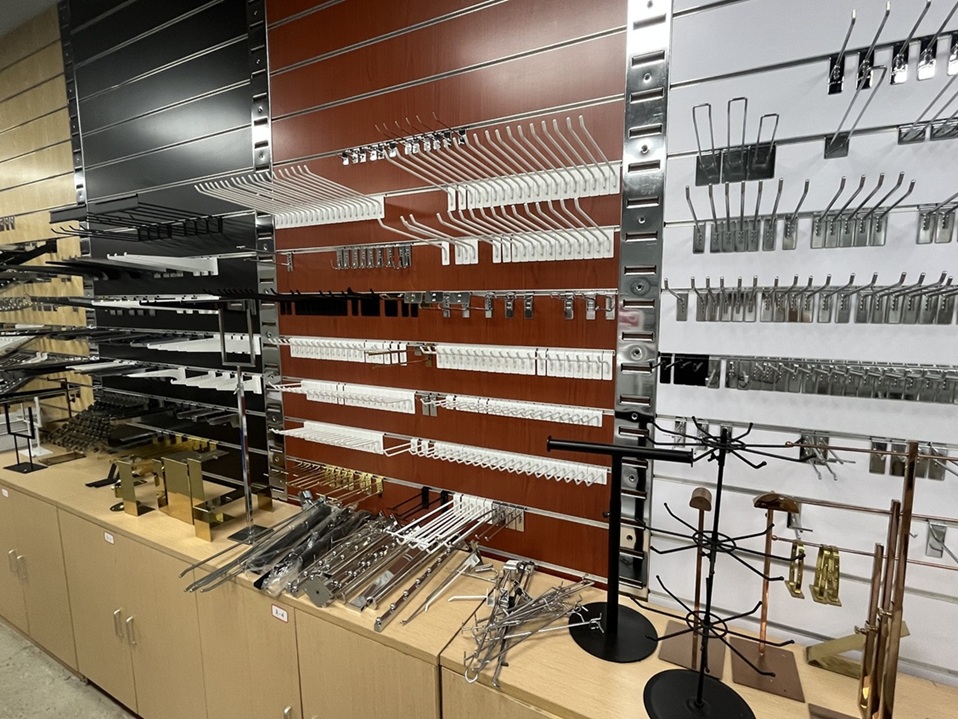
Temporary displays require quick installation and easy removal. Lightweight plastic hooks, corrugated-display hooks, and adaptable metal hooks may be suitable.
The key considerations are:
- Installation speed.
- Low shipping weight.
- Compatibility with temporary panels.
- Resistance to repeated assembly.
- Low replacement cost.
## A Practical Hook-Selection Workflow
For an efficient sourcing process, I recommend the following five-step method:
1. Measure the display panel. Confirm hole spacing, groove size, panel thickness, and mounting position.
2. Record product information. Include weight, package dimensions, hang-hole size, and units per hook.
3. Define the retail environment. Identify traffic level, replenishment frequency, humidity, and customer handling.
4. Select a prototype. Test the hook with real packaging and the actual fixture panel.
5. Approve performance samples. Confirm appearance, fit, load capacity, and installation before mass production.
This process prevents a common sourcing mistake: approving a hook based only on a product photograph or a nominal length.
## Quality Control and Load Testing in OEM Manufacturing
For B2B buyers, product quality should be managed through a documented process rather than visual inspection alone.
A reliable OEM supplier should be able to discuss:
- Incoming material inspection
- Wire diameter or plastic dimension checks
- Fixture compatibility tests
- Surface-finish inspection
- Load testing
- Batch traceability
- Packaging and drop protection
- Pre-shipment sampling
A practical test program may include:
- Applying the specified working load.
- Checking for permanent deformation.
- Testing the hook at different lengths.
- Repeating loading and unloading cycles.
- Testing the complete hook-and-panel assembly.
- Inspecting welds, bends, coatings, and mounting points.
The complete assembly matters. A strong hook can still fail in practice if the mounting base is incompatible with the panel.
For custom projects, buyers should request a written specification that identifies material, dimensions, finish, working load, test method, inspection frequency, and acceptance criteria.
## Custom Design and OEM Manufacturing Options
Standard hooks are efficient when the product and fixture match common specifications. Custom design becomes valuable when a brand needs a distinctive display, special loading capacity, or compatibility with a proprietary fixture.
OEM customization may include:
- Custom hook length.
- Single- or double-prong structure.
- Integrated price-label holder.
- Safety stop or locking mechanism.
- Special mounting base.
- Custom color or finish.
- Logo or brand marking.
- Plastic and metal combination.
- Custom packaging and private labeling.
A strong OEM development process normally follows this sequence:
1. Review the product and fixture requirements.
2. Confirm drawings or create a prototype.
3. Produce samples.
4. Conduct fit and load testing.
5. Approve the final specification.
6. Begin mass production with documented quality controls.
The most effective supplier relationship is not based only on the lowest quotation. It is based on repeatable quality, clear communication, reliable lead times, and the ability to solve display problems at scale.
## Common Mistakes to Avoid
Avoid these frequent errors when purchasing retail display hooks:
- Choosing by length only: Length does not define total performance.
- Ignoring panel compatibility: Hole spacing and groove dimensions must be verified.
- Using maximum failure load as working load: This reduces safety margins.
- Skipping real-product testing: Packaging can behave differently from specifications.
- Using a thin hook for heavy products: Deflection can make the display look unprofessional.
- Selecting the wrong finish: Coating quality matters in visible retail areas.
- Approving samples without batch standards: Mass-production consistency must be defined.
## Conclusion and OEM Inquiry
The right retail display hooks should match the store fixture, product packaging, operating environment, and expected load. Slatwall hooks offer flexibility, pegboard hooks support dense merchandising, and display brackets provide broader support for larger or irregular products.
For retailers, wholesalers, and brand owners, the safest approach is to combine accurate measurements, real-product testing, documented load requirements, and supplier quality control. Waigaoqiao supports OEM retail display fixture projects with custom design, prototype development, material selection, surface finishing, load testing, and production coordination.
Need a custom retail display hook? Send your product dimensions, panel type, target load, preferred material, finish, and estimated order quantity. Our engineering team can recommend a suitable design and prepare an OEM sample for evaluation.
## Frequently Asked Questions
Retail display hooks hold packaged products on pegboards, slatwalls, metal panels, wire displays, and temporary point-of-purchase fixtures. They are commonly used for hardware, accessories, toys, stationery, electronics accessories, and convenience goods.
Slatwall hooks attach to horizontal grooves in slatwall panels, while pegboard hooks mount through regularly spaced holes. The correct choice depends on the fixture system installed in the store.
Metal hooks are generally suitable for heavier loads and long-term use. Plastic hooks can be effective for lightweight products, temporary displays, and applications requiring lower weight or custom colors. The best material depends on the product and operating conditions.
Consider the product weight, number of units per hook, hook length, loading frequency, and panel strength. Confirm the recommended working load with the manufacturer and test the complete hook-and-panel assembly.
Yes. OEM customization may include length, diameter, mounting base, safety features, label holders, color, coating, logo marking, packaging, and material combinations.
Load testing helps identify bending, detachment, weld failure, mounting instability, and permanent deformation before mass production. It is especially important for heavy products and high-traffic retail environments.
Provide the display-system type, panel dimensions, product weight, package size, hang-hole dimensions, required hook length, material, finish, estimated quantity, and any drawings or photographs.
## References
- SI Retail — Display Hooks: Overview of retail display hooks, compatible display systems, and common retail applications. [https://www.siretail.com/eshop/display-hooks](https://www.siretail.com/eshop/display-hooks)
- Clip Strip Corp. — Pegboard and Slatwall Hooks: Information on ABS plastic hooks, compatibility, lengths, and lightweight retail merchandising applications. [https://www.clipstrip.com/pegboard-slatwall-hooks-for-retail-displays-white-abs-plastic-2-10](https://www.clipstrip.com/pegboard-slatwall-hooks-for-retail-displays-white-abs-plastic-2-10)
- SI Retail — Pegboard and Volcano Hooks: Information about dual-prong pegboard hooks and stability features. [https://www.siretail.com/eshop/pegboard-volcano-hooks](https://www.siretail.com/eshop/pegboard-volcano-hooks)
- Clip Strip Corp. — Display and Pegboard Hooks: Overview of hook materials, mounting systems, and retail merchandising formats. [https://www.clipstrip.com/display-and-pegboard-hooks](https://www.clipstrip.com/display-and-pegboard-hooks)
- Highbright Retail Solutions — Display Hooks: Examples of pegboard hooks, slatwall hooks, label-holder hooks, and related retail display formats. [https://www.supermarketequipments.com/Display-Hooks-pl569802.html](https://www.supermarketequipments.com/Display-Hooks-pl569802.html)
- Shopfitting Manufacturer — Pegboard, Slatwall, and Gridwall Comparison: General comparison of common retail display hook systems. [https://shopfittingmanufacturer.com/display-hooks-pegboard-vs-slatwall-vs-gridwall](https://shopfittingmanufacturer.com/display-hooks-pegboard-vs-slatwall-vs-gridwall)


