
Views: 220 Author: WAIGAOQIAO Publish Time: 2026-04-03 Origin: Site
Content Menu
● Understanding the Commercial Demand for Quality Fixtures
● The Engineering Process: From Concept to Production
>> Material Selection and Sourcing
>> Advanced Fabrication Techniques
● Scaling for OEM Requirements
>> Supply Chain and Logistic Efficiency
● Enhancing Visual Merchandising through Custom Fixtures
● Sustainability and Future Trends in Rack Manufacturing
In the fast-paced world of retail, the infrastructure supporting fashion display is just as crucial as the garments themselves. For businesses looking to optimize their visual merchandising, the quality, durability, and aesthetics of garment racks define the shopping experience. At WAIGAOQIAO, we recognize that our partners—international brands, wholesalers, and manufacturers—require more than just metal structures. They need engineered solutions that marry form with function. This comprehensive guide explores the professional process of manufacturing commercial-grade clothing racks, tailored for businesses seeking reliable OEM expertise.
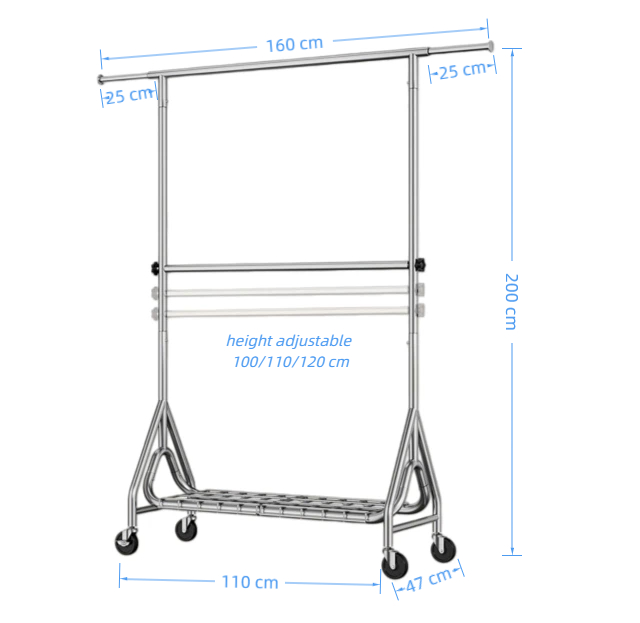
Commercial clothing racks serve as the backbone of retail environments. Unlike domestic solutions, these units must endure heavy daily usage, frequent repositioning, and the weight of diverse garment types. Whether a retail space focuses on high-end boutique displays or high-turnover warehouse storage, the manufacturing requirements are stringent.
Retailers are constantly seeking fixtures that not only display merchandise effectively but also contribute to the overall store atmosphere. An industrial-pipe rack might offer a rugged, modern vibe, while sleek, minimalist stainless steel frames provide a luxury aesthetic. Manufacturers must have the capacity to adapt to these varied design requirements while maintaining structural integrity. The longevity of a fixture is a direct reflection of the brand's commitment to quality; a rack that wobbles or rusts within a few months sends a negative message to customers. Therefore, commercial-grade manufacturing is defined by its ability to provide consistent, high-performance equipment under demanding retail conditions.
Manufacturing high-quality commercial garment racks is a sophisticated process that begins long before the first piece of metal is cut. It involves a collaborative effort between the OEM partner and the client to ensure the final product meets specific operational and visual needs.
The journey starts with a detailed design phase. Clients often present sketches, CAD files, or reference images of the desired aesthetic. Engineers must assess the feasibility of these designs, considering load-bearing capacity, stability, and material compatibility. This phase is not merely about making a rack that looks good; it is about ensuring the structural physics are sound. A design that looks elegant on a screen must be able to hold several dozen winter coats without the frame bowing.
Prototyping is a critical step in the OEM workflow. A prototype allows for rigorous testing—ensuring that a rack designed for heavy denim can handle the weight without buckling, and that a collapsible rack functions smoothly without jamming. This stage also allows for fine-tuning the finish, whether it be powder coating, chrome plating, or brushed metal, to match the brand's identity. By iterating through a prototype, we can identify potential weak points in the connection mechanisms or weight distribution, ensuring that the final mass-produced version is flawless.
Durability starts with material selection. For industrial-strength racks, steel—specifically carbon steel, stainless steel, or galvanized pipe—is the standard. Carbon steel offers excellent strength-to-cost ratios, while stainless steel is preferred for environments prone to humidity or for brands that demand a premium, rust-resistant finish. The choice of material dictates the manufacturing techniques required, such as specialized welding or precision bending. We also source high-quality casters, as the mobility of a commercial rack is often its most used feature. Poor-quality wheels will fail long before the metal frame, leading to customer dissatisfaction. Thus, every component, from the smallest bolt to the heaviest upright beam, is selected with industrial longevity in mind.
The fabrication stage involves several core processes that transform raw steel into finished retail furniture:
- Precision Cutting: Using automated laser or high-speed saw-cutting technology to ensure precise dimensions for all frame components. Laser cutting, in particular, allows for intricate designs and perfect hole alignment for modular attachments.
- Tube Bending: Precision pipe and tube bending machines create the structural curves and shapes required for both aesthetics and functionality. Achieving consistent bends without flattening the tube is a hallmark of high-quality craftsmanship.
- Expert Welding: High-quality welding is essential for the structural joints of a garment rack. Whether utilizing robotic welding for high-volume consistency or expert manual welding for complex, custom detailing, the integrity of the joints is paramount. A weld must not only be strong but also aesthetically clean, minimizing the need for excessive grinding and polishing.
- Surface Finishing: This is where the product receives its final appearance and protective layer. Powder coating provides a durable, customizable finish, while plating (like chrome or nickel) offers a polished, professional look. Each finish requires specific pretreatment to ensure longevity and resistance to chipping, scratching, or corrosion, which is vital for high-traffic retail environments.
For international brands and wholesalers, consistency across large volumes is non-negotiable. An OEM partner must possess the infrastructure to scale production while maintaining strict quality control.
Quality control at an OEM facility like WAIGAOQIAO involves systematic checks at every stage. We do not wait until the end of the line to inspect the products.
- Incoming Material Inspection: We verify the grade, thickness, and chemical composition of the steel before it enters our production floor.
- In-Process QC: Our team monitors weld penetration, tube dimensions, and coating consistency during every shift. If a machine calibration drifts even slightly, it is corrected immediately to prevent a batch of defective units.
- Final Inspection: Rigorous testing of the finished product, including load-testing, stress-testing on wheels and fasteners, and visual inspections for aesthetic flaws. Every rack is checked to ensure that assembly is intuitive and that all hardware kits are complete.
Reliable delivery is as important as product quality. Effective OEM services include integrated supply chain management—sourcing reliable casters, specialized packaging materials, and protective shipping components to ensure the final assembly reaches the destination in pristine condition. International shipping presents unique challenges, including the risk of moisture and vibration damage during transit. We use specialized, knock-down (KD) designs that allow racks to be shipped efficiently in flat-packed boxes, reducing shipping costs for our clients while making assembly on the retail floor quick and frustration-free.
The impact of well-designed garment racks on retail success is profound. Retailers are increasingly moving toward modular display solutions that allow for rapid changes in floor plans. A rack that can be easily reconfigured or expanded offers immense value to a business that frequently rotates its inventory.
Furthermore, custom fixtures allow brands to express their unique identity. A brand specializing in luxury streetwear might require a matte-black, powder-coated rack with minimalist lines, while a vintage clothing store might prefer an antique-brass finish with pipe-style fittings. Customization helps brands differentiate themselves in a crowded marketplace. By working closely with interior designers and brand managers, we translate their vision into durable hardware that acts as a silent salesperson, highlighting the clothing in the best possible light.
Modern manufacturing is rapidly evolving toward more sustainable practices. This includes optimizing raw material usage to minimize scrap metal, improving energy efficiency in our laser-cutting and welding stations, and utilizing environmentally friendly, low-VOC powder coating techniques. For OEM partners, adopting these practices is becoming a requirement for working with global retailers who prioritize corporate responsibility.
Looking ahead, we anticipate a continued shift toward "smart" retail fixtures. This might include racks with integrated LED lighting to illuminate clothing, or modular racks that incorporate digital signage frames for promotions. As manufacturers, our role is to remain at the forefront of these technological advancements, providing our clients with the innovative display solutions necessary to thrive in the modern retail landscape. We are also investing in design optimization, aiming to reduce the weight of our racks without sacrificing strength, which lowers carbon footprints during transportation.
The manufacturing of commercial clothing racks is a discipline that requires a unique blend of engineering precision, aesthetic awareness, and logistical efficiency. For companies like WAIGAOQIAO, the goal is to provide more than just furniture; we provide the foundation for successful retail displays. By focusing on high-quality materials, rigorous quality control, and a commitment to innovation, we enable brands and wholesalers to achieve their merchandising goals. As the retail landscape continues to evolve, the demand for durable, flexible, and visually striking display solutions will only grow, and we remain dedicated to meeting that demand with excellence.
1. What are the key differences between residential and commercial clothing racks?
Commercial racks are engineered for high-frequency, heavy-duty use. They utilize thicker gauge metals, robust welding, and professional-grade industrial casters capable of sustaining heavy loads for years. Residential racks are typically designed for lighter, infrequent use and often cannot withstand the stresses of a busy retail environment.
2. Why is powder coating preferred over painting for commercial racks?
Powder coating provides a much harder, more durable finish than liquid paint. It is resistant to chipping, scratching, and fading, which is essential for retail fixtures that undergo constant contact with metal hangers and frequent movement on the shop floor. It is also an environmentally friendlier process.
3. Can custom-designed clothing racks be cost-effective for smaller retail chains?
Yes. Through efficient OEM processes, customization can be tailored to the scale of the order. While tooling for unique, complex shapes has an upfront cost, the long-term benefit of brand-specific, highly durable fixtures that fit a store perfectly often outweighs the expense of purchasing lower-quality, off-the-shelf units that need frequent replacement.
4. How do you ensure the stability of tall or heavily loaded commercial racks?
Stability is achieved through precise structural engineering. This includes proper base-to-height ratios, the use of reinforced joints, and weight-distributing designs. We also conduct stress-testing on prototypes to ensure the center of gravity remains safe during movement and that the structure does not deflect under full-capacity loading.
5. What should a brand consider when selecting an OEM manufacturer for retail fixtures?
Key considerations include the manufacturer's capacity to scale production, their history of quality control, their experience with various materials (such as stainless steel versus carbon steel), their ability to meet international shipping standards, and their capability for collaborative design and rapid prototyping.


