
Views: 220 Author: WAIGAOQIAO Publish Time: 2026-03-24 Origin: Site
Content Menu
● The Foundation of Retail Display Success
>> Site Assessment and Safety Planning
>> Understanding the Component Anatomy
● The Professional Installation Process: Step-by-Step
>> Step 1: Establishing the Base and Stability
>> Step 2: Erecting the Uprights and Cross-Bracing
>> Step 3: Integrating the Telescopic Rails
● Maintaining Structural Integrity in High-Traffic Environments
>> The Importance of Regular Torque Checks
>> Managing Inventory Distribution
● Logistical Benefits of OEM Design for Installation
>> The Knock-Down Design Advantage
>> Customization and Professional Finish
● Safety Protocols and Regulatory Compliance
>> Anchoring and Tipping Prevention
>> Documenting Installation Compliance
In the competitive world of fashion retail, the infrastructure supporting your inventory is just as important as the clothing itself. Heavy-duty clothing racks are the backbone of a successful store layout, providing the necessary strength to display high-volume or heavy-fabric collections while maintaining a clean, professional aesthetic. For retailers, wholesalers, and brand managers, the installation process is not merely about assembling furniture; it is a critical task that ensures safety, protects valuable inventory, and impacts the long-term ROI of store fixtures. As an OEM manufacturer, WAIGAOQIAO understands that even the most robust rack design can fail if not installed with precision. This guide provides a comprehensive look at the professional installation process, ensuring that your retail display assets are both secure and optimized for operational success.

Before unpacking your heavy-duty racks, it is vital to acknowledge that installation begins with preparation. A stable retail floor is the starting point. Whether your boutique features polished concrete, luxury vinyl planking, or carpet, the rack must sit level to prevent stress on the joints. In high-traffic environments, even a slight imbalance in a rack's position can cause the vertical uprights to bear uneven loads, leading to premature wear and potential safety risks.
The first step in any professional installation is a site assessment. Evaluate the traffic flow of your sales floor. Heavy-duty racks are designed to handle significant weight, but their footprint must be considered in relation to how customers and staff navigate the store. Ensure that the installation area is free of obstructions and that the flooring is level. For large-scale rollouts, we recommend mapping out the floor plan and marking the exact positions of each rack to ensure a uniform and organized appearance across the entire retail space.
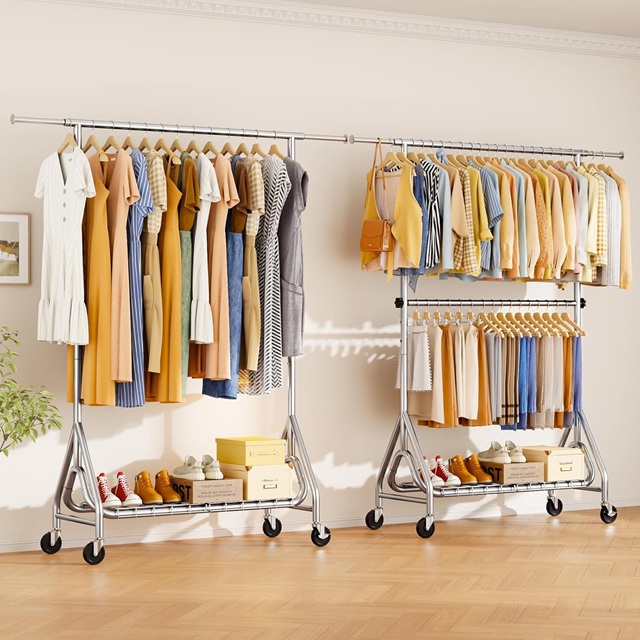
As an OEM partner, we design our heavy-duty racks with a focus on modularity. A typical professional garment rack consists of base stability bars, vertical uprights, telescopic hang rails, and high-tensile connection hardware. Before beginning, identify all components. Familiarize yourself with the locking mechanisms and the load-bearing requirements for each specific model. Professional-grade racks often feature specialized washers or locking nuts that are essential for vibration resistance—a feature that prevents hardware from loosening over time in a busy store environment.
Installing heavy-duty racks requires a systematic approach. By following these professional guidelines, you ensure the structural integrity of the display unit and minimize the risk of assembly errors.
The base is the most critical element of stability. Begin by assembling the base structure on a level surface. If the unit features adjustable leveling feet, ensure they are retracted during the initial assembly so that the frame can be squared. If the rack utilizes industrial-grade, locking casters, verify that each wheel is securely bolted into the designated mounting plate. Once the base frame is constructed, perform a "wobble test." If the base is not perfectly flat, adjust the feet until all contact points meet the floor with equal pressure.
With the base secure, mount the vertical uprights. It is crucial to maintain absolute vertical alignment. Even a two-degree deviation from the vertical axis can significantly decrease the load-bearing capacity of the rack. Use a spirit level during this stage to verify alignment. Once the uprights are set, attach any horizontal cross-bracing. In heavy-duty designs, cross-braces are not optional; they are vital for preventing the rack from twisting or "racking" when moved or subjected to heavy, uneven garment weights. Tighten all hardware to the manufacturer's specified torque, but avoid over-tightening, which can strip threads or compress thin-walled tubing beyond its elastic limit.
The hang rail is the working component of the rack. During installation, ensure the telescopic mechanism moves smoothly and locks securely. When inserting the rail into the uprights, ensure that the locking pins or collars are fully engaged. A common failure point in retail displays is a rail that is "clicked" into place but not locked, which can collapse under weight. Perform a final check of all height adjustment points to ensure that the rack is set to the desired operational height and that all safety pins are in their locked positions.
An installation is not a "set it and forget it" task. Retail environments are dynamic, and heavy-duty racks are subject to constant force.
During the first week of operation, the materials will naturally "settle." We recommend a post-installation maintenance check after seven days. Re-verify the torque on all bolts and connections. Heavy-duty units are subjected to vibrations from foot traffic and the daily movement of hangers; a simple check of the hardware can prevent small issues from becoming significant structural failures.
While your racks are designed to be heavy-duty, even the strongest steel has limits. During installation, train your floor staff on the proper way to load the racks. Inventory should be distributed as evenly as possible along the hang rail. If a rack is designed for a 150kg load, placing 100kg of heavy winter coats on one end of a 1.5-meter rail will create a concentrated force that can bend even high-tensile steel. Use the center of the rack for the heaviest items and distribute lighter garments toward the edges to maintain the equilibrium of the unit.
For retailers and wholesale partners, the installation process is often influenced by the design quality provided by the OEM partner. At WAIGAOQIAO, we design our fixtures to simplify the installation process without sacrificing structural integrity.
Our heavy-duty racks are engineered as "knock-down" units. This means the components are precision-machined to fit together seamlessly upon arrival at your store. This reduces the time required for assembly by as much as 40 percent compared to generic, poorly-fitted displays. By utilizing high-tolerance manufacturing, we ensure that the bolt holes align perfectly and the joints are snug, making the installation process efficient and reliable for retail teams.
Professional installation also includes the aesthetic fine-tuning of the store. Our racks are finished with advanced powder coating that is resistant to scuffs and impacts during the assembly process. Unlike low-quality finishes that chip when a tool slips or a bolt is tightened, our coating maintains its integrity, ensuring that the installation is clean and that the racks look brand-new from day one.
Retailers have a duty of care to their customers and staff. Ensuring that heavy-duty racks are installed according to safety standards is part of your operational responsibility.
In some retail settings, particularly those with high-traffic corridors or stores catering to families with children, wall-anchoring kits should be utilized as part of the installation. Even heavy-duty, wide-base racks can become a tipping hazard if loaded unevenly or bumped by equipment. If you are installing high-profile racks, evaluate the need for wall-mounting or floor-bolting to guarantee maximum safety.
For large-scale retail chains, we recommend maintaining an installation log for every store rollout. Document the date of assembly, the staff responsible, and the completion of safety checks. This documentation is not only vital for internal quality control but can also be essential for insurance and safety audit purposes.
Installing heavy-duty clothing racks for retail is a process that demands attention to detail, precision, and an understanding of structural mechanics. By preparing the site, carefully assembling the foundation and uprights, and implementing a schedule of regular maintenance, you ensure that your display fixtures remain safe and effective for years to come. As an OEM specialist, WAIGAOQIAO is committed to providing hardware that simplifies this process through superior design, modular precision, and high-tensile strength. Investing in the professional installation of your retail infrastructure is the final step in ensuring that your brand's physical presentation remains as strong and durable as the products you sell. Through proper installation, your garment racks become more than just furniture—they become an enduring asset in your retail success.
1. How do I know if a garment rack is truly "heavy-duty" during the installation?
You should look for thick-walled steel tubing (typically over 1.2mm in thickness), solid metal joints rather than plastic connectors, and industrial-grade casters. During assembly, the rack should feel solid and stable, with no "play" or rattling in the connections.
2. Can I install heavy-duty racks without professional tools?
While our racks are designed for easy assembly, having professional-grade tools—such as a hex key set, a spirit level, and a rubber mallet for gently seating components—will significantly improve the speed and accuracy of the installation. Avoid using power drills unless you are very careful, as they can easily overtighten and damage the hardware.
3. What is the most common mistake made during the installation of retail clothing racks?
The most common mistake is failing to level the base. If the rack is not perfectly level, the weight of the clothing will be distributed unevenly, which can cause the frame to twist and lead to early hardware failure or a collapse under heavy load.
4. Should I use wall anchors for my retail garment racks?
It depends on the height and design of the rack. For high-profile racks or those placed in high-traffic, customer-dense areas, wall anchoring is a best-practice safety measure to prevent tipping, even if the rack is designed to be free-standing.
5. How does the "knock-down" design help my store rollout?
Knock-down design means the product is modular and flat-packed. This makes it significantly easier to transport, store, and assemble within the store footprint. By reducing the complexity of the components, it minimizes the potential for assembly errors and speeds up the opening schedule for your retail location.


