
Views: 220 Author: WAIGAOQIAO Publish Time: 2026-04-12 Origin: Site
Content Menu
● The Philosophy of Industrial Design
>> Understanding the Demands of Commercial Environments
● Material Science and Component Selection
>> Selecting High-Tensile Steel
>> Precision Tubing and Connectors
● The Manufacturing Process: Precision and Quality
>> Robotic Welding for Structural Consistency
● Finishing: Protection and Brand Aesthetics
>> The Superiority of Powder Coating
>> Specialized Plating Techniques
● Designing for Modularity and Logistics
>> The "Flat-Pack" Engineering Challenge
>> Load Balancing and Weight Distribution
● Quality Control and Stress Testing
>> The Importance of Iterative Prototyping
● Sustainability and Environmental Considerations
● Building the Future of Retail Displays
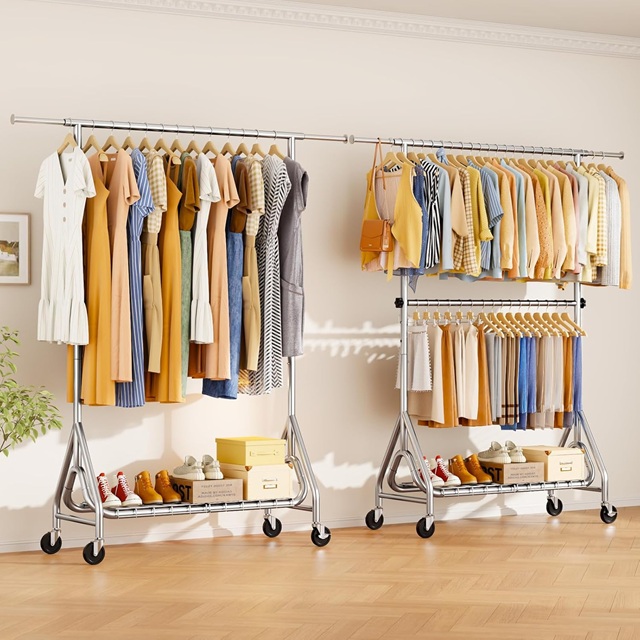
In the global retail landscape, the equipment supporting your merchandise acts as the silent foundation of your brand's physical presence. For brand owners, wholesalers, and retail producers, the clothing stand is far more than a functional rack—it is an engineering challenge that must balance aesthetics, durability, and operational efficiency. At WAIGAOQIAO, we specialize in the manufacturing and development of industrial-grade commercial clothing stands. Creating these fixtures requires a meticulous approach to material science, structural design, and finishing processes. This comprehensive guide outlines the professional methodology behind making high-performance industrial clothing stands that can withstand the rigors of the most demanding retail environments.

The creation of an industrial commercial clothing stand begins long before the first piece of steel is cut. It starts with a design philosophy that prioritizes the "three pillars of retail fixtures": stability, modularity, and longevity. Unlike residential garment racks, which are built for occasional home use, industrial stands are subjected to continuous mechanical stress, daily customer interaction, and the heavy, shifting loads of seasonal inventory.
Commercial retail is a high-traffic environment. Customers pull on racks, reorganize inventory, and occasionally bump into fixtures with shopping carts or strollers. Consequently, the design must account for dynamic stress. A well-engineered stand must remain rigid under significant weight while maintaining a center of gravity that prevents tipping. Our approach at WAIGAOQIAO is to treat every rack as a structural component, applying the principles of civil and mechanical engineering to create fixtures that are effectively "retail architecture."
The foundation of any superior clothing stand is the material quality. In the industrial sector, compromises in raw materials lead to catastrophic failure in the retail space.
Steel is the undisputed king of industrial display fixtures. However, not all steel is created equal. We utilize high-tensile cold-rolled steel, which offers a superior strength-to-weight ratio compared to standard hot-rolled variants. This material provides the necessary rigidity to prevent the horizontal rails from bowing under the weight of heavy winter coats or dense inventory.
The structural integrity of a stand is often determined by its joints. We prefer square or rectangular tubing over round tubing for high-stress applications, as these shapes offer greater resistance to torque and twisting. The connectors—whether they are welded joints or mechanical tension fittings—must be engineered for precision. Loose connections are the primary cause of rack failure; therefore, we utilize CNC-bent components and robotic welding to ensure that every connection is exact and uniform across mass production runs.
Once the material specifications are finalized, the manufacturing process begins. This is where engineering drawings are translated into physical assets.
Modern manufacturing relies on precision. CNC laser cutting allows us to create perfectly aligned mounting holes, which are critical for the rapid, error-free assembly of modular racks. Similarly, CNC bending machines ensure that the uprights and crossbars are shaped with exact radii, which not only looks professional but also prevents stress concentrations in the metal that can lead to fractures over time.
In high-volume production, manual welding can lead to variability in strength. We employ robotic welding stations to ensure that every weld bead is consistent in depth and penetration. This guarantees that every rack that leaves the factory floor possesses the same structural capacity, an essential requirement for brands that need their retail fleet to be identical across dozens of locations.
The finish of a clothing stand serves a dual purpose: it acts as a barrier against oxidation and environmental wear, and it defines the stand's visual identity in the retail space.
For industrial applications, powder coating is the gold standard. Unlike liquid paint, which can chip or peel under the friction of hangers, powder coating creates a robust, chemically bonded shell around the steel. This finish is exceptionally resistant to abrasion, chemicals, and the daily "wear and tear" of a bustling store. We offer a wide spectrum of textures—from matte to gloss—that can be customized to align with your brand's specific color palette.
For retailers seeking a more "high-end" or "boutique" aesthetic, chrome plating or brushed-nickel finishes remain popular. When applying these finishes, the base metal must be perfectly polished. Any imperfections in the steel will be magnified by the reflective nature of the plating. Our finishing department employs multi-stage polishing processes to ensure a mirror-like result that is free of burrs or surface defects.
One of the most significant challenges in commercial retail is the ability to adapt to changing floor plans. Industrial stands should not be static; they should be modular.
Retailers operate globally, and shipping bulky, fully assembled racks is logistically inefficient and costly. We design our industrial stands to be "flat-packed," meaning they are broken down into their base components and packed into compact boxes. The engineering challenge here is to ensure that the assembly remains simple and intuitive. Using integrated locking pins, spring-loaded buttons, or bolt-less tension connections allows retail staff to assemble or dismantle a rack in minutes without requiring specialized tools.
Even the most robust stand can fail if the weight distribution is improper. During the design phase, we conduct simulations to determine the center of gravity for each rack configuration. We place the mounting points for crossbars and shelves in locations that naturally encourage staff to distribute weight evenly, thereby reducing the stress on the vertical uprights and extending the life of the fixture.
Before a design is cleared for full production, it must undergo rigorous stress testing. This involves loading the rack to 150% of its rated capacity and subjecting it to vibration and impact tests to simulate real-world retail conditions.
Our process involves creating a series of prototypes. We test the "wobble factor," the ease of movement on casters, and the durability of the finish. If a rack shows signs of deformation or if a joint exhibits movement under stress, the design is sent back for modification. This rigorous testing ensures that when our partners receive their shipment, they are getting a product that has been proven to perform under pressure.
As modern retail shifts toward greener practices, the manufacturing of commercial fixtures is also evolving. We prioritize the use of eco-friendly, lead-free powder coatings and ensure that our scrap steel is recycled back into the production cycle. By designing for durability—creating a stand that lasts for a decade rather than a year—we also help our partners reduce their environmental footprint by minimizing the need for replacement fixtures.
Industrial commercial clothing stands are the silent, reliable workers of the retail world. By integrating high-tensile materials, precision engineering, robotic manufacturing, and robust finishing, we help brands create environments where their merchandise is the undisputed star. At WAIGAOQIAO, our commitment is to provide the backbone that supports your vision. Whether you are a small boutique or a global wholesaler, the principles of quality construction remain the same: precision, durability, and a dedication to the craft of manufacturing.
1. Why is square tubing preferred for industrial garment racks?
Square or rectangular tubing provides significantly higher resistance to torsional stress compared to round tubing. In a busy retail environment, this means the rack is less likely to twist or warp when loaded with heavy inventory or when moved frequently across the store floor.
2. How does powder coating improve the longevity of a retail fixture?
Powder coating forms a thick, hardened layer that is far more resistant to scratching and chemical corrosion than traditional liquid paint. This is essential for retail racks that experience constant contact with metal hangers and frequent cleaning with industrial agents.
3. What is the advantage of a flat-pack design for retail wholesalers?
Flat-pack designs significantly reduce shipping costs by minimizing the volume of the cargo. Furthermore, they allow for easier storage in stockrooms and enable retail staff to assemble or disassemble the units quickly without the need for heavy equipment or professional installers.
4. How do you ensure structural consistency in mass production?
We use robotic welding and CNC precision machining to eliminate the human error inherent in manual labor. These automated processes ensure that every joint, hole, and bend is identical across thousands of units, providing the structural uniformity that large retail chains require.
5. How often should industrial clothing stands be inspected in a store?
In a high-traffic environment, we recommend a monthly safety and maintenance check. This includes inspecting joints for tightness, ensuring that casters are not clogged with debris, and checking for any chips in the finish that might lead to localized rusting.


