
Language
Views: 260 Author: Waigaoqiao Co.,Ltd Publish Time: 2026-11-02 Origin: Waigaoqiao Co.,Ltd
Content Menu
● How to Make Wire Closet Shelves Stronger: Start With the Weakest Connection
● Diagnose Why Your Wire Closet Shelf Is Sagging
● 1. Add Compatible Support Brackets to Reduce Unsupported Spans
>> Choose Brackets That Match the Shelf
● 2. Improve Wall Connections Without Guessing About Anchors
>> Check the Complete Fastening Detail
● 3. Redistribute Weight Before Buying More Hardware
● 4. Use Shelf Liners for Surface Support—not Structural Reinforcement
>> Choose a Liner for the Actual Problem
● 5. Support the Front Edge and Hanging Rod Correctly
● 6. Replace Damaged Shelves Instead of Reinforcing Around Failure
● A Practical Reinforcement Workflow
>> Step 2: Identify the System
>> Step 3: Separate Damage From Installation Problems
>> Step 4: Select Approved Components
>> Step 5: Install and Inspect
● A Manufacturer's Perspective: Specify a Stronger System Before Production
● FAQs About Making Wire Closet Shelves Stronger
>> How far apart should wire shelf brackets be?
>> Can I put plywood over wire closet shelves?
>> Will adding one center bracket double the weight capacity?
>> Can drywall anchors support wire shelving?
>> Should I straighten a bent wire shelf?
>> What should I do if a reinforced shelf still sags?
● Plan a Better-Supported Storage Solution With Waigaoqiao
At Waigaoqiao, a manufacturer of metal wire racks and garment display racks established in 2003, we approach storage strength as a complete-system question—not simply a question of thicker wire. If you are wondering how to make wire closet shelves stronger, start with the supports, wall connections, shelf condition, and placement of stored items.
The most effective improvements usually involve shortening unsupported spans, installing compatible brackets, securing hardware to suitable wall structure, and redistributing concentrated loads. However, reinforcement does not automatically create a higher certified load rating.
This guide explains how to diagnose weak shelving, choose an appropriate repair, and recognize when replacement is the safer investment.

A closet shelf transfers weight through several connected components: the wire deck, brackets, clips or standards, fasteners, and wall structure.
Strength depends on the entire load path. A sturdy shelf can still fail if its wall connection is unsuitable, while excellent anchors cannot prevent a damaged wire deck from bending.
Before purchasing reinforcement hardware, empty the shelf and inspect:
- The middle of each unsupported section.
- Front-edge wires and hanging-rod connections.
- Welds, clips, brackets, and locking features.
- Wall surfaces around screws and anchors.
- Areas showing rust, distortion, or coating damage.
Do not tighten hardware and reload immediately if anchors are moving, drywall is crumbling, or wires have cracked. Those symptoms require further assessment.
Different symptoms call for different solutions. Adding brackets everywhere may waste money while leaving the actual problem unresolved.
| What you notice | Possible cause | Appropriate next step |
|---|---|---|
| The shelf bows between brackets | Excessive unsupported span or concentrated weight | Check support spacing and redistribute items |
| The front edge dips | Insufficient front support or excessive hanging load | Inspect approved front supports and rod connections |
| Screws or clips pull away | Unsuitable fastening or damaged wall material | Unload and assess the mounting system |
| One small area bends | A heavy object bears on a few wires | Remove the item and inspect for permanent damage |
| The shelf remains bent when empty | Permanent deformation | Replace the affected shelf section |
| A weld separates | Local structural failure | Replace the damaged component |
Photograph the installation before removing parts. Record the shelf depth, bracket positions, wall type, and any identifying labels. These details make compatible replacement parts easier to select.
[Suggested image: An annotated closet showing mid-span sagging, loose wall clips, front-edge deflection, and damaged welds.]
Adding a correctly positioned support is often more useful than placing another material over the wire deck.
A long unsupported section has more opportunity to bend. An additional bracket can shorten that section and provide another route for weight to reach the supporting structure.
However, bracket spacing is system-specific.
For example, ClosetMaid's fixed-mount wire shelving specifications describe front support at maximum 36-inch intervals and recommend 24-inch spacing for heavy-use applications. Its adjustable shelving specifications use different requirements, including standards no more than 24 inches apart. These figures illustrate why one universal spacing rule is inappropriate.
Check:
1. The shelving brand and product family.
2. Shelf depth and front-edge shape.
3. Bracket engagement and locking method.
4. Compatibility with existing tracks or standards.
5. Required fasteners and wall conditions.
Do not assume that a bracket is suitable because its advertised depth matches your shelf. Some systems use specific depth combinations or connection designs.
Position new supports according to the manufacturer's layout, including end-support and overhang requirements.
A reinforcement bracket helps only when its connection can carry the intended load.
Where the shelving system specifies attachment to structural framing, locate and confirm the framing before installation. A screw driven only into drywall is not equivalent to a properly specified connection into a stud.
When framing does not align with the required support positions, investigate the manufacturer's approved alternatives. These may involve an appropriate track arrangement or specified hollow-wall hardware—not an improvised substitute.
Confirm:
- Whether the wall contains timber framing, metal framing, masonry, or another construction.
- The specified screw or anchor type.
- Required embedment and installation method.
- Whether existing holes or wall damage affect suitability.
- Whether concealed utilities could be present.
Do not select anchors by adding together the largest numbers printed on their packaging. Shelf loading creates a combination of forces, and installation conditions matter.
For damaged walls, uncertain construction, or substantial loads, use a qualified installer.
Sometimes the most useful improvement costs nothing: change where the weight sits.
A shelf carrying several evenly spaced clothing baskets behaves differently from one carrying a single dense box at its midpoint. Concentrated loads can bend individual wires or overstress a limited area.
Start with these changes:
- Move dense items to lower storage locations.
- Avoid placing the heaviest box midway between supports.
- Spread stored items across the usable shelf area.
- Keep objects stable and away from unsupported overhangs.
- Avoid hanging extra accessories from wires not intended for that purpose.
Do not interpret "near a bracket" as permission to exceed the shelf's rating. Better distribution improves loading conditions; it does not establish a new capacity.
Recheck the arrangement when seasonal storage changes. A shelf previously used for sweaters may behave differently after it becomes storage for books, equipment, or tightly packed containers.
A liner can make wire shelving more convenient. It can stop small items slipping through gaps and provide a smoother surface for baskets or folded clothing.
A suitably rigid panel may also spread an object's contact across more wires. But that does not prove that the shelf assembly can safely carry more total weight.
| Option | Useful purpose | Important limitation |
|---|---|---|
| Flexible plastic liner | Holds small objects above wire gaps | Provides little structural stiffness |
| Rigid panel | Creates a flatter contact surface | Adds weight and does not strengthen wall connections |
| Manufacturer-approved insert | Offers system-specific fit | Must still follow the stated loading conditions |
Avoid presenting plywood as a universal reinforcement method. Its weight becomes part of the shelf load, and an unsuitable panel can obscure damage or interfere with connections.
If the shelf is already permanently bent, cover-up is not repair.
Closet shelves frequently support two kinds of storage: objects above and hanging garments below.
That makes the front edge especially important. A shelf can appear acceptable at the rear while its front edge twists or dips under clothing weight.
Inspect the connections between the shelf, rod, rod supports, and brackets. Where the system requires end brackets, diagonal supports, or dedicated rod supports, install the specified components.
Do not suspend a loaded clothing rod from arbitrary deck wires or replace missing structural parts with cable ties.
Also avoid assuming the published shelf capacity is an additional allowance for hanging garments. Check whether the manufacturer specifies separate limits, combined loading conditions, or a particular installation configuration.
Reinforcement makes sense when sound components lack adequate support. It is less appropriate when components have already failed.
Consider replacement when you find:
- Broken welds or cracked wires.
- Permanent bending after unloading.
- Severely distorted brackets.
- Significant corrosion affecting the metal.
- Repeated movement at repaired mounting points.
- Missing identification that prevents reliable compatibility checks.
Bending damaged wire back into shape does not restore a documented load rating.
For frequent heavy storage, a purpose-designed system may offer a more dependable solution than repeatedly modifying light-duty closet shelving. Compare complete installation requirements, not just shelf appearance or wire thickness.
Use this sequence to avoid solving the wrong problem.
Remove everything. Photograph the installation and measure shelf depth, unsupported spans, and existing support locations.
Find the product family and installation instructions. Determine whether it is fixed-mount, track-mounted, or another design.
Identify whether the weakness comes from the deck, supports, fastening, wall condition, or loading arrangement.
Choose compatible brackets, clips, standards, and fasteners. Replace damaged components rather than building around them.
Follow the documented layout. Confirm that connections are engaged, hardware is properly installed, and the shelf is level.
Reload within the manufacturer's stated limits and distribution requirements. Watch for movement or renewed sagging. This check is not a substitute for a certified load test.
Stop using the shelf if distress returns.
[Suggested video: A short demonstration of diagnosis, compatible bracket installation, and final inspection—without an improvised overload test.]
For overseas brands, wholesalers, and manufacturers, the better question is often: "How do we prevent weak shelving before customers install it?"
Waigaoqiao provides OEM services for metal wire racks and garment display racks. In an OEM discussion, the useful starting point is the intended application—not an unsupported promise of "heavy duty."
A practical specification should define:
- Shelf dimensions and intended stored items.
- Expected load distribution.
- Support spacing and attachment arrangement.
- Wire geometry, weld requirements, and finish.
- Installation instructions and supplied hardware.
- Agreed testing conditions and acceptance criteria.
Ask suppliers to distinguish the capacity of a shelf component from the capacity of the installed assembly. Test conditions should identify the support arrangement, loading method, and acceptance criteria.
Customer feedback can improve this process, but only when it is genuine and specific. Comments about sagging, difficult installation, or missing hardware should be connected to the actual product and installation conditions before drawing design conclusions.
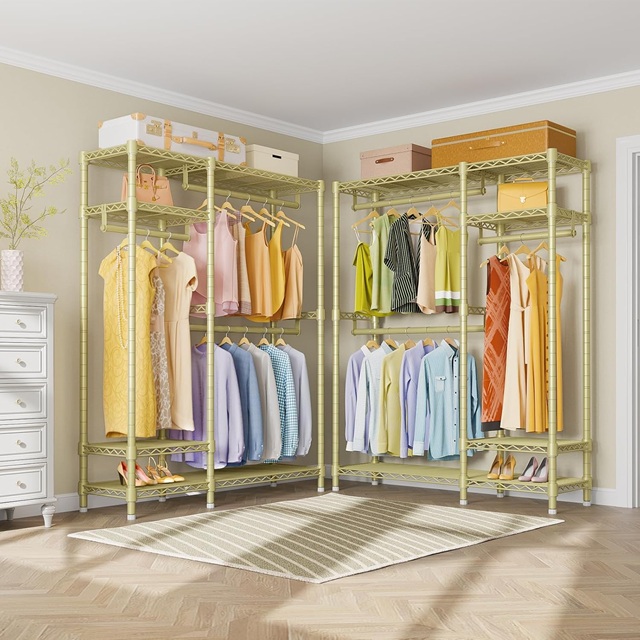
Follow the specific system's instructions. Some fixed-mount specifications allow 36-inch support intervals and recommend closer spacing for heavy use; adjustable systems may require different layouts. Never apply one brand's spacing rule universally.
A panel can provide a smoother surface and spread contact across wires. It also adds weight. It does not automatically increase the rated capacity or repair weak anchors, damaged welds, or inadequate brackets.
No. A center bracket may reduce the unsupported span, but the improvement depends on the complete assembly. Only applicable manufacturer documentation or appropriate testing can establish a revised rating.
Some systems permit specified hollow-wall anchors under defined conditions. Others require structural attachment at certain points. Use the exact approved fastening arrangement rather than assuming any anchor is adequate.
A shelf that remains bent after unloading has undergone permanent deformation. Replacement is more dependable than assuming straightening restores its original performance.
Unload it and reassess the complete system. Check compatibility, wall condition, support layout, component damage, and loading. Do not keep adding weight to determine when it fails.
For a home repair, identify the shelving system before purchasing reinforcement parts.
For an OEM project, contact Waigaoqiao with your target dimensions, intended use, load expectations, mounting arrangement, and destination market. Use those details to start a focused discussion about product design, installation requirements, and verification—not simply a thicker-wire quotation.
- Waigaoqiao company information supplied in the project brief: establishment in 2003, metal wire rack and garment display rack manufacturing, and OEM services for overseas brands, wholesalers, and manufacturers. No company website, independent certifications, test reports, or customer reviews were supplied.
- ClosetMaid, "Wire Shelving Specifications." Manufacturer guidance supporting the discussion of fixed-mount support spacing, heavy-use layouts, and specified installation components. [View technical specifications]. [design.closetmaid]
- ClosetMaid, "Adjustable Wire Shelving" specification document. Supports the distinction between adjustable and fixed-mount installation requirements, including standard spacing and bracket compatibility exceptions. [View specification document]. [design.closetmaid]
- Shelving Inc., "Add-On Shelf Wire Brackets, Direct to Wall Mounts." Illustrates that published capacities can specify evenly distributed loading and that anchors must suit individual wall construction. Its rating should not be transferred to unrelated closet systems. [View product details]. [shelving]
- Rubbermaid, "FastTrack Rail Garage Wire Shelf." Illustrates that a published shelf capacity depends on specified uprights and brackets; this garage-system rating does not establish the capacity of household closet shelving. [View manufacturer product information]. [rubbermaid]
Hot Tags: China, Global, OEM, private label, manufacturers, factory, suppliers, manufacturing company


