
Views: 220 Author: WAIGAOQIAO Publish Time: 2026-02-25 Origin: Site
Content Menu
● The Rise of the Industrial Aesthetic in Garment Storage
● Understanding Pipe Materials and Engineering Grades
>> Iron vs. Steel: Choosing the Right Foundation
>> The Significance of Wall Thickness and Pipe Diameter
● Finishes and Surface Treatments: Protection Meets Style
>> Industrial Black Powder Coating
>> Galvanization for High-Humidity Environments
>> Clear Coating for the "Raw" Aesthetic
● The Engineering of Fittings and Connections
>> Threaded vs. Slip-on Fittings
>> The Importance of the Floor Flange
● Structural Stability and Load-Bearing Design
>> H-Base vs. Square Base Configurations
● Mobility and Caster Selection for Industrial Use
>> Heavy-Duty Polyurethane Wheels
>> Locking Mechanisms and Safety
● The OEM Advantage: Customizing for Brand Identity
>> Custom Dimensions for Space Optimization
>> Branding and Private Labeling
● Assembly and Logistics: The "Knock-Down" Factor
>> Ease of Assembly for the End-User
>> Packaging for Global Distribution
● Maintenance and Long-Term Care
● Practical Tips for Large-Scale Procurement
● Conclusion: Why Pipe Stands are the Future of Storage
● Related Questions and Answers
In the world of fashion retail and warehouse management, the presentation of clothing is as vital as the product itself. Over the last decade, a significant shift has occurred in how brands and wholesalers choose their storage infrastructure. The "Industrial Look," characterized by raw materials, exposed structures, and rugged functionality, has moved from the fringes of boutique design into the mainstream of global retail. At the center of this movement is the pipe garment stand.
For a specialized OEM manufacturer like WAIGAOQIAO, the pipe garment stand represents the perfect marriage of form and function. These stands, often constructed from heavy-duty metal pipes and plumbing-style fittings, offer a level of structural integrity that traditional wire or thin-walled tubing cannot match. However, for a brand owner or wholesaler, selecting the right pipe stand requires a deep understanding of materials, finishes, and engineering. This guide provides an exhaustive analysis of how to select the best pipe garment stands to ensure durability, style, and operational efficiency.
The most critical factor in selecting a pipe garment stand is the quality of the metal itself. While many products on the market claim to be "industrial," the actual grade of the metal determines whether the rack will last for decades or sag under the weight of a few winter coats.
Most authentic industrial pipe racks are made from either black malleable iron or carbon steel. Iron pipes are traditional and offer a thick, heavy feel that many high-end boutiques prefer for their "vintage" or "authentic" appeal. However, steel pipes are often preferred for modern industrial applications because they offer a higher strength-to-weight ratio. When selecting for a warehouse or high-volume retail environment, steel is often the superior choice due to its resilience against bending and its better performance during the precision threading process.
The strength of a pipe stand is dictated by its "Schedule," which refers to the thickness of the pipe wall. In the OEM world, we typically work with Schedule 40 pipes, which are the standard for structural applications. Selecting a pipe with a wall that is too thin—often seen in low-cost consumer versions—leads to a "flimsy" feel and a high risk of the threaded joints stripping. The outer diameter of the pipe also matters; a 1-inch (roughly 25mm to 32mm) pipe is the industry standard for a balance of visual weight and physical strength.
Raw metal pipes, while aesthetically pleasing, are susceptible to oxidation (rust) and can leave oily residues on expensive garments. Therefore, the surface treatment is a non-negotiable selection criterion.
The most popular finish for pipe stands is black powder coating. Unlike traditional liquid paint, powder coating is applied as a dry powder and then cured under high heat. This creates a hard, durable "skin" that is resistant to scratching, chipping, and fading. For wholesalers, a high-quality matte or semi-gloss black powder coat provides a universal look that fits almost any retail environment.
If the garment stands are intended for use in humid climates, coastal regions, or industrial warehouses without climate control, galvanized piping is essential. Galvanization involves coating the steel in a layer of zinc, providing a chemical barrier against rust. While the finish is typically a dull silver/grey, it offers the highest level of protection for long-term industrial use.
Many brands desire the look of raw, "gunmetal" grey iron. To achieve this safely, the manufacturer must apply a high-quality clear powder coat. This preserves the natural texture and color variations of the metal while sealing it against moisture and preventing the "greasy" feel common with untreated industrial pipes.
What distinguishes a professional pipe stand from a DIY project is the quality of the fittings—the elbows, tees, and flanges that hold the structure together.
Traditional pipe stands utilize NPT (National Pipe Thread) or similar threading systems. This creates a rigid, permanent connection. When selecting a threaded stand, ensure that the threads are cut precisely; uneven threads lead to a crooked rack. Alternatively, some modern industrial stands use "slip-on" fittings secured by hex screws. These are excellent for modular systems where the height or width needs to be adjusted frequently.
The base of the pipe stand usually terminates in a circular floor flange. For stationary racks, the diameter and thickness of this flange determine the stand's footprint and stability. A high-quality OEM manufacturer will ensure that the flange is perfectly flat and features pre-drilled holes for either leveling feet or floor-anchoring bolts.

A garment stand is a tool of utility. Its primary job is to hold weight safely. When selecting a design, one must consider the physics of the load.
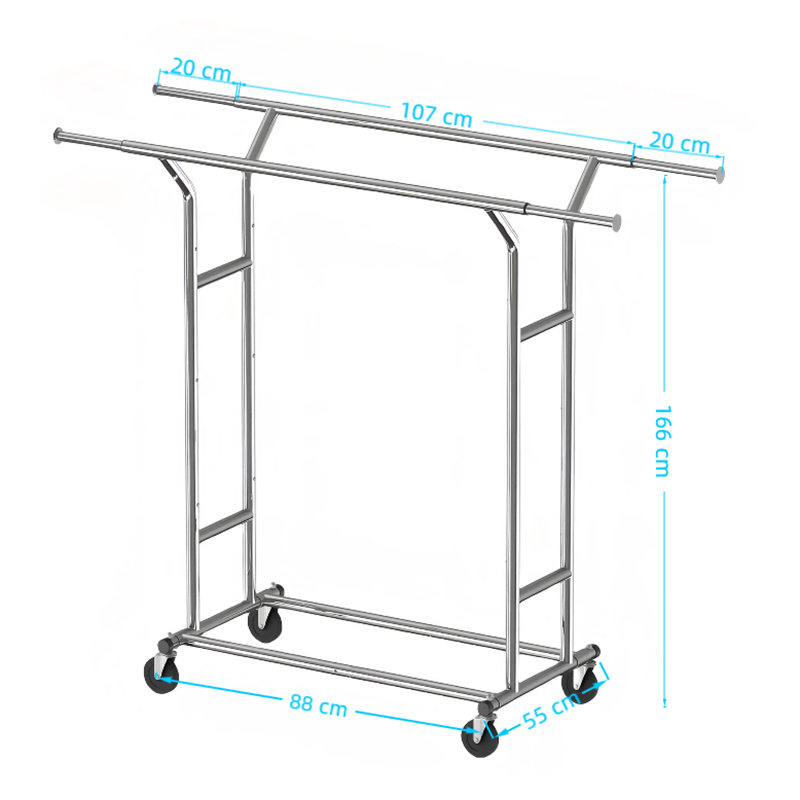
The "H-Base" design is the classic choice for rolling pipe racks. It provides a wide center of gravity, preventing the rack from tipping when pushed. A square or rectangular base is often preferred for stationary display stands in the middle of a retail floor, as it allows for the addition of a bottom shelf for shoes or accessories.
One common issue with tall pipe racks is "lateral sway"—the tendency of the rack to wobble from side to side. To prevent this, the best pipe stands incorporate cross-bracing or utilize oversized fittings at the base to create a more rigid vertical connection. If you are ordering custom heights over 160cm, ensuring structural reinforcement is vital.
For many wholesalers and large-scale retailers, the ability to move inventory quickly is essential. This makes the choice of casters as important as the pipes themselves.
Standard plastic wheels are prone to cracking under the heavy load of a pipe rack. We recommend industrial-grade polyurethane casters with ball-bearing swivels. These wheels are non-marking, meaning they won't leave streaks on expensive retail floors, and they provide a smooth, silent glide even when the rack is fully loaded with heavy winter coats.
At least two of the four casters on a pipe stand should feature a robust locking mechanism. In a retail setting, this ensures that customers don't accidentally move the display. In a warehouse setting, it is a critical safety feature to prevent racks from rolling on uneven surfaces.
As a brand owner or wholesaler, you are not just buying a rack; you are building an identity. Working with an OEM partner like WAIGAOQIAO allows for a level of customization that retail products cannot provide.
Not every retail space fits a standard 120cm wide rack. OEM manufacturing allows you to specify the exact width, height, and depth of your pipe stands. This is particularly important for maximizing vertical storage in high-rent urban retail locations.
For wholesalers, the ability to add private labeling—such as laser-etched logos on the flanges or custom-branded packaging—adds significant value to the product line. We can also customize the "texture" of the pipe, from a smooth modern finish to a distressed, rustic feel that aligns with specific brand stories.
Metal pipe stands are heavy, which makes shipping a significant cost factor. The best pipe stands are designed with "Knock-Down" (KD) engineering in mind.
A well-designed pipe stand should be easy to assemble with minimal tools. While traditional pipes are threaded together, we ensure that the components are labeled and that the threading is cleaned of any metal shards or debris. This ensures that the wholesaler's customers have a positive experience from the moment they open the box.
Heavy metal parts can easily damage each other during ocean freight. High-quality OEM sourcing includes specialized packaging—usually involving reinforced corrugated boxes and internal foam or EPE wrapping—to ensure that the powder-coated finish arrives in pristine condition, regardless of how far it travels.
To ensure that the pipe stands remain a permanent part of your infrastructure, a simple maintenance routine is required.
In a retail environment, the "elbows" and "tees" of pipe racks tend to collect dust. A soft microfiber cloth is usually sufficient. Avoid using harsh chemical cleaners, especially on clear-coated or powder-coated surfaces, as these can degrade the protective layer over time.
Over months of use, especially for rolling racks, the threaded joints may experience slight loosening due to vibration. A quick quarterly check to ensures everything is tight and level will prevent structural issues and keep the display looking professional.
When ordering pipe stands in bulk, there are several "red flags" and "green flags" to look for.
- Check the Weld Points: If the fittings are welded rather than cast, the welds should be smooth and continuous, with no visible "slag."
- Verify the Weight Capacity: Always ask for a certified weight capacity. A true heavy-duty pipe rack should support at least 100kg to 150kg without bowing.
- Request Samples: Before a full production run of 500 units, always request a production-grade sample to verify the thread quality and the finish consistency.
Selecting the best pipe garment stand is about more than just picking a design from a catalog. it is about understanding the metallurgy, the precision of the fittings, and the durability of the finish. For international brands and wholesalers, these stands offer a unique combination of "indestructible" industrial performance and high-end design appeal.
By focusing on high-grade steel, professional surface treatments like powder coating, and the structural advantages of the H-base and industrial casters, you can create a storage and display system that enhances your brand's reputation for quality. WAIGAOQIAO remains dedicated to helping our global partners navigate these choices, providing the OEM expertise and manufacturing precision needed to turn raw metal pipes into world-class garment display solutions.
---
Q1: Are pipe garment stands actually stronger than standard chrome racks?
A1: Yes, in almost all cases. Standard chrome racks often use thin-walled 22-gauge steel tubing. Pipe stands use structural steel or iron pipes (Schedule 40), which have much thicker walls and larger diameters. This makes them significantly more resistant to bending, swaying, and structural failure under heavy loads.
Q2: Will the black finish on the pipes rub off on white clothing?
A2: If the stand is properly powder-coated or clear-coated by a professional manufacturer, it will not rub off. The "rub-off" issue only occurs with "DIY" racks made from raw, oily plumbing pipes that haven't been cleaned and sealed. Professional OEM products from WAIGAOQIAO are fully cured to prevent any residue.
Q3: Can these racks be used for heavy outdoor apparel or wet items?
A3: If the racks are intended for wet environments or very heavy outdoor gear, we recommend a galvanized finish or a high-grade stainless steel pipe option. Standard powder coating is excellent for indoor retail, but galvanization provides the chemical protection needed to prevent rust in wet or high-salinity conditions.
Q4: How do I handle the high shipping weight of these heavy metal stands?
A4: The best strategy is "Knock-Down" (KD) engineering. By designing the rack to be disassembled into its individual pipe lengths and fittings, we can pack them into flat, high-density cartons. This maximizes container space and reduces the per-unit shipping cost significantly for international wholesalers.
Q5: Is it possible to add shelves to a pipe garment stand?
A5: Absolutely. One of the greatest benefits of the pipe system is its modularity. By using "Tee" fittings, you can easily add horizontal supports for wooden or metal shelves at the bottom or top of the rack, creating a multi-functional display for both hanging and folded items.


