
Language
Views: 178 Author: waigaoqiao Publish Time: 2026-10-04 Origin: Site
Content Menu
● What Is the Difference Between Single and Double Slatwall Hooks?
● Single vs. Double Slatwall Hooks at a Glance
● When to Choose Single Slatwall Hooks
● When to Choose Double Slatwall Hooks
● How to Decide: A Product-Fit Checklist
● A Useful Merchandising Test: Observe the Display in Use
● Length, Wire, and Mounting Matter as Much as Hook Type
● Slatwall Hooks, Pegboard Hooks, and Display Brackets
● Load Testing: Questions B2B Buyers Should Ask
● OEM Manufacturing and Custom Design for Retail Display Hooks
● Quality Control Before Production Approval
● Common Selection Mistakes to Avoid
>> Are single or double Slatwall Hooks better for retail displays?
>> Do double Slatwall Hooks hold twice as much weight?
>> Can I use a double hook if my package has one hole?
>> What should I send a supplier for a custom hook quote?
>> Are Slatwall Hooks and Pegboard Hooks interchangeable?
>> What should a load test report include?
Retail display hooks help retailers present hanging merchandise clearly and make products easy to browse. When choosing between single and double Slatwall Hooks, the right option depends on your product's packaging, hang hole, weight, display density, and how shoppers will remove it. Neither design is universally better: the best choice is the one that supports the product securely while keeping the display easy to shop.
For brands, wholesalers, and manufacturers sourcing Slatwall Hooks, Pegboard Hooks, or Display Brackets, this guide compares the two hook styles and outlines what to specify when requesting OEM manufacturing, custom design, quality control, and load testing.
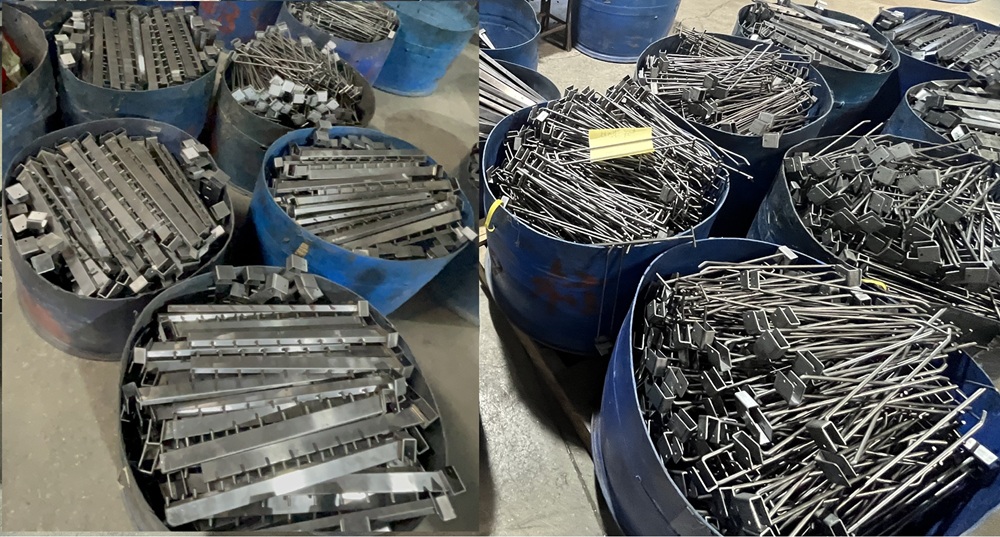
A single hook has one main wire or prong extending from its mounting end. A double hook uses two parallel wires or prongs to support the hanging product at two points. Exact designs vary by supplier, so confirm the drawing and mounting interface rather than relying on the product name alone. Retail fixture suppliers offer both single- and double-prong hook styles for merchandise displays. [trolleymfg](https://www.trolleymfg.com/display-hooks) [trolleymfg](https://www.trolleymfg.com/slatwall-hooks)
A double hook can help keep some products or packages more stable, while a single hook may provide a simpler, less visually obstructive presentation. These are practical design considerations—not guarantees. Product shape, hole design, hook geometry, material, and panel fit all affect how a particular item hangs.
- Single Slatwall Hooks: A good starting point for products with a suitable hanging hole and a package that hangs steadily from one support.
- Double Slatwall Hooks: Worth evaluating for products that need support at two points or benefit from reduced twisting or tilting.
- Both designs: Must be checked for product fit, ease of removal, mounting compatibility, finish, and the intended load.
The word "double" does not automatically mean double the capacity. Load performance depends on the complete hook design and the fixture it is installed on. Request test details for the specific configuration rather than inferring capacity from the number of wires.
A single hook can be a practical option when the product's hang hole and package geometry allow it to sit securely on one prong. It may also suit displays where a clean, simple presentation is important.
Consider testing a single hook when:
- The item has a centered hang hole or a package designed for one-point hanging.
- The product hangs straight and does not rotate excessively during normal browsing.
- Shoppers can remove an item without pulling neighboring merchandise off the hook.
- The display needs a straightforward, low-visual-impact hook arrangement.
- The panel and intended product load are compatible with the selected design.
A single hook is not automatically the more economical or more space-efficient choice. Compare complete, approved samples—including mounting ends, finishes, packaging, and required quantities—before making a purchasing decision.
A double hook may be appropriate when the product's package has two usable hanging points or when two-point support improves its position on the display. Some retail suppliers describe double-hook designs as helping to secure tagged items against slipping, but the result depends on the specific product and hook geometry. [szcers](https://www.szcers.com/news/industry-news/how-is-a-single-wire-display-hook-transforming-modern-retail.html)
Consider a double hook when:
- The package has two holes or a wide hanger that can engage both prongs.
- A sample shows that the merchandise twists, tilts, or sits inconsistently on a single hook.
- Products need to remain aligned during browsing and restocking.
- The hook design can support the product without damaging or distorting the packaging.
A double hook can also create a fit problem if the package's hang hole is too narrow or the spacing between the prongs does not match the product. Test with actual merchandise before approving the design.
Use this sequence to compare single and double Slatwall Hooks for a specific SKU or product family:
1. Inspect the package. Note the number, position, and width of hang holes or slots.
2. Measure the merchandise. Record package width, depth, and total weight.
3. Load a sample hook. Test with the actual product and the intended quantity per hook.
4. Check hanging behavior. Look for twisting, tilting, slipping, or contact with nearby products.
5. Test customer access. Remove and replace items as a shopper would. Check for snags or neighboring products being displaced.
6. Check the panel fit. Install each sample on the intended slatwall panel or a confirmed equivalent.
7. Record the approved design. Document dimensions, mounting style, finish, product configuration, and test conditions.
This practical comparison is more informative than selecting a hook based on a product label or wire count alone.
When a display is intended for a store program or a large product assortment, evaluate the hooks in a small mock-up before finalizing the order. Use representative products, including the widest package, the heaviest item, and any item with an unusual hang-hole design.
During the mock-up, check:
- Whether packages hang at a consistent angle.
- Whether products rotate or overlap.
- Whether shoppers can identify and remove one item at a time.
- Whether neighboring hooks leave adequate clearance.
- Whether staff can restock the display quickly.
- Whether repeated handling causes the hook to loosen or the finish to show damage.
The result may be a mixed specification: single hooks for one product group and double hooks for another. A consistent fixture appearance does not require every SKU to use the same hook design.
Choosing single versus double is only one part of hook selection. Buyers should also confirm:
- Hook length: Match the usable arm to package depth, desired quantity, and removal clearance.
- Wire diameter and material: Specify the actual requirements; do not use "heavy duty" as the only specification.
- Prong spacing: For double hooks, ensure spacing matches the package's hanging points.
- Mounting interface: Confirm the hook is designed for the specific slatwall profile or insert.
- Finish: Define the required color or coating and its appearance criteria.
- Tip and end design: Ensure the end retains products appropriately without making them difficult to remove.
Slatwall systems and accessories are offered in different constructions. Compatibility and performance should therefore be confirmed for the intended panel and application. For example, a supplier describes different load figures for reinforced slatwall with aluminum inserts and standard construction, illustrating why a hook cannot be evaluated independently of its supporting fixture. [testritealuminum](https://www.testritealuminum.com/blogs/news/aluminum-slatwall)
Slatwall Hooks are designed to engage a slatwall interface. Pegboard Hooks are made for perforated board and require compatible hole geometry and spacing. Display Brackets can provide broader support or serve as part of a shelf-style merchandising solution.
These product groups are related, but they are not automatically interchangeable. When sourcing a retail fixture, specify the panel or board type and provide a sample, drawing, or clear interface measurements. This helps an OEM supplier identify the correct mounting design before sampling.
Neither a single nor a double hook should be assigned a capacity based on appearance alone. The result depends on the hook's materials and geometry, the way it is mounted, the panel, the panel support, and the position and duration of the load.
When discussing Load Testing with a supplier, ask:
- Was the hook tested on the intended panel or fixture?
- What product or test load was used, and where was it applied?
- Was the test static, repeated, or both?
- What conditions count as a pass or failure?
- Does the result apply to the exact dimensions, material, finish, and mounting design being quoted?
- Can the supplier provide test records for the approved configuration?
A meaningful test result should identify the tested design and conditions. It should not be presented as a universal capacity for every hook in the product family.

For international brands, wholesalers, and manufacturers, a precise RFQ helps align the product design with the merchandising application. Include:
- Product type: single or double Slatwall Hook, Pegboard Hook, or Display Bracket
- Overall dimensions, hook length, and wire diameter
- Material and finish requirements
- Prong spacing, tip design, and mounting interface
- Product package dimensions, hang-hole layout, and intended loading
- Required quantity per display and order volume
- Packaging requirements, inspection criteria, and testing expectations
For Custom Design, provide a dimensioned drawing alongside product photographs or physical samples. A reference image can communicate the general style, but it does not establish the exact dimensions or panel compatibility.
Waigaoqiao is a China-based factory focused on retail display fixtures and OEM services for overseas brands, wholesalers, and manufacturers. A clear brief lets the factory review the application, develop or refine the design, prepare samples, and align quality checks with the approved specification.
A useful Quality Control plan checks whether the delivered hooks match the approved design and function in the intended application. Agree on inspection points before mass production, such as:
- Dimensions: Length, wire diameter, bends, and double-prong spacing.
- Fit: Secure engagement with the specified panel system.
- Appearance: Finish consistency and visible surface defects.
- Function: Product retention, hanging position, and ease of removal.
- Packaging: Protection against bending and surface damage in transit.
- Records: Sample approval and any application-specific test documentation.
For repeat orders, keep an approved reference sample and document changes to materials, dimensions, or finish. This gives the buyer and supplier a shared basis for production review.
- Assuming double means stronger: Wire count alone does not establish load capacity.
- Choosing without the actual package: Hang-hole size and spacing can determine whether a design fits.
- Ignoring shopper access: A stable display still needs to make products easy to remove.
- Forgetting the panel: The hook, panel, and panel support work together.
- Using vague RFQ language: Replace "heavy duty" with defined dimensions, materials, application, and test expectations.
- Skipping sample approval: A physical test can reveal fit and handling issues before a full order.
Neither is universally better. Choose based on package design, hang-hole layout, hanging stability, customer access, and compatibility with the display panel. Compare samples using actual merchandise.
Not necessarily. Capacity depends on the design, mounting, panel, support, and loading conditions. Request results for the exact hook and fixture configuration.
Possibly, but fit and stability depend on prong spacing and package geometry. Test a sample to confirm both prongs engage properly and do not damage the package.
Provide a drawing or measurements, product and package details, panel type, hook style, finish, expected quantity, and any inspection or test requirements.
No. They use different mounting interfaces. Confirm the fixture system and specify the compatible hook type.
It should identify the hook design, mounting setup, test load and position, test method or conditions, and pass/fail criteria. Results should relate to the application being quoted.
- [Trolley Manufacturing: Slatwall Hooks](https://www.trolleymfg.com/slatwall-hooks) — Supplier information on slatwall hook products.
- [RedSheep: Customized Display Hooks](https://www.trolleymfg.com/display-hooks) — Supplier information on customized retail display hook options.
- [SZCERS: Single-Wire Display Hooks](https://www.szcers.com/news/industry-news/how-is-a-single-wire-display-hook-transforming-modern-retail.html) — Product examples and discussion of single- and double-wire display hooks.
- [Testrite Aluminum: Aluminum Slatwall](https://www.testritealuminum.com/blogs/news/aluminum-slatwall) — Overview of slatwall construction and how panel design can affect application requirements.


