
Views: 170 Author: waigaoqiao Publish Time: 2026-08-23 Origin: Site
Content Menu
● Why High-Traffic Stores Need Heavy-Duty Retail Display Hooks
● What Makes a Retail Display Hook "Heavy-Duty"?
● Selecting Materials for Heavy-Duty Retail Display Hooks
● Load Capacity Depends on More Than Wire Diameter
● Quality-Control Process for Heavy-Duty Retail Display Hooks
>> Incoming Material Inspection
>> First-Piece and Tooling Inspection
>> Final Inspection and Packing Verification
● Load Testing: What Buyers Should Request
● Designing Hooks for Customer Safety
● Choosing the Correct Mounting System
● Packaging and Transportation Quality
● A Practical OEM Quality-Approval Workflow
● How Waigaoqiao Supports Heavy-Duty OEM Projects
● Recommended Content and Visual Assets
>> What is the best material for heavy-duty retail display hooks?
>> How do I know whether a retail display hook is suitable for a high-traffic store?
>> Does a thicker wire always mean a stronger display hook?
>> What should a heavy-duty hook load-test report include?
>> How can I prevent hooks from scratching during shipment?
>> Can Waigaoqiao customize hooks for pegboards and slatwalls?
>> Should I request compliance documents for retail display hooks?
>> How can repeat-order quality remain consistent?
● Request a Heavy-Duty Retail Display Hook Quote
In high-traffic stores, heavy-duty retail display hooks must withstand more than the weight of merchandise. They are repeatedly loaded, unloaded, touched, pulled, bumped, and exposed to demanding retail environments. For brands, wholesalers, and manufacturers sourcing OEM products from China, the key question is not simply whether a hook looks strong. It is whether the manufacturer can consistently control materials, dimensions, load performance, surface finish, packaging, and repeat-order quality.
Waigaoqiao provides OEM retail display fixtures and customized metal display components for overseas customers. From our industry experience, a reliable heavy-duty hook begins with application analysis—not with an attractive catalogue photograph or the lowest quotation.
This guide explains how to evaluate heavy-duty retail display hook quality, what tests to request, and how Waigaoqiao can support OEM projects for supermarkets, hardware stores, convenience stores, apparel retailers, and other high-traffic commercial environments.

A store fixture in a busy retail environment faces continuous operational stress:
- Frequent customer handling
- Repeated product replenishment
- Accidental side impacts
- Uneven or concentrated loads
- Long operating hours
- Cleaning chemicals and humidity
- Transport and installation movement
- Repeated removal and reinstallation
A hook that performs well in a quiet showroom may not perform equally well in a supermarket or discount store where customers handle products hundreds of times each day.
The risks of an unsuitable hook include:
- Bent wire or permanent deformation.
- Weld cracking or joint failure.
- Fixture detachment from the panel.
- Damaged merchandise.
- Sharp edges or exposed burrs.
- Falling products and customer complaints.
- Expensive store-level replacement work.
- Inconsistent appearance across locations.
For this reason, heavy-duty retail hooks for high-traffic stores should be specified according to their actual operating conditions. Load capacity, hook length, mounting system, product packaging, and expected handling frequency all influence the final design.
"Heavy-duty" should be treated as a technical description, not just a marketing phrase. A hook becomes suitable for demanding use through a combination of design, material, fabrication, and quality control.
Important factors include:
- Wire diameter: Larger diameter generally increases rigidity, but it is not the only strength factor.
- Steel grade: The material must be appropriate for forming and the required load.
- Bend geometry: Smooth, controlled bends reduce stress concentration.
- Base construction: The mounting plate or rear bracket must transfer the load safely.
- Weld quality: Welds must be strong, consistent, and free from dangerous defects.
- Hook projection: Longer hooks create greater leverage and may require reinforcement.
- Product stopper: A front lip, ball, or cap can prevent products from sliding off.
- Surface treatment: The finish must resist wear, corrosion, and handling damage.
- Mounting compatibility: The hook must fit the intended pegboard, slatwall, gridwall, or custom panel.
A heavy-duty display hook should therefore be evaluated as a complete load-bearing system, not as an isolated piece of wire.
Material selection should be based on load, environment, appearance, cost, and destination-market requirements.
| Material or finish | Suitable advantages | Important checks |
|---|---|---|
| Low-carbon steel wire | Economical, easy to form, suitable for many retail hooks | Wire diameter, tensile properties, weldability |
| Stainless steel | Strong corrosion resistance and premium appearance | Grade, hardness, forming cost |
| Zinc plating | Practical corrosion protection at a competitive cost | Coating coverage, thickness, adhesion |
| Chrome plating | Bright decorative finish | Surface preparation, adhesion, corrosion performance |
| Powder coating | Wide color selection and durable finish | Color consistency, coating thickness, impact resistance |
| Plastic or rubber tips | Edge protection and improved product retention | Hardness, aging, attachment strength |
The correct choice depends on the store environment. For indoor general merchandise, powder-coated or plated steel may provide an effective balance between durability and price. For humid areas or premium applications, stainless steel may be more appropriate.
The buyer should request clear information about:
- Material grade
- Wire diameter
- Surface-treatment process
- Color reference
- Coating or plating requirements
- Applicable material documentation
- Supplier traceability
Do not accept a generic statement such as "high-quality steel." A professional OEM manufacturer should identify the material and connect it to the approved technical specification.
One common sourcing mistake is to assume that a thicker wire automatically makes a hook suitable for heavy merchandise. In reality, performance is influenced by several variables:
- Hook length
- Bend radius
- Mounting orientation
- Base-plate design
- Weld structure
- Load position
- Product center of gravity
- Number of products
- Dynamic handling
- Panel strength
A long hook carrying weight near the front experiences greater bending force than a short hook carrying the same weight close to its base. A hook may also pass a static test but fail when customers repeatedly pull products from the front.
For OEM projects, define the application precisely:
1. What products will be displayed?
2. What is the total expected load?
3. Is the load evenly distributed or concentrated?
4. How long will the hook be?
5. How often will merchandise be handled?
6. Which display system will support the hook?
7. What level of deflection is acceptable?
A responsible supplier should discuss these conditions before recommending a final design.
A strong quality system begins before production and continues until shipment. Waigaoqiao recommends dividing inspection into several stages.
The factory should verify the incoming wire, sheet metal, tubes, fasteners, and surface-treatment materials.
Typical checks include:
- Material type and specification
- Wire diameter or sheet thickness
- Surface condition
- Rust, contamination, or damage
- Supplier batch information
- Quantity received
Material problems discovered early are less expensive to correct than defects found after mass production.
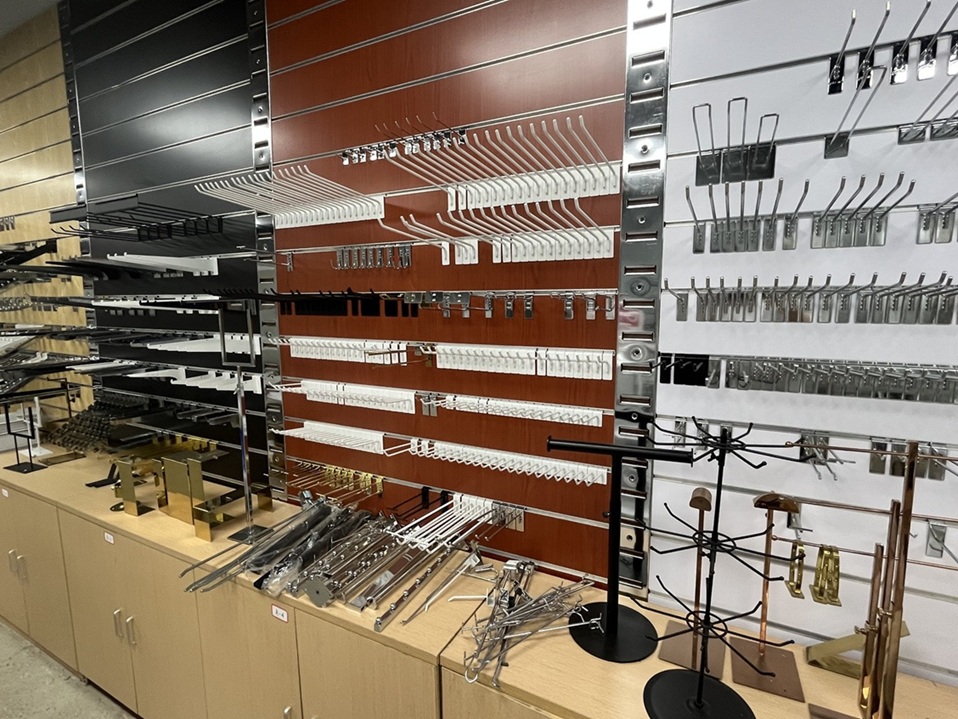
After machine setup or tooling adjustment, the first completed pieces should be measured against the approved drawing.
Inspect:
- Overall length
- Hook projection
- Bend angle
- Base dimensions
- Mounting-slot position
- Label-holder alignment
- Tip height
- Weld location
First-piece approval helps prevent an incorrect machine setup from affecting an entire production batch.
During manufacturing, operators and quality personnel should monitor critical dimensions and visual characteristics.
Key checkpoints may include:
- Wire-form accuracy
- Bend consistency
- Weld appearance
- Component alignment
- Burr removal
- Fixture compatibility
- Product-retention features
Inspection frequency should reflect the risk of the component. A small decorative variation may be acceptable in one area, while a mounting dimension or weld defect may be critical.
The surface finish protects the metal and contributes to brand presentation. Inspectors should look for:
- Uneven color
- Bare metal
- Orange peel
- Blistering
- Peeling
- Scratches
- Sharp edges
- Excessive weld discoloration
- Poor coverage inside bends
For branded retail programs, the approved color standard should be clearly defined. A physical color sample or recognized color reference is preferable to a verbal description such as "dark black."
Before shipment, the factory should verify:
- Product quantity
- Dimensions
- Function
- Appearance
- Load-test results where required
- Accessories
- Labels and barcodes
- Inner-pack quantity
- Carton quantity
- Carton condition
- Shipping marks
A final inspection report should contain actual results and sample sizes whenever possible.
For a heavy-duty hook, load testing should be based on a written test method. The report should state:
- Test sample quantity
- Applied load
- Loading position
- Loading direction
- Test duration
- Support or panel type
- Maximum permitted deflection
- Permanent deformation limit
- Failure criteria
- Test date and product revision
A basic static test can determine whether the hook bends or fails under a specified load. A more realistic evaluation may also include repeated loading and unloading to simulate store operations.
Potential test types include:
| Test type | Purpose |
|---|---|
| Static load test | Measures performance under a defined continuous load |
| Deflection test | Determines how far the hook bends under load |
| Permanent-deformation test | Checks whether the hook returns to its original shape |
| Repeated-load test | Simulates repeated merchandising activity |
| Weld inspection | Evaluates joint consistency and visible defects |
| Coating adhesion test | Checks whether the finish remains attached |
| Corrosion test | Assesses finish performance in specified conditions |
| Fit test | Confirms compatibility with the intended display system |
Testing should not be presented as a universal certification unless the exact product configuration and test method support that claim. Buyers should confirm whether the test applies to the same material, finish, dimensions, mounting system, and production revision they intend to purchase.
Recommended visual: Add a short factory video showing a hook installed on the actual panel system and tested under a defined load. Display the load value, duration, and result on screen.
Retail display hooks are touched frequently. Safety details therefore deserve the same attention as strength.
The design should address:
- Burr removal
- Smooth bends
- Protected ends
- Rounded tips
- Secure caps
- Stable mounting
- No exposed sharp welds
- No loose components
- Adequate product retention
For products in children's areas, hardware departments, or crowded aisles, the risk of accidental contact may be higher. The supplier should review the installation height, aisle layout, product weight, and customer interaction pattern.
A technically strong hook that creates a sharp contact point is not a successful retail fixture.
A hook is only as reliable as the panel or fixture supporting it. Before production, confirm compatibility with the intended system:
- Pegboard
- Slatwall
- Gridwall
- European slot panels
- Perforated metal panels
- Custom cabinets
- Freestanding retail racks
Check the following dimensions:
- Hole or slot spacing
- Panel thickness
- Mounting-tab shape
- Back-plate dimensions
- Insertion depth
- Clearance
- Vertical alignment
- Removal method
A small dimensional error can make thousands of hooks difficult to install. During sampling, test the hook on the actual display panel rather than relying only on a drawing.
Heavy-duty hooks are often packed in bulk. Without suitable protection, friction during transport can cause scratches, chipped coating, bent tips, or tangled wire forms.
Packaging should be designed around:
- Product geometry
- Surface finish
- Shipping distance
- Handling method
- Carton weight
- Stacking conditions
- Retail unpacking requirements
Possible solutions include:
- Individual sleeves.
- Layered cartons.
- Corrugated dividers.
- Polybags.
- Protective caps.
- Molded trays.
- Palletized export cartons.
The packaging specification should identify pieces per inner carton, pieces per master carton, carton dimensions, gross weight, net weight, and shipping marks. Request packaging samples before mass production if the product has a delicate finish or unusual shape.
For overseas brand owners, wholesalers, and manufacturers, the following process reduces risk:
1. Submit the application brief.
2. Share drawings, photographs, or a physical sample.
3. Confirm dimensions, material, finish, load, and packaging.
4. Ask the manufacturer to identify design risks.
5. Review the quotation and manufacturing assumptions.
6. Approve a prototype or pre-production sample.
7. Test fit, appearance, strength, and packaging.
8. Record all changes in a revised drawing.
9. Approve the golden sample.
10. Set inspection criteria before mass production.
11. Complete in-process and final inspections.
12. Review shipment documents before release.
This workflow creates a traceable link between the initial request and the delivered product.
Waigaoqiao focuses on retail display fixtures and customized OEM manufacturing for international customers. Our project approach is based on understanding the customer's application before finalizing the product.
We can support discussions involving:
- Custom wire dimensions
- Hook length and projection
- Mounting configurations
- Metal materials
- Powder coating and plating
- Label holders and product stoppers
- Prototype development
- Packaging design
- Dimensional and appearance inspection
- Repeat-order consistency
To request a practical quotation, provide:
- Product drawing or sample.
- Product photographs.
- Intended retail application.
- Required load.
- Display-panel type.
- Material and finish preference.
- Quantity and forecast.
- Packaging requirements.
- Destination country.
- Target delivery schedule.
A complete specification enables the factory to recommend a realistic solution and avoid assumptions that may create quality problems later.
To strengthen user experience and demonstrate manufacturing expertise, add the following assets to this article or related product pages:
- Factory-process photographs showing forming, welding, finishing, inspection, and packing.
- Load-testing video with clearly stated conditions.
- Before-and-after design comparison showing how reinforcement improves performance.
- Technical diagram labeling hook projection, wire diameter, base, and mounting point.
- Quality-control checklist available as a downloadable PDF.
- Application gallery showing hooks in supermarkets, hardware stores, and convenience stores.
- Packaging photograph showing protection against abrasion and deformation.
Use original factory images whenever possible. Include descriptive alt text, captions, product dimensions, and application information rather than decorative stock photography.
There is no universal best material. Low-carbon steel is often cost-effective, stainless steel offers stronger corrosion resistance, and powder-coated or plated steel can balance durability, appearance, and price. The correct choice depends on load, environment, finish, and budget.
Request a sample and evaluate the complete system under the expected load. Check static performance, deflection, mounting stability, weld quality, surface finish, edge safety, and repeated product handling.
No. Strength also depends on hook length, bend geometry, base construction, weld quality, load position, and mounting system. A manufacturer should review the entire design rather than recommend wire diameter alone.
It should identify the product revision, sample quantity, load, loading position, test duration, support system, deflection limit, deformation limit, failure criteria, and test result. The tested configuration should match the production product.
Use packaging matched to the finish and geometry. Sleeves, dividers, protective caps, layered cartons, and appropriate palletization can reduce friction, impact, tangling, and coating damage.
OEM buyers should provide the actual panel dimensions, slot or hole spacing, thickness, and mounting requirements. Waigaoqiao can then review the design and develop a sample for fit and function approval.
Discuss destination-market and retailer requirements before production. If documentation is needed, confirm that it covers the exact material, finish, product configuration, and production version.
Use a controlled drawing revision, an approved golden sample, written inspection standards, documented packaging instructions, and formal approval for any material, tooling, or finish change.
If your retail program requires reliable hooks for supermarkets, hardware stores, convenience stores, apparel stores, or other high-traffic environments, send Waigaoqiao your drawing, sample, product photograph, or application requirements.
Our team can help review:
- Load and mounting requirements
- Material and finish options
- Manufacturing feasibility
- Prototype and testing needs
- Packaging design
- Inspection criteria
- MOQ and lead-time expectations
Request an OEM quotation from Waigaoqiao today and start your project with a clearly defined, testable, and repeatable retail display hook specification.
- [Google Search Central: Creating Helpful, Reliable, People-First Content](https://developers.google.com/search/docs/fundamentals/creating-helpful-content) — Guidance on creating original, useful, experience-based, and trustworthy content.
- [Google Search Central: How Search Works](https://developers.google.com/search/docs/fundamentals/how-search-works) — Background on how Google discovers and evaluates web content.
- [ISO: Quality Management Principles](https://www.iso.org/quality-management-principles.html) — Principles related to customer focus, process management, continual improvement, and evidence-based decisions.
- [ASTM International](https://www.astm.org/) — Technical standards and testing resources relevant to materials and product performance.
- [European Commission: REACH Regulation](https://environment.ec.europa.eu/topics/chemicals/reach-regulation_en) — Official information about chemical requirements in the European Union.
- [European Commission: RoHS Directive](https://environment.ec.europa.eu/topics/waste-and-recycling/rohs-directive_en) — Official information about restricted substances in applicable electrical and electronic equipment.
- [UL Solutions: Retail Fixtures and Display Equipment](https://www.ul.com/) — Reference point for applicable safety and performance requirements; buyers should verify the exact standard for their product and market.
- [Waigaoqiao](https://www.waigaoqiao.com/) — Company-specific information about OEM retail display fixtures, product capabilities, manufacturing processes, and customer feedback should be verified and updated by the manufacturer before publication.


