
Views: 178 Author: waigaoqiao Publish Time: 2026-10-16 Origin: Site
Content Menu
● What Are Wall-Mounted Retail Display Brackets?
● Slatwall Hooks, Pegboard Hooks, and Display Brackets: How They Differ
>> Slatwall Hooks for Reconfigurable Merchandising
>> Pegboard Hooks for Hole-Based Panels
>> Display Brackets for Shelves and Specialized Displays
● How to Choose Retail Display Hooks for a Store Layout
>> 1. Identify the Wall System
>> 2. Define the Product and Hanging Method
>> 3. Match Projection to the Aisle and Product
>> 4. Specify Finish and Store Conditions
● Load Testing and Quality Control for Retail Display Brackets
● OEM Manufacturing: From Custom Design to Production
>> What to Include in an OEM RFQ
>> Custom Design and Sample Approval
● Common Problems—and How to Prevent Them
● Plan a More Flexible Store Display
● FAQs
>> Are slatwall hooks and pegboard hooks interchangeable?
>> How do I choose the right display bracket projection?
>> What information should I provide for an OEM quote?
>> Should retail display brackets be load tested?
>> Can a manufacturer customize slatwall hooks or pegboard hooks?
Retail display hooks and wall-mounted display brackets help retailers make merchandise visible, accessible, and easier to rearrange. For brands, wholesalers, and fixture manufacturers, choosing the right slatwall hooks, pegboard hooks, and display brackets is not just a merchandising decision. It also affects compatibility, product safety, replenishment, and the cost of scaling a store rollout.
At Waigaoqiao, we work with overseas businesses on OEM retail display fixtures. In our experience, a successful wall display starts with a clear understanding of the panel system, the merchandise, and how staff will use the fixture every day. A hook that looks right in a drawing may still be unsuitable if its fitting is incompatible, its projection is too long for the aisle, or its capacity has not been validated for the intended load.
This guide explains how to select wall-mounted retail display brackets, compare hook types, specify testing, and plan a custom OEM order.
Wall-mounted retail display brackets are metal or plastic supports that attach to a retail wall system and hold products, shelves, signage, or other merchandising accessories. They can be used alone or with retail display hooks to create a configurable display.
The term display bracket covers a range of products, including:
- Straight hooks for packaged products with hanging holes.
- Scan hooks with a label holder for product and price information.
- Waterfall arms for garments or accessories.
- Shelf brackets that support a shelf or display tray.
- Face-outs and arms that present merchandise at an angle.
- Custom brackets designed for a particular panel, product, or store program.
A well-designed bracket should do more than hold merchandise. It should fit the intended wall system, stay secure during normal use, and allow staff to replenish or rearrange products without unnecessary effort.
The best choice depends on the panel, the product, and the desired store presentation. Slatwall hooks and pegboard hooks are not automatically interchangeable. Their attachment geometry is different, and even products designed for the same panel type may vary in dimensions.
Slatwall hooks fit into horizontal grooves in slatwall panels. They are commonly used for packaged goods, accessories, and other items designed to hang from a hook.
Before ordering, confirm the slot profile and the hook's fitting dimensions with the panel supplier. Slatwall systems can vary, so a sample or technical drawing is more reliable than assuming all panels share one standard.
Consider slatwall hooks when you need to:
- Rearrange product groups without changing the wall structure.
- Use hooks, shelves, and brackets on the same panel system.
- Create a clean, coordinated display across a store or dealer network.
Pegboard hooks fit into holes in a pegboard panel. The correct hook depends on the hole pattern, hole size, panel thickness, and the way the hook is retained.
When evaluating pegboard hooks, check whether the fitting is stable when customers remove products. A hook that lifts, tilts, or pulls out under routine handling can disrupt the display and create additional work for store staff.
A display bracket may support a shelf, tray, face-out arm, or another merchandising accessory. It can also be designed for a specific wall panel or product range. For these applications, the bracket geometry and intended use should be defined before production.
A clear specification typically includes the panel type, attachment method, projection, finish, target load, and any required label or end-stop features.
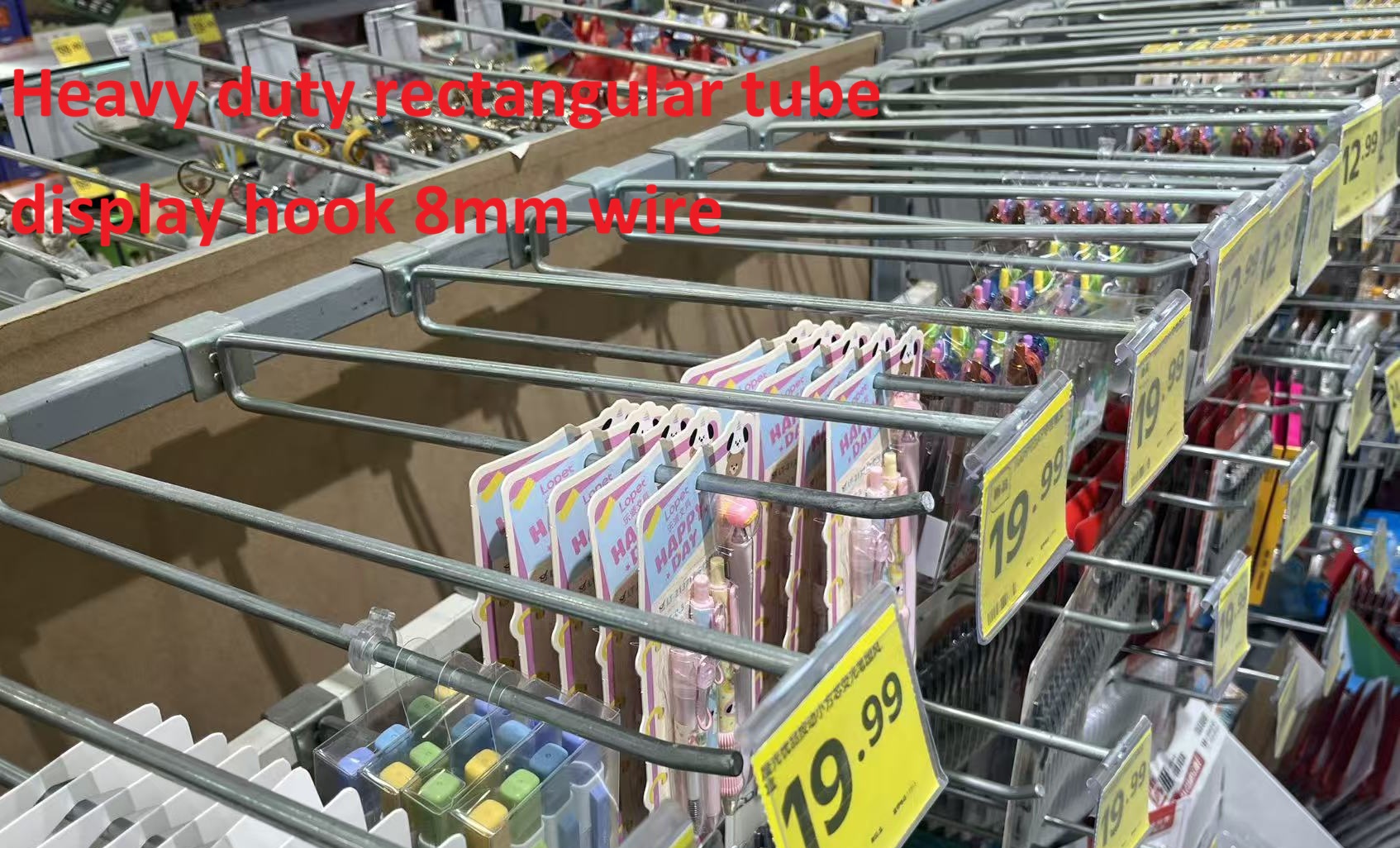
The right retail display hook should suit the full merchandising task—not just the product weight.
Start with the actual panel or fixture the bracket will attach to. Record its type and critical dimensions, then compare them with the proposed fitting. If the project involves multiple suppliers, request samples before approving a production run.
Confirm how the merchandise attaches to the hook. A blister pack, garment, tool, and accessory may each need a different hook length, wire diameter, tip, or stopper.
Questions to answer include:
- Does the product have a hanging hole, loop, or card slot?
- How many units should each hook hold?
- Should products slide forward automatically, or remain in place?
- Is a price tag or scan label required?
Longer hooks can improve capacity, but they also extend farther into the shopping space. Select a projection that presents products clearly while fitting the store's layout and merchandising plan.
The finish should match the brand and the intended environment. Common options include chrome-like finishes, powder coating, and other specified coatings. Agree on the color reference, surface appearance, and inspection criteria before production; names such as "black" or "chrome" alone may leave room for interpretation.
Retail staff need to restock quickly. Hook spacing, label placement, product access, and the ease of removing or replacing a hook all affect daily use. Where possible, test the fixture with the actual product packaging and replenishment process.
A product's intended load should be established and validated for the actual design and use case. Do not treat a generic load claim as proof that every bracket, panel, or installation is suitable. Performance depends on the bracket, attachment, panel, load position, and how the fixture is used.
For an OEM project, a practical validation plan can include:
1. Confirm the test configuration. Identify the panel type, bracket model, installation method, and load position.
2. Set the acceptance criteria. Agree on the test load, duration, allowable deformation, and any movement or damage that constitutes failure.
3. Test representative samples. Use production-representative parts and the intended panel system.
4. Inspect after testing. Check for permanent bending, loose fittings, coating damage, cracks, or other defined defects.
5. Document results. Record the sample identification, test method, load, duration, observations, and approval decision.
Quality control should also cover the dimensions that affect fit, the appearance of the finish, and the consistency of production. For repeat orders, buyers can request an agreed inspection plan and retain approved samples or drawings as reference points.
Important: Test results only apply to the configuration and criteria that were tested. A bracket tested on one panel should not automatically be assumed to perform the same way on another panel or with a different installation.
For overseas brands, wholesalers, and fixture manufacturers, OEM production can support a consistent display program across product lines and store locations. The most efficient projects begin with a complete brief.
Provide as much of the following as possible:
- Product type: slatwall hook, pegboard hook, shelf bracket, or custom fixture.
- Panel information: system type, key dimensions, and sample or drawing if available.
- Product details: weight, package dimensions, hanging feature, and units per hook.
- Design requirements: projection, wire or material specification, label holder, end stop, and finish.
- Quality requirements: inspection points, sample approval process, and testing criteria.
- Commercial details: estimated order quantity, packaging, labeling, and delivery requirements.
A complete request reduces avoidable back-and-forth and helps the factory assess feasibility earlier. If the design is still being developed, share a sketch, reference product, or functional description and identify which details are fixed versus open to improvement.
Custom retail display hooks and brackets may need adjusted geometry, a specific finish, a branded label holder, or compatibility with a proprietary panel. Before approving production, review the sample against the intended panel and actual merchandise.
Confirm:
- The fitting is secure and compatible.
- The merchandise hangs and removes as intended.
- The display is easy to replenish.
- The finish and color meet the approved reference.
- The packaging protects the product during shipping and handling.
Sample approval is a key control point. A signed-off sample or drawing gives the buyer and manufacturer a shared reference for production and future repeat orders.
Ordering by product name alone: "Pegboard hook" does not specify hole size, panel thickness, or retention. Provide dimensions or a sample.
Choosing a hook based only on appearance: Check fit, product access, and the real merchandising load before finalizing the design.
Skipping sample approval: A drawing cannot reveal every practical issue. Test the sample on the intended panel with the real product.
Using vague finish descriptions: Define the finish with a color reference, sample, or agreed specification.
Assuming one test proves every application: Load performance depends on the complete configuration. Keep the tested setup and acceptance criteria with the project records.
Wall-mounted retail display brackets give retailers a practical way to adapt product presentation as assortments and promotional priorities change. The strongest results come from matching slatwall hooks, pegboard hooks, and display brackets to the exact panel and merchandising task, then confirming fit, finish, and performance before mass production.
For a custom OEM project, Waigaoqiao can work from your drawing, sample, or product brief. Send us the panel details, target product, required finish, and estimated quantity to discuss a suitable retail display hook or bracket program.

No. They use different attachment systems. Confirm the panel type and fitting dimensions before ordering.
Consider the product size, number of units per hook, visibility, and the space available around the display. Validate the choice with the actual merchandise.
Share the panel system, dimensions, product details, desired design and finish, target quantity, packaging needs, and any testing or inspection criteria.
If load performance matters to the project, define a test configuration and acceptance criteria with the supplier. Results should be documented for the configuration tested.
OEM customization may include dimensions, geometry, finish, label holders, and other functional details. Final feasibility depends on the design and production requirements.
No third-party data or external industry statistics are cited in this article. Product recommendations are general OEM and retail-fixture guidance; confirm technical specifications, compatibility, and test requirements for each project.


