
Views: 170 Author: waigaoqiao Publish Time: 2026-09-09 Origin: Site
Content Menu
● Why Traditional Retail Hooks Are No Longer Enough
● How Anti-Slip Hooks Support Better Retail Operations
● Why Adjustability Matters for Brand Owners
● Modular Design Versus One-Piece Displays
● A Practical OEM Development Process
● Surface and Finish Inspection
● 1. What are anti-slip retail hooks used for?
● 2. Can Waigaoqiao customize hook length and spacing?
● 3. Are modular retail fixtures suitable for seasonal campaigns?
● 4. What information is needed for an OEM quotation?
● 5. How can buyers test a retail display fixture before mass production?
● 6. Are adjustable fixtures more expensive than fixed fixtures?
● 7. What makes a retail fixture suitable for international OEM supply?
Retail display fixtures do far more than hold merchandise. They influence product visibility, shopper confidence, replenishment speed, store safety, and brand consistency. For overseas brand owners, wholesalers, and manufacturers, the right fixture system must therefore be durable, flexible, easy to install, and suitable for repeated retail use.
As a China-based OEM factory specializing in retail display fixtures, Waigaoqiao has developed a practical understanding of these requirements. In our experience, retailers are no longer looking for simple hooks alone. They need anti-slip retail hooks, adjustable merchandising fixtures, modular display systems, and customized OEM solutions that can adapt to different products, store formats, and promotional campaigns.

A conventional retail hook may appear simple, but its performance affects the entire shopping experience.
When a hook is poorly designed, several problems can occur:
- Products slide forward or fall off.
- Packages become misaligned or difficult to remove.
- Display capacity is reduced.
- Staff spend more time correcting merchandise.
- The fixture creates an inconsistent brand presentation.
- Heavy or unbalanced products may increase safety risks.
These problems become more serious in high-traffic environments such as hardware stores, supermarkets, pharmacies, electronics shops, and specialty retail outlets.
From a merchandising perspective, a fixture should support three objectives:
1. Present the product clearly.
2. Allow customers to select products easily.
3. Help staff replenish and maintain the display efficiently.
This is why fixture design must consider more than appearance. Load capacity, material selection, product geometry, installation method, and daily handling are all essential.
## Anti-Slip Retail Hooks Improve Product Stability and Presentation
One of the most practical innovations in modern retail display hardware is the anti-slip hook.
An anti-slip hook is designed to reduce unwanted product movement along the hook arm. Depending on the application, this may be achieved through:
- Rubber or elastomeric tips
- Textured or coated surfaces
- Raised end stops
- Integrated front retainers
- Angled hook geometry
- Custom spacing and product-positioning features
The correct solution depends on the product. Lightweight blister packs may need a small end stop, while heavier boxed goods may require a stronger retaining design and a higher load rating.
Anti-slip features provide benefits beyond visual neatness.
Improved product stability helps prevent merchandise from sliding into an untidy pile. A stable product position also makes the front item easier to identify and remove.
Better facing consistency supports planogram compliance. When each SKU remains in the intended position, retailers can maintain a more professional presentation.
Lower maintenance requirements can reduce the time employees spend straightening displays. The exact labor savings depend on store layout, product type, traffic, and replenishment routines, so retailers should validate performance through store testing.
Reduced packaging damage may also be possible when products are less likely to collide or fall. However, the hook must be tested with the actual package weight and dimensions.
For this reason, Waigaoqiao recommends evaluating anti-slip performance using real products rather than relying only on empty fixture samples.
## Adjustable Retail Display Fixtures Support Changing Product Lines
Retail products rarely remain unchanged. Packaging sizes, SKU assortments, promotional bundles, and seasonal collections all evolve.
A fixed fixture may work well for one product today but become inefficient after a packaging redesign. An adjustable retail display fixture provides greater flexibility by allowing retailers to modify:
- Hook length
- Hook spacing
- Shelf position
- Product dividers
- Back-panel configuration
- Signage location
- Fixture height or width
This flexibility is especially valuable for brands selling multiple product categories through different retail channels.
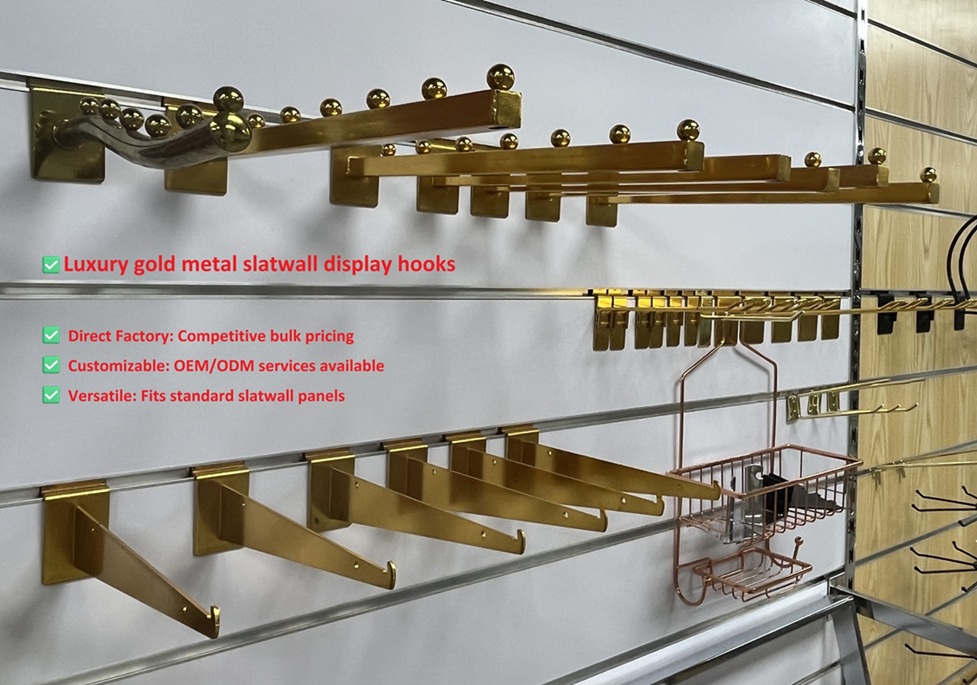
A brand may need the same merchandising platform for:
- Standard retail shelves
- Countertop displays
- Pegboard systems
- Slatwall installations
- Promotional endcaps
- Temporary event displays
- Regional retail programs
Instead of creating a completely new fixture for every campaign, an adjustable system can use a common structure with interchangeable components.
This approach may help brands achieve:
- Faster product updates
- Lower tooling requirements
- More consistent visual identity
- Simpler spare-parts management
- Greater compatibility across stores
The key is to design adjustability without making the fixture unstable or difficult to operate. A fixture should be flexible for the retailer but intuitive for store staff.
## Modular Retail Fixture Systems Create Long-Term Flexibility
A modular retail fixture system consists of compatible components that can be combined, removed, or reconfigured. Typical elements may include hooks, shelves, baskets, dividers, headers, sign holders, brackets, and base structures.
The main advantage is scalability.
A small retailer may begin with a compact display. As the product range grows, the same system can be expanded or rearranged. For national and international brands, modularity can simplify the creation of different display versions for different store sizes.
A one-piece display can be effective for a single campaign, but it may have limited value after the campaign ends. A modular display is usually designed for repeated use.
One-piece display characteristics:
- Simple installation for one specific application
- Strong visual impact for a fixed campaign
- Less adaptable after product or layout changes
- Greater risk of obsolescence
Modular system characteristics:
- Replaceable components
- Easier product updates
- Better reuse across locations
- More opportunities for customization
- Potentially simpler packaging and shipping
A modular solution is not automatically better in every situation. The most suitable option depends on order volume, campaign duration, store environment, product weight, and expected reuse.
## Waigaoqiao's OEM Approach: Designing From the Product Backward
A common mistake in fixture development is to select a standard hook first and attempt to make the product fit afterward. A stronger approach begins with the merchandise.
At Waigaoqiao, the product and retail environment should be considered before finalizing the fixture structure. Important design inputs include:
- Product weight
- Package dimensions
- Center of gravity
- Packaging material
- Hanging-hole size and position
- Required product quantity per hook
- Customer removal behavior
- Store installation method
- Target retail price
- Shipping and packaging requirements
This product-first approach helps avoid problems such as excessive hook depth, poor product visibility, insufficient clearance, or difficult replenishment.
A professional OEM fixture project can follow these steps:
1. Collect product and store information.
Provide drawings, product samples, dimensions, photographs, and installation requirements.
2. Define the merchandising objective.
Decide whether the priority is capacity, visibility, security, speed of replenishment, or premium presentation.
3. Develop the initial fixture concept.
Select suitable materials, finishes, dimensions, and modular components.
4. Review engineering details.
Check load-bearing areas, connection points, sharp edges, surface treatment, and packaging protection.
5. Produce a prototype or sample.
Test the fixture with actual products rather than empty packaging.
6. Conduct functional testing.
Evaluate stability, product removal, replenishment speed, installation, and repeated use.
7. Confirm production specifications.
Approve drawings, tolerances, finish requirements, packaging, inspection standards, and labeling.
8. Monitor mass production.
Use quality-control procedures to maintain consistency between samples and production units.
This process is particularly useful for overseas buyers who require a dependable supplier for repeat orders.
## Testing Anti-Slip and Adjustable Fixture Performance
A fixture should be assessed under conditions similar to real retail use. Waigaoqiao recommends that buyers and suppliers agree on test criteria before mass production.
Useful evaluation points include:
Test the fixture with the maximum intended product weight, not only the average weight. If the fixture will hold multiple units, test the complete loaded configuration.
Store employees may remove and replace products hundreds or thousands of times. Repeated-use testing can reveal loosened joints, coating wear, deformation, or component fatigue.
Check whether products slide, rotate, tilt, or fall when the fixture is loaded and unloaded. Testing should include different product orientations.
Confirm that the fixture can be installed correctly using the intended retail panel, shelf, pegboard, slatwall, or bracket system.
Inspect for:
- Sharp edges
- Incomplete welding
- Uneven plating or powder coating
- Peeling finishes
- Visible scratches
- Inconsistent color
- Poorly fitted components
The final test protocol should reflect the destination market and the relevant customer requirements. Retailers should also verify any applicable local safety, material, packaging, or environmental regulations.
## Material and Finish Choices Affect Retail Fixture Performance
Material selection influences strength, appearance, cost, and service life.
Common options include:
- Steel: Suitable for durable hooks, brackets, frames, and heavy-duty systems.
- Stainless steel: Useful where corrosion resistance and a premium appearance are priorities.
- Aluminum: Lightweight and suitable for selected display structures.
- Acrylic: Often used for transparent shelves, holders, and visual merchandising elements.
- ABS or other plastics: Useful for molded components, end caps, clips, and lightweight accessories.
- Wood or engineered panels: Suitable for warmer, lifestyle-oriented retail environments.
Finishing options may include powder coating, electroplating, anodizing, polishing, or custom color matching.
The correct finish should be selected according to store conditions, brand guidelines, expected handling, cleaning requirements, and target budget. A visually attractive finish is valuable, but it should not compromise durability or functional performance.
## Common Information Gaps in Retail Fixture Projects
Many fixture problems originate before production begins. Buyers may provide only a product photograph and a general request such as "make a display hook." That information is rarely sufficient for reliable engineering.
Before requesting a quotation, prepare:
- Product samples or accurate technical drawings
- Individual and packed product weights
- Required display quantity
- Mounting surface information
- Target hook length and spacing
- Preferred materials and finish
- Annual or initial order quantity
- Destination market
- Packaging and labeling requirements
- Expected testing standards
- Photos of the intended store environment
Better input usually leads to faster sampling, clearer quotations, and fewer revisions.
## Sustainability and Reuse in Modular Merchandising
Retail sustainability is increasingly connected to fixture lifespan and reuse. A display that can be updated instead of discarded may support a more efficient merchandising program.
Modular design can contribute by enabling:
- Component replacement instead of full-unit replacement
- Reuse across seasonal campaigns
- Reduced fixture obsolescence
- Simplified maintenance
- More efficient inventory management
Sustainability claims should be specific and evidence-based. Buyers should ask about material composition, recyclability, packaging materials, coating processes, and expected service life rather than using broad environmental language without verification.
## How to Select the Right OEM Retail Fixture Manufacturer
The lowest unit price is not always the lowest total cost. A dependable manufacturer should be evaluated across the entire project lifecycle.
Consider asking:
- Can the supplier manufacture custom anti-slip hooks?
- Does the factory support prototype development and engineering changes?
- Can it provide consistent finishes and dimensions?
- Does it understand overseas packaging and shipping requirements?
- Can it perform or coordinate load and functional testing?
- Are drawings, samples, and production specifications clearly controlled?
- Can the supplier support repeat orders and replacement components?
- Is communication clear during design approval and production?
For brand owners and wholesalers, a factory that combines engineering support, OEM flexibility, quality control, and export experience can reduce development risk.
## Frequently Asked Questions
Anti-slip retail hooks help keep hanging products in a more stable and organized position. They are useful for packaged goods, accessories, tools, electronics, and other merchandise displayed on pegboards, slatwalls, or retail panels.
Yes. Customization may include hook length, diameter, end stops, spacing, mounting style, surface finish, color, and packaging. Final feasibility depends on the product and required order quantity.
Yes. Modular systems are often suitable for seasonal or promotional programs because components can be rearranged, replaced, or reused for different products and store layouts.
Useful information includes product dimensions, weight, packaging details, display quantity, mounting method, preferred material, surface finish, order quantity, destination market, and any required testing or packaging specifications.
Buyers should request a production-representative sample and test it with the actual products. Important checks include load capacity, stability, product removal, repeated use, installation, finish quality, and packaging protection.
They may have a higher initial development cost because they require additional components or engineering. However, adjustability can provide better long-term value when the system is reused for multiple SKUs, campaigns, or store formats.
A suitable supplier should provide clear specifications, reliable quality control, accurate sampling, consistent production, export-ready packaging, responsive communication, and support for repeat orders.
## Conclusion: Build Displays That Perform Beyond the First Sale
Modern retail fixture design is moving beyond basic hooks. Anti-slip features improve product stability, adjustable components support changing assortments, and modular systems create long-term merchandising flexibility.
For overseas brands, wholesalers, and manufacturers, the most effective solution is not simply a low-cost metal hook. It is a well-engineered system that combines product compatibility, retail usability, visual consistency, durability, testing, and OEM support.
Waigaoqiao works with international customers to develop customized retail display fixtures for specific products, store environments, and merchandising objectives. Send us your product dimensions, display requirements, and target quantity to discuss an anti-slip, adjustable, or modular fixture solution for your next retail program.
## References
1. Google Search Central, "Creating helpful, reliable, people-first content." [https://developers.google.com/search/docs/fundamentals/creating-helpful-content](https://developers.google.com/search/docs/fundamentals/creating-helpful-content)
2. Google Search Central, "Search Quality Evaluator Guidelines." [https://developers.google.com/search/docs/fundamentals/creating-helpful-content](https://developers.google.com/search/docs/fundamentals/creating-helpful-content)
3. U.S. Consumer Product Safety Commission, "Business Guidance." [https://www.cpsc.gov/Business--Manufacturing/Business-Education](https://www.cpsc.gov/Business--Manufacturing/Business-Education)
4. International Organization for Standardization, "ISO 9001 Quality Management Systems." [https://www.iso.org/iso-9001-quality-management.html](https://www.iso.org/iso-9001-quality-management.html)
5. ASTM International, "Standards and Technical Information." [https://www.astm.org/](https://www.astm.org/)
6. U.S. Department of Energy, "Sustainable Materials Management." [https://www.energy.gov/femp/sustainable-materials-management](https://www.energy.gov/femp/sustainable-materials-management)
7. U.S. Environmental Protection Agency, "Sustainable Materials Management." [https://www.epa.gov/smm](https://www.epa.gov/smm)


