
Views: 170 Author: waigaoqiao Publish Time: 2026-09-07 Origin: Site
Content Menu
● Introduction: Why Retail Display Design Can Influence Returns
● The Business Problem: Customers Were Misunderstanding the Product
● Why Standard Hooks Were Not Enough for This Fashion Brand
● Waigaoqiao's Approach: Designing the Hook Around the Complete Display System
>> Step 1: Product and Packaging Analysis
>> Step 2: Display Environment Review
>> Step 3: Prototype Development
>> Step 4: Custom Geometry and Orientation Control
>> Step 5: Production and Quality Control
● The Custom Hook Design: Small Hardware, Measurable Retail Impact
>> Improved Product Visibility
>> More Consistent Brand Presentation
● How the Brand Measured the 30% Reduction in Returns
>> Recommended Measurement Framework
>> How to Use These Metrics in a Pilot Program
● New Expert Insight: Display Fixtures Are Part of the Product Information System
● New Expert Insight: The Total Cost of a Fixture Is More Important Than Unit Price
● New Expert Insight: Design for Retail Reality, Not Only for the Factory Sample
● What Other Fashion Brands Can Learn from This Case
>> Start With the Customer Problem
>> Treat Product and Fixture as One System
>> Use Prototypes Before Mass Production
>> Define Quality Requirements Early
● Frequently Asked Questions About Custom Retail Display Hooks
>> Can a custom retail display hook reduce product returns?
>> What products are suitable for custom garment hooks?
>> What materials are commonly used for retail display hooks?
>> How does Waigaoqiao support OEM retail fixture projects?
>> What information should buyers provide when requesting a quotation?
>> How long does custom hook development take?
>> Can custom hooks be branded?
● Conclusion: Better Retail Hardware Can Create Better Customer Experiences
Meta description: Discover how a European fashion brand reduced product returns by 30% after implementing Waigaoqiao's custom retail display hook design. Learn how fixture engineering, product presentation, packaging, and customer feedback can improve retail performance.
Suggested URL slug:
`/case-study-european-fashion-brand-custom-retail-display-hook-reduced-returns`
Primary keywords: custom retail display hooks, retail display fixtures manufacturer, fashion retail display solutions, custom garment hooks, reduce fashion product returns.
Secondary keywords: OEM retail display fixtures, retail merchandising hardware, custom metal hooks for apparel, point-of-sale display fixtures, retail fixture manufacturer in China.

A fashion product can be well-designed, correctly manufactured, and competitively priced—yet still generate unnecessary returns if shoppers cannot understand how it should be used, worn, or selected.
This was the challenge faced by a European fashion brand selling accessories and lightweight apparel through department stores, specialty retailers, and online channels. The brand noticed that some products were frequently returned because customers misunderstood the product's size, shape, orientation, or intended use after seeing it in-store.
The solution was not a new return policy or a discount campaign. It was a custom retail display hook designed around the product, packaging, shopper behavior, and merchandising environment.
Working with Waigaoqiao, a China-based manufacturer specializing in retail display fixtures and OEM merchandising hardware, the brand redesigned its product-hanging system. After a controlled rollout and performance review, the brand reported a 30% reduction in returns for the selected product range.
This case study explains how the project worked, why the hook design mattered, and what other fashion brands can learn when selecting a custom retail display fixtures manufacturer.
> Important note: The 30% result is presented as a client-reported outcome for the selected product range. It should not be interpreted as a guaranteed result for every product, market, or retail environment.
Suggested visual: Add a photograph showing the original hook design beside the customized hook. A side-by-side image can immediately communicate the difference in product orientation, spacing, and visibility.
---
The European brand's products were displayed using a standard hanging solution. The fixture was functional, but it was not optimized for the product's actual characteristics.
Several issues appeared during store visits and customer-service reviews:
- The product did not always face forward.
- Packaging partially covered key product details.
- Items overlapped when multiple units were placed together.
- The hanging angle changed depending on the display rail.
- The fixture did not visually communicate product size or application.
- Customers sometimes selected the wrong variation.
- Retail staff had to explain basic product differences repeatedly.
These problems created a gap between the brand's intended presentation and the customer's actual experience.
In a physical store, customers often make decisions quickly. They may have only a few seconds to understand:
1. What the product is.
2. How large it is.
3. Which variation they need.
4. How it should be used.
5. Whether the packaging and product quality meet expectations.
If the fixture causes the product to twist, fold, hide, or overlap, the customer may form an inaccurate impression. That can lead to a purchase that does not match expectations—and ultimately to a return.
Fit and sizing are recognized as major contributors to fashion returns. Industry research consistently identifies fit and sizing as important influences on conversion, customer satisfaction, and return behavior, although exact percentages vary by category, market, and research methodology. A display fixture cannot solve every fit-related problem, but it can improve product visibility and reduce presentation-related uncertainty.
---
Standard hooks are attractive because they are inexpensive, readily available, and easy to replace. However, they are usually designed for general use rather than for a particular product specification.
A standard hook may not account for:
- Product weight
- Packaging dimensions
- Center of gravity
- Display rail thickness
- Required viewing angle
- Security requirements
- Brand identity
- Retail staff workflow
- Store-level replenishment speed
For a high-volume fashion brand, these details matter. A small fixture problem repeated across hundreds or thousands of stores can create a significant operational and customer-experience issue.
The brand needed a solution that would:
- Keep each product facing the shopper.
- Reduce product overlap.
- Support consistent spacing.
- Make product differences easier to compare.
- Work with existing retail fixtures.
- Remain durable during repeated handling.
- Support efficient packing and shipping.
- Be scalable for OEM production.
This required more than selecting a hook from a catalogue. It required fixture engineering based on real retail conditions.
Suggested visual: Insert a close-up image or short video showing how a standard hook allows products to twist or overlap during customer handling.
---
Waigaoqiao began by reviewing the product, packaging, retail environment, and customer feedback together.
This is an important distinction. A hook should not be designed in isolation. Its performance depends on the interaction between:
- The hook
- The product
- The packaging
- The display rail
- The shelf or gondola
- The shopper
- The retail employee
The first stage focused on the product's physical dimensions and behavior.
Waigaoqiao reviewed:
- Product length and width.
- Packaging thickness.
- Hanging-hole position.
- Product weight.
- Material flexibility.
- Potential movement during handling.
- The way products were removed and returned to the rail.
The team also examined whether the existing hanging point caused the product to tilt or rotate. In some cases, changing the contact position by only a few millimeters can improve balance and front-facing visibility.
Packaging was also important. If the package is too flexible, too narrow, or poorly balanced, even a well-made hook may not hold the product correctly. For that reason, the hook and packaging should be evaluated as one display system.
The new hook needed to fit into the brand's current retail infrastructure. The team considered:
- Rail diameter.
- Hole-board compatibility.
- Available vertical space.
- Product density per linear meter.
- Customer reach height.
- Retail staff access.
- Compatibility with European store formats.
This prevented a common OEM problem: developing a fixture that works in a factory sample but performs poorly in real stores.
The review also considered how shoppers interact with merchandise. Customers may move several products aside, remove one item, or return it to a different position. A successful fixture must remain functional after repeated, uncontrolled handling.
Waigaoqiao produced prototype samples for physical testing. The prototypes were evaluated for:
- Load-bearing performance
- Product stability
- Ease of installation
- Ease of removal
- Visibility from different angles
- Resistance to deformation
- Compatibility with the client's packaging
- Appearance after repeated use
The prototype stage also made it possible to compare different wire diameters, hook lengths, bends, mounting methods, and surface finishes.
Prototype testing is one of the most valuable stages in custom retail fixture development. A drawing may appear correct, but physical testing reveals practical problems such as difficult loading, insufficient clearance, sharp edges, excessive movement, or unexpected packaging deformation.
The final hook incorporated a custom geometry intended to keep the product in a more consistent position.
The design focused on:
- A more stable hanging point.
- Better spacing between adjacent products.
- A front-facing product orientation.
- Reduced twisting on the rail.
- Easier product comparison.
- A cleaner overall visual presentation.
The goal was not to make the fixture visually complicated. The best retail hardware often appears simple because the engineering is hidden in the details.
After approval, Waigaoqiao moved the design into OEM production.
A robust production process for custom metal retail hooks should include:
- Incoming material inspection
- Wire or tube diameter verification
- Dimensional checks
- Bending-angle inspection
- Welding or joint inspection
- Surface-finish inspection
- Load testing
- Packaging inspection
- Random sampling before shipment
For international customers, packaging quality is also critical. A fixture that arrives scratched, bent, or poorly packed can create additional costs before it reaches the store.
Suggested visual: Add a factory image showing wire bending, welding, powder coating, inspection, or final packing. These images support the brand's first-hand manufacturing experience and strengthen E-E-A-T signals.
---
The project demonstrated that retail display hardware can influence more than appearance.
The new hook helped products remain more visible from the main shopping angle. Customers could see the front of the product more consistently without manually adjusting it.
Better visibility is especially important for products with visual differences that are difficult to communicate through text alone. Color, shape, texture, finish, and scale can all influence the purchasing decision.
When products hang at a similar height and orientation, shoppers can compare colors, sizes, and styles more easily.
This reduces the cognitive effort required to make a purchase. Clear comparison is particularly important when several similar product variants are displayed together.
The customized spacing reduced the extent to which neighboring products covered one another. This made labels, product features, and packaging information easier to read.
Reduced overlap also makes the display look more organized. A clean display can influence perceived product quality, especially in fashion, beauty, accessories, and lifestyle retail.
A consistent display helped the brand create a more unified presentation across different retail locations.
This is especially valuable for international brands, where store layouts and merchandising standards can vary significantly. A standardized hook can help maintain a consistent product-facing angle, spacing, and visual hierarchy.
Retail employees could install and remove products more quickly. A fixture that is easy to use supports better shelf maintenance and reduces the likelihood of incorrect product placement.
Improved staff usability can also reduce training requirements. When the correct installation position is intuitive, store teams are less likely to place products incorrectly.
---
A credible case study should distinguish between an observed result and a universal promise.
The brand compared return performance for the selected product range before and after the new hook design was introduced. The review considered:
- Return volume
- Return rate
- Product category
- Retail location
- Sales period
- Customer feedback
- Product-related complaints
- Display implementation
The reported result was a 30% reduction in returns for the participating product range.
However, fixture redesign was not treated as the only possible variable. A responsible analysis should also consider:
- Seasonal demand.
- Promotional campaigns.
- Product assortment changes.
- Store staff training.
- Pricing changes.
- Online and offline sales mix.
- Distribution changes.
- Changes in return-policy communication.
This is why pilot testing is essential. Brands should compare similar stores or product groups whenever possible.
A clear measurement framework helps the brand evaluate whether the custom retail display hook is improving both customer understanding and store operations.
- Return rate: Shows whether fewer customers are sending products back after purchase.
- Return reasons: Helps identify whether confusion about product presentation, size, or use is declining.
- Exchange rate: Indicates whether customers prefer selecting another product instead of requesting a refund.
- Conversion rate: Shows whether clearer product presentation is increasing purchase confidence.
- Sales per display meter: Measures how effectively the retail fixture uses available store space.
- Replenishment time: Reveals whether retail employees can restock and maintain the display efficiently.
- Damage rate: Helps determine whether the hook protects the product and packaging during handling.
- Customer-service questions: Shows whether shoppers are still experiencing uncertainty about product features or usage.
The most valuable insight often comes from analyzing specific return reasons, rather than reviewing the overall return percentage alone. A lower return rate is useful, but understanding why customers are returning fewer products provides stronger evidence for future merchandising decisions.
For brands evaluating a new custom hook design, the following process is recommended:
1. Select a representative product range.
Include products with similar packaging, weight, and customer profiles.
2. Record baseline performance.
Measure return rates, customer questions, replenishment time, and display-related complaints before changing the fixture.
3. Introduce the custom retail display hook.
Use the new fixture in selected stores while maintaining comparable locations with the original fixture when possible.
4. Collect feedback from retail employees.
Store teams can identify problems that may not appear in sales reports, such as difficult installation, product instability, or slow replenishment.
5. Review the results after a defined period.
Compare the pilot stores with the baseline data and examine whether the main return reasons have changed.
6. Adjust the design before full production.
Minor changes to hook length, spacing, finish, or mounting position can improve performance before mass production.
---
Many brands think of a retail fixture as a passive support component. In practice, it communicates information.
The fixture helps answer questions that customers may not ask directly:
- Is this product fragile?
- How should it be held?
- Which side is the front?
- Are these products different sizes or different styles?
- Is this item intended to be worn, attached, displayed, or used in a particular way?
- Is the product easy to remove and return?
This means a custom hook should be considered part of the product information system.
The fixture communicates through:
- Orientation
- Spacing
- Height
- Visibility
- Grouping
- Movement
- Accessibility
When these signals are clear, customers can make decisions with greater confidence. When they are inconsistent, shoppers may rely on assumptions that do not match the product's actual features.
This is particularly relevant for international brands. A well-designed fixture can support communication even when customers speak different languages or when product descriptions are brief.
---
When buyers compare OEM retail display fixtures, unit price is often the first consideration. However, the total cost of ownership can be more meaningful.
A low-cost hook may create hidden expenses through:
- Product damage.
- Packaging deformation.
- Higher replacement frequency.
- Slow store replenishment.
- Additional staff training.
- Inconsistent presentation.
- Customer-service requests.
- Unnecessary product returns.
A slightly more engineered fixture may have a higher initial cost but deliver better value over the complete retail lifecycle.
Before selecting a supplier, buyers should assess:
- Material quality
- Production consistency
- Load-bearing performance
- Surface durability
- Packaging protection
- Prototype support
- Communication speed
- Quality-control procedures
- Production capacity
- Export experience
This broader evaluation helps brands choose a manufacturer based on business impact rather than only on purchase price.
---
A fixture can pass a basic factory inspection and still fail in a busy store.
Retail environments involve:
- Repeated customer handling.
- Uncontrolled product movement.
- Crowded display rails.
- Different staff experience levels.
- Frequent cleaning.
- Restocking under time pressure.
- Variations in installation.
- Transportation and unpacking.
For this reason, the most useful testing process combines laboratory inspection with real-world simulation.
A practical retail-use test may include:
1. Loading the hook with the intended product weight.
2. Repeating product removal and replacement.
3. Moving the display rail or fixture.
4. Checking front-facing orientation.
5. Testing multiple products side by side.
6. Inspecting the hook after repeated handling.
7. Recording staff feedback.
8. Reviewing product and packaging condition.
This process gives the buyer a more realistic understanding of long-term performance.
---
The case provides several practical lessons for brands, wholesalers, and retail buyers.
Do not begin with the question, "Which hook is cheapest?" Begin with:
- What are customers misunderstanding?
- Which products are difficult to compare?
- Why are items becoming disorganized?
- What do store employees find difficult?
- Which return reasons may be related to presentation?
A clear problem definition leads to a more effective fixture design.
The product, packaging, hook, display rail, and signage should work together.
Changing only one component may not solve the problem if the other elements remain incompatible.
Prototype testing reduces the risk of expensive tooling changes, quality problems, and large-scale replacement.
It also allows the buyer to collect feedback from both shoppers and retail employees.
Before production, establish measurable requirements for:
- Dimensions.
- Material.
- Finish.
- Weight capacity.
- Tolerance.
- Packaging.
- Inspection.
- Delivery.
- Sample approval.
Clear requirements reduce misunderstandings between the brand and the factory.
A custom display fixture should be evaluated through more than appearance.
Track:
- Return reasons.
- Conversion.
- Product visibility.
- Customer questions.
- Replenishment time.
- Display damage.
- Store feedback.
These metrics help determine whether the solution is producing practical value.
---
It can help reduce returns related to product visibility, orientation, comparison, packaging, and customer misunderstanding. However, results depend on the product category, retail environment, product information, customer expectations, and implementation quality. A custom hook should be viewed as one part of a broader merchandising and customer-experience strategy.
Custom garment hooks can be used for apparel accessories, lightweight garments, fashion items, packaged clothing, scarves, belts, small bags, jewelry packaging, and other products that require hanging presentation. The appropriate design depends on product weight, packaging, hanging method, display rail, and required customer access.
Common materials include steel wire, stainless steel, aluminum, plastic, and combinations of metal and plastic components. Steel wire is often selected for strength and cost efficiency, while stainless steel may be preferred for corrosion resistance or a premium appearance. The material should be selected according to load, finish, environment, and budget.
A typical OEM project may include product review, design discussion, prototype development, sample approval, production, inspection, packaging, and shipment coordination. Buyers should provide product dimensions, drawings, photographs, packaging details, target quantity, finish requirements, and retail-environment information whenever available.
Useful information includes:
- Product photographs.
- Product dimensions.
- Product weight.
- Packaging drawings.
- Hanging-hole size and position.
- Display rail or panel specifications.
- Required material.
- Surface finish.
- Estimated order quantity.
- Target delivery schedule.
- Export destination.
- Required testing or inspection standards.
The more complete the information, the more accurately the manufacturer can recommend a design and estimate production costs.
The timeline depends on design complexity, prototype requirements, material availability, tooling, approval speed, order quantity, and surface treatment. A simple wire hook may move quickly through development, while a more complex fixture with multiple components or custom tooling may require additional time. The supplier should confirm the schedule after reviewing the technical requirements.
Many retail display hooks can be customized with finishes, colors, coatings, labels, packaging, or additional brand elements. The available options depend on the material, design, production method, and required order quantity.
---
The European fashion brand's reported 30% reduction in returns demonstrates how a carefully engineered fixture can contribute to a broader retail-performance strategy.
The custom hook did not replace product quality, accurate product information, or effective customer service. Instead, it supported these elements by making the product easier to see, compare, understand, and handle.
For fashion brands, wholesalers, and retailers, the main lesson is clear: retail display fixtures are not merely accessories for holding products. They are part of the customer-experience system.
A successful custom hook should:
- Present the product clearly.
- Maintain stable orientation.
- Reduce visual overlap.
- Support efficient replenishment.
- Match existing store infrastructure.
- Protect the product and packaging.
- Be suitable for consistent OEM production.
Brands considering a new retail fixture should begin with a practical pilot program. Review product behavior, customer feedback, store conditions, and return reasons before finalizing the design.
If your products twist, overlap, fall forward, or become difficult to understand on the retail floor, Waigaoqiao can help develop a custom solution.
Contact Waigaoqiao to discuss:
- Custom retail display hooks
- OEM retail display fixtures
- Custom metal hooks for apparel
- Product-specific merchandising hardware
- Prototype development
- Mass production and quality control
Share your product dimensions, packaging drawings, display requirements, target quantity, and preferred finish to receive a more accurate recommendation.
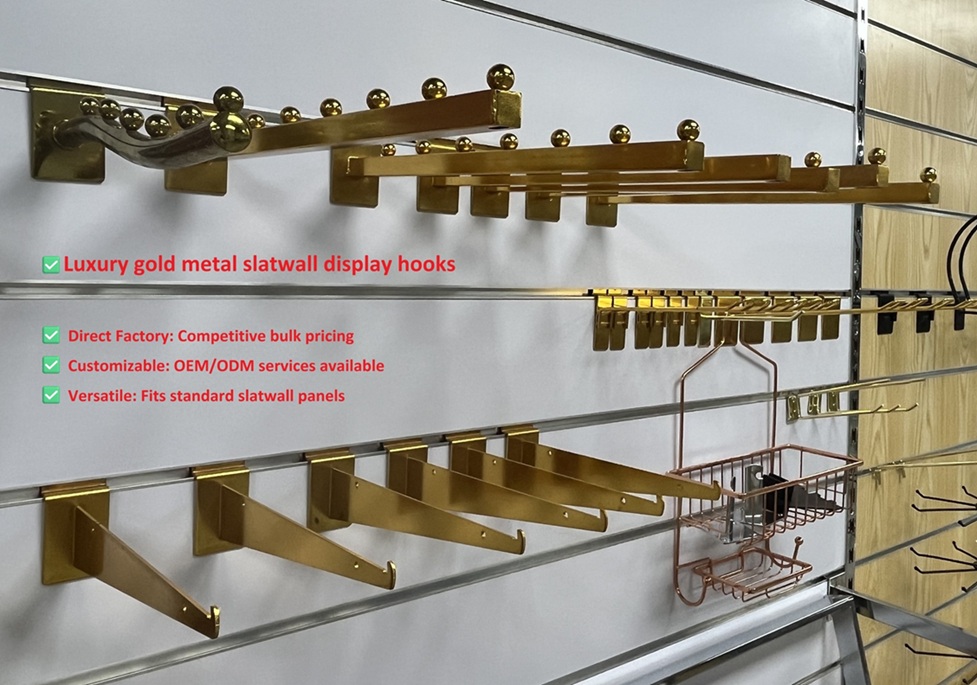
To strengthen the article's user experience and credibility, consider adding the following visual elements:
- Before-and-after product photographs: Show the original standard hook and the customized Waigaoqiao hook.
- Prototype development images: Show early samples, design adjustments, and testing.
- Factory production photographs: Include wire bending, welding, coating, inspection, and packing.
- Short product-use video: Demonstrate how customers remove and replace products on the new fixture.
- Display-performance graphic: Illustrate how improved spacing and orientation increase product visibility.
- Customer-journey diagram: Show the relationship between product presentation, customer understanding, purchase confidence, and returns.
All images should include descriptive alt text, such as:
- `custom retail display hook for European fashion brand`
- `OEM metal garment hook manufacturing`
- `retail display fixture prototype testing`
- `custom apparel display hook factory production`
---
1. Bold Metrics — "Fit and Sizing: The Core of Apparel Ecommerce Success in 2026."
https://blog.boldmetrics.com/fit-and-sizing-the-core-of-apparel-ecommerce-success-in-2026?hs_amp=true
2. Baymard Institute — "Cart Abandonment Rate Statistics."
https://baymard.com/lists/cart-abandonment-rate
3. National Retail Federation — Retail Returns Research and Industry Insights.
https://nrf.com/research
4. Google Search Central — Creating Helpful, Reliable, People-First Content.
https://developers.google.com/search/docs/fundamentals/creating-helpful-content
5. Google Search Central — E-E-A-T and Quality Content Guidance.
https://developers.google.com/search/docs/fundamentals/eeat
6. Waigaoqiao — Company Product Information and OEM Retail Display Fixture Capabilities.
Add the official Waigaoqiao company page, product catalogue, factory profile, or project documentation here.
> Editorial note: The reported 30% reduction in returns should be supported by internal client data, project records, or an approved testimonial before publication. If confidentiality restrictions apply, describe the result as a client-reported outcome and avoid presenting it as an independently audited statistic.


