
Views: 178 Author: waigaoqiao Publish Time: 2026-10-15 Origin: Site
Content Menu
● What Are Retail Display Hooks?
● Retail Display Brackets vs. Display Hooks: Key Differences
● When to Choose Slatwall Hooks
● When to Choose Pegboard Hooks
● When to Choose Display Brackets
● How to Select the Right Component: A Practical Checklist
● Load Testing and Quality Control for OEM Orders
● Custom Design and OEM Manufacturing
● Common Sourcing Mistakes to Avoid
>> 1. Are display hooks and display brackets interchangeable?
>> 2. Are slatwall hooks compatible with pegboard?
>> 3. How do I determine the load capacity of a retail display hook?
>> 4. What information should I provide for a custom OEM hook?
>> 5. When should I use a display bracket instead of a hook?
>> 6. Can hooks include label holders or custom finishes?
*An OEM buyer's guide to retail display hooks, slatwall hooks, pegboard hooks, display brackets, and product testing.*
Retail display hooks and display brackets both support merchandise, but they solve different merchandising problems. Retail display hooks are designed mainly for hanging packaged products on compatible panels; display brackets provide a support arm or ledge for products, shelves, signs, or other display components. The right choice depends on the fixture system, product packaging, expected load, and how often the display will be restocked or rearranged.
For overseas brands, wholesalers, and manufacturers, choosing a component is only part of the decision. Compatibility, repeatable quality, load testing, and OEM customization help ensure the finished fixture works consistently across stores. This guide explains the differences and outlines practical questions to ask when sourcing custom retail display hardware.
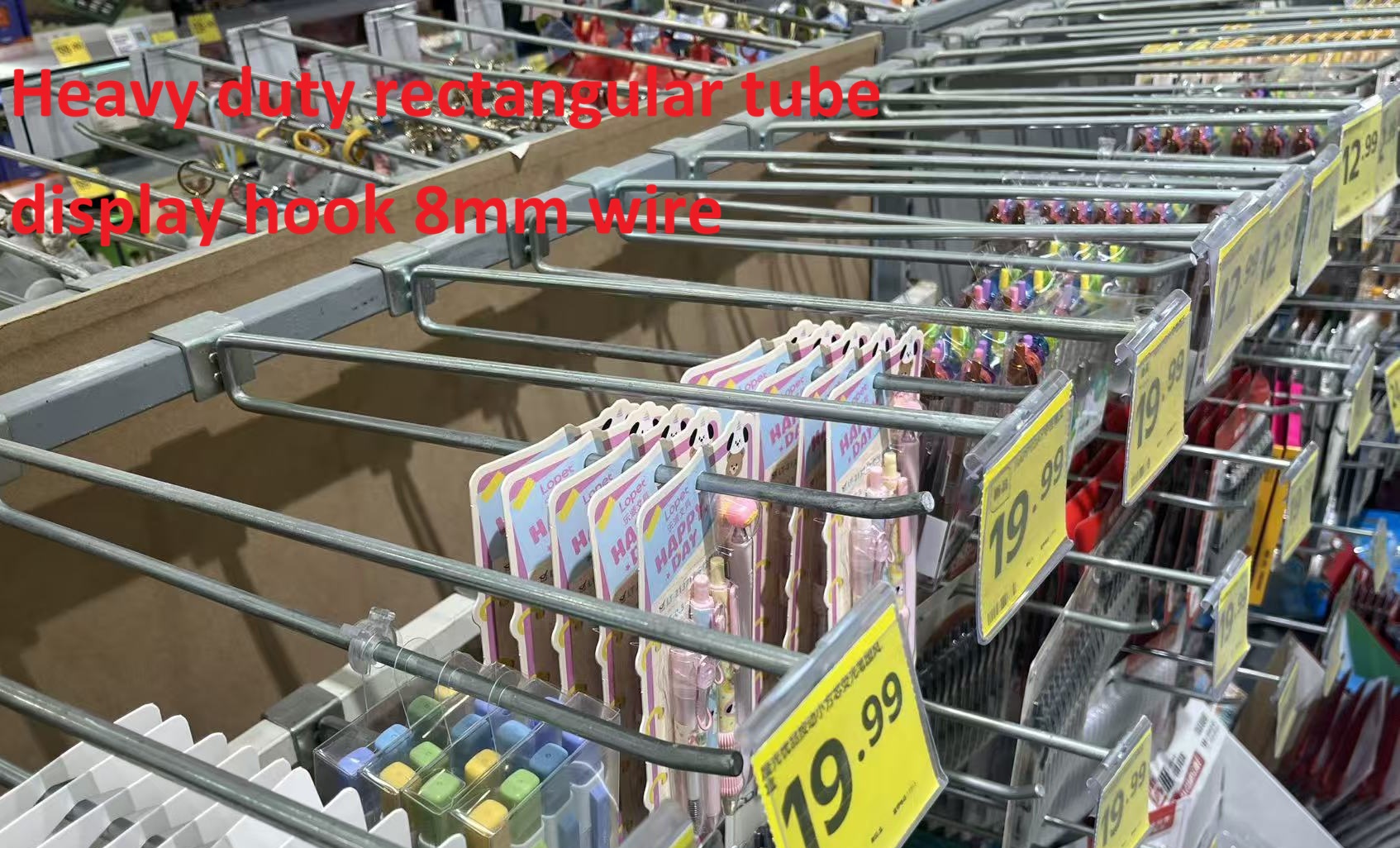
A retail display hook is a projecting fixture component that holds products with a hanging hole, tab, or blister-pack slot. It is commonly installed on pegboard, slatwall, or other compatible display panels. Hooks keep products visible, organized, and easy for shoppers to pick up.
Common retail display hook types include:
- Pegboard hooks: Designed for pegboard holes; available in different lengths, wire diameters, and configurations.
- Slatwall hooks: Attach to slatwall through a compatible bracket or insert.
- Single-prong and double-prong hooks: Used for different product widths, packaging styles, and display stability.
- Hooks with label holders: Combine product hanging with a location for price or product information.
- Plastic and metal hooks: Selected according to product weight, appearance, durability, and cost requirements.
Product specifications vary by design. For example, one supplier lists pegboard-compatible plastic hooks in lengths from 2 to 10 inches and specifies compatibility with 1-inch on-center pegboard with 0.25-inch holes. That illustrates why buyers should confirm dimensions and panel standards rather than relying on the product name alone. [clipstrip](https://www.clipstrip.com/pegboard-slatwall-hooks-for-retail-displays-white-abs-plastic-2-10)
Display brackets are support components that extend from a panel, upright, or fixture structure. A bracket may hold a shelf, sign, display arm, or other accessory. Unlike a simple hook, it can provide a broader or more rigid support point.
Brackets are often the better choice when merchandise cannot hang securely from a package hole, when a shelf-like support is needed, or when the display requires a more substantial arm. The exact design varies: a bracket may be made for slatwall, pegboard, a wire grid, or a custom fixture profile. Always verify the mounting interface and intended use with the supplier.
The main difference is how each component carries and presents the product.
- Display hooks suspend products from a projecting point or prong. They suit hang-sell merchandise such as accessories, small packaged goods, and hardware.
- Display brackets support a shelf, arm, sign, or product surface. They suit applications where the product needs a ledge, a wider base, or additional structural support.
- Hooks can make individual items easy to browse and replenish. Brackets can help create a defined display level or support a fixture component.
- Neither product has a universal load rating. Capacity depends on dimensions, material, attachment, panel condition, and how the load is applied.
A hook that fits a panel is not automatically appropriate for every product weight. Likewise, a bracket's capacity cannot be judged by appearance alone. Request specifications and test results for the complete assembly—not only the metal part.
Slatwall hooks are used with slatwall panels and are useful when a store needs flexible product placement across a wall or fixture. They can support hang-sell merchandise, and many designs can be repositioned as assortments change.
Before ordering, confirm:
1. The hook's slatwall attachment style and dimensions.
2. Whether the panel profile and thickness match the hook.
3. The product's package opening and required hook length.
4. Whether a label holder, end stop, or other retention feature is needed.
5. The target load and the supplier's test conditions.
A mismatch between the hook interface and panel can lead to poor fit or instability, even if the hook appears similar to an existing model.
Pegboard hooks are intended for pegboard systems. Buyers should specify hole diameter, hole spacing, panel thickness, and the hook's retaining or locking mechanism. A standard-looking peg hook may not fit every board.
Pegboard hooks are a practical choice for stores that use pegboard panels and need a wide range of product positions. They work best when the product has a suitable hanging feature and the hook length allows shoppers to remove items without damaging the packaging or disturbing neighboring products.
Choose display brackets when the merchandising task calls for support rather than suspension. Examples include supporting a shelf or display arm, creating a product ledge, or mounting a sign or accessory to a fixture.
A useful design review should consider the force applied at the end of the bracket. A longer arm can increase leverage on both the bracket and the panel connection. Buyers should therefore assess the whole setup—including mounting points, panel material, fasteners, and the position of the load—rather than evaluating the bracket in isolation.
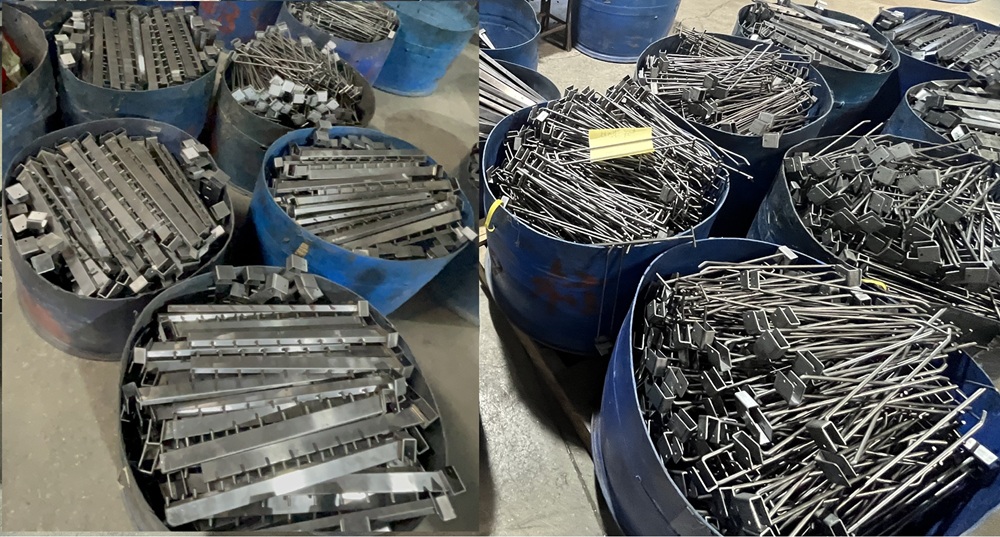
Use this sequence when specifying retail display hooks or brackets for a new project:
1. Define the merchandise. Record product weight, package dimensions, hanging-hole size, and how customers will remove items.
2. Identify the fixture system. Specify pegboard, slatwall, grid, or a custom fixture, including key dimensions and interface details.
3. Choose the display function. Select a hook for hanging merchandise, or a bracket for supporting a shelf, arm, sign, or other component.
4. Set operating requirements. State the expected load, restocking frequency, environment, finish, and service life.
5. Review fit and usability. Check insertion, removal, product spacing, label visibility, and whether the product stays in place during normal use.
6. Request samples and test criteria. Agree on how the component will be tested and what constitutes acceptance before mass production.
7. Approve a controlled specification. Document materials, dimensions, finish, tolerances, packaging, and inspection requirements.
This process helps convert a general sourcing request into a verifiable manufacturing specification.
For OEM buyers, a stated load capacity is meaningful only when the test method and assembly conditions are clear. Ask the supplier to document what was tested, how it was mounted, how the load was applied, and what failure or deformation limits were used.
A practical test plan may include:
- Dimensional inspection: Check critical lengths, wire diameter, mounting features, and fit against the approved drawing.
- Static load test: Apply the agreed load to the mounted component for a defined period.
- Functional check: Confirm that the hook or bracket remains secure and usable after loading.
- Finish inspection: Review coating consistency, visible defects, corrosion requirements, and color against an approved sample.
- Production checks: Define sampling frequency, batch identification, and corrective action for nonconforming parts.
One manufacturer lists wire hook options with wire diameters from 3 to 6 mm and lengths from 50 to 400 mm, and describes load capacity as dependent on length and diameter. This supports a key sourcing principle: capacity is design-specific, not a universal property of "display hooks." Buyers should request project-specific evidence rather than transferring a rating from a different size or setup. [szcers](https://www.szcers.com/heavy-duty-single-wire-hooks-for-retail-displays.html)
A capable retail display fixture OEM should be able to work from a drawing, sample, or functional brief. Customization may involve hook length, wire diameter, prong shape, mounting interface, label-holder position, finish, packaging, or a purpose-built bracket geometry.
To speed up development, provide:
- A drawing or reference sample, if available.
- The fixture panel or interface dimensions.
- Product and packaging measurements.
- Target load and intended usage.
- Finish, color, branding, and packaging requirements.
- Required inspection records or approval steps.
The OEM process should move from design review to prototype, sample approval, production control, and shipment inspection. Changes made after sample approval should be recorded and reapproved where they affect fit, finish, performance, or packaging.
- Ordering by product name alone: "Slatwall hook" or "pegboard hook" does not confirm exact compatibility.
- Comparing load ratings without test conditions: Different mounting systems and hook lengths produce different results.
- Ignoring package geometry: A hook may fit the panel but still be too short, too long, or poorly suited to the product opening.
- Changing material or finish without validation: A seemingly small change can affect appearance, durability, or fit.
- Skipping sample approval: A production drawing and a physical sample help prevent avoidable mismatch at scale.

No. Hooks hang products, while brackets generally support a shelf, arm, sign, or other component. Choose according to the display function and mounting system.
Not necessarily. The mounting interfaces differ. Confirm the panel type, dimensions, and attachment design before ordering.
Request a rating tied to the specific hook design and test setup. Confirm the mounting panel, load application, test duration, and acceptance criteria.
Share the fixture interface, product weight and dimensions, package opening, required length, finish, target quantity, and any test or inspection requirements.
Use a bracket when the product or fixture needs a supporting surface or arm rather than a point from which merchandise can hang.
Many designs can be customized, but availability depends on the product design and manufacturer. Confirm the requirements during drawing review and approve a sample before production.
Need retail display hooks, slatwall hooks, pegboard hooks, or custom display brackets for a new product line? Send your fixture dimensions, product details, target load, finish, and estimated order quantity. Waigaoqiao can review the requirements and discuss a suitable OEM design, sample approval, and quality-control plan.
- Clip Strip Corp., "Pegboard & Slatwall Hooks for Retail Displays." [Product details and compatibility information](https://www.clipstrip.com/pegboard-slatwall-hooks-for-retail-displays-white-abs-plastic-2-10). [clipstrip](https://www.clipstrip.com/pegboard-slatwall-hooks-for-retail-displays-white-abs-plastic-2-10)
- Suzhou CERS Commercial Equipment Co., "Heavy Duty Single Wire Hooks for Retail Displays." [Product dimensions and capacity information](https://www.szcers.com/heavy-duty-single-wire-hooks-for-retail-displays.html). [szcers](https://www.szcers.com/heavy-duty-single-wire-hooks-for-retail-displays.html)
- SI Retail, "Display Hooks." [Overview of display hook use and fixture applications](https://www.siretail.com/eshop/display-hooks). [siretail](https://www.siretail.com/eshop/display-hooks)
- Clip Strip Corp., "Easy Remove Pegboard and Slatwall Metal Hooks." [Example of removable hook design](https://www.clipstrip.com/easy-remove-pegboard-slatwall-hooks-metal-display-hooks-for-retail-fixtures-2-to-8-lengths). [clipstrip](https://www.clipstrip.com/easy-remove-pegboard-slatwall-hooks-metal-display-hooks-for-retail-fixtures-2-to-8-lengths)


