
Views: 225 Author: Waigaoqiao Co.,Ltd Publish Time: 2026-10-15 Origin: Waigaoqiao Co.,Ltd
Content Menu
● Why Creative Clothing Displays Matter
● 19 Creative Clothing Display Ideas
>> 1. Build a "Hero Look" at the Entrance
>> 3. Merchandise by Occasion, Not Category
>> 4. Create a Color-Blocked Feature Wall
>> 5. Highlight Texture With Open Wire Racks
>> 6. Add Depth With Angled Rails
>> 7. Use Mirrors as Display Tools
>> 8. Light Products in Layers
>> 9. Display New Arrivals at Eye Level
>> 10. Make Outfits Easy to Rebuild
>> 11. Rotate Displays Every Two to Four Weeks
>> 12. Use Negative Space Intentionally
>> 13. Cross-Merchandise Accessories
>> 14. Turn Fitting Rooms Into Conversion Zones
>> 15. Create a Seasonal Story Window
>> 16. Use Modular Fixtures for Flexibility
>> 17. Use Repetition to Create Impact
>> 18. Add Digital or Interactive Elements Carefully
>> 19. Design for Maintenance From Day One
● Fixture Selection: Matching Display Ideas to Store Needs
● A Practical 5-Step Display Planning Process
● Waigaoqiao's Manufacturing Perspective
● Common Display Mistakes to Avoid
>> 1. What are the best creative clothing display ideas for small stores?
>> 2. How often should clothing displays be changed?
>> 3. What is the most effective height for clothing displays?
>> 4. Are metal wire racks suitable for clothing stores?
>> 5. How do I choose a clothing display manufacturer?
>> 6. What is the difference between visual merchandising and clothing display?
● Ready to Create Displays That Sell?
Creative clothing display ideas are one of the most cost-effective ways to make an apparel brand memorable, guide shoppers through a store, and increase conversion. As a manufacturer of metal wire racks and clothing display systems since 2003, Waigaoqiao has helped overseas brands, wholesalers, and producers turn display concepts into durable, export-ready OEM fixtures. This guide shares practical display ideas, merchandising principles, and fixture-selection advice from a factory and retail-display perspective.
Visual merchandising is not decoration. It is a commercial system that uses layout, lighting, color, height, signage, and product grouping to influence how customers browse and buy. Effective apparel displays create a clear focal point, keep products visible and accessible, and make outfit combinations easy to understand.

A clothing display has three jobs:
- Attract attention from the street, entrance, or another department.
- Communicate value quickly: fit, quality, season, price positioning, or brand personality.
- Make purchasing easier by showing complete looks, sizes, colors, and complementary items.
Retail merchandising guidance consistently emphasizes clean organization, eye-level placement, clear focal points, good lighting, and regular refreshes. For apparel, the stakes are higher because customers often need to see texture, drape, scale, and styling before they feel confident buying.
From Waigaoqiao's experience supporting apparel brands and display buyers, the most successful stores do not use the most expensive fixtures. They use the right fixture in the right place, then repeat that visual language throughout the store.
Place one complete outfit on a mannequin or styled rack near the entrance. Include the jacket, top, bottom, shoes, and accessories in one cohesive story.
Why it works: Customers immediately understand the brand's aesthetic and see how individual pieces work together. Keep the full outfit within close range so shoppers can easily find the displayed items.
Fixture tip: Use a sturdy floor-standing garment rack with a clean silhouette so the clothing remains the visual focus.
Group three related garments or accessories at different heights: one tall, one medium, one low. This creates depth without looking cluttered.
Example: A long coat on a wall-mounted rail, a knit top folded on a riser, and a scarf or bag on a lower shelf.
Expert merchandising advice often recommends varied heights and layered placement rather than placing everything on one flat plane.
Instead of separating all shirts, pants, and dresses into separate zones, create themed displays such as:
- "Weekend Getaway"
- "Office to Evening"
- "Rainy Day Layers"
- "Festival Ready"
- "New Parent Essentials"
This approach helps shoppers imagine real-life use. Retail display guides specifically suggest merchandising by occasion—for example, combining outfits, luggage, and accessories in a "Weekend Getaway" collection.
Choose three to five colors and arrange garments in a deliberate gradient or repeating pattern. Color blocking is especially effective for basics, activewear, childrenswear, and seasonal collections.
Best practice: Keep the background simple. A busy wall finish competes with the clothing.
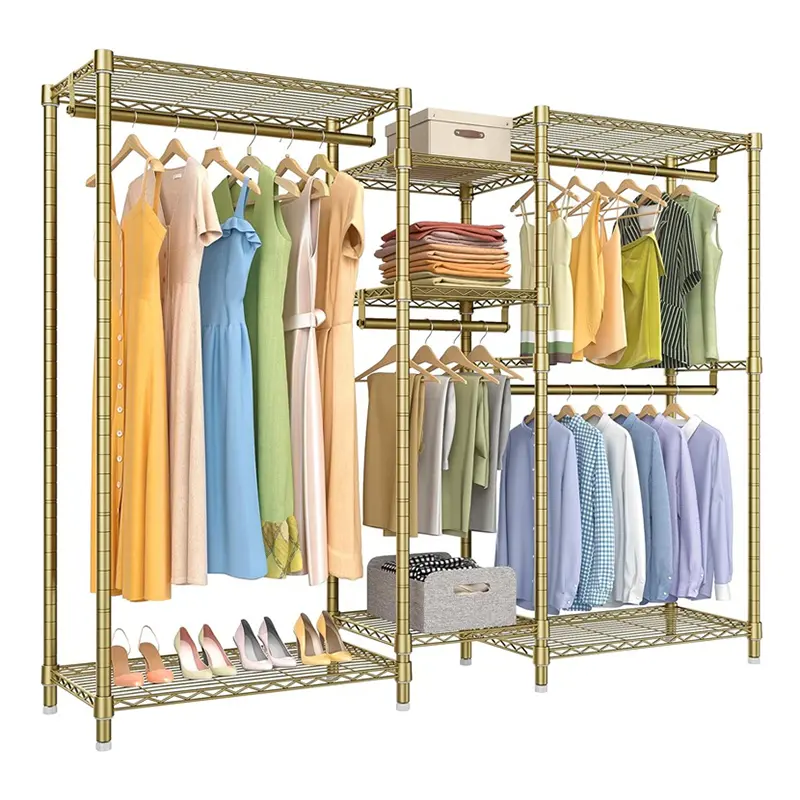
Metal wire racks are ideal when you want clothing to feel light, visible, and modern. Their open structure reduces visual bulk and works well in compact boutiques, pop-up shops, and minimalist fashion stores.
Waigaoqiao manufactures wire display racks and clothing display structures for brands that need stable geometry, clean finishes, and repeatable production quality. For apparel, wire fixtures are particularly useful for hanging rails, accessory hooks, folded-goods shelves, and modular wall systems.
Straight rows can look flat. Use angled hanging rails, staggered wall fixtures, or curved racks to create visual movement.
A display should not place every product on the same linear plane; varied angles and depth make the arrangement more interesting and more lifelike.
A large floor mirror can become a focal point, while smaller mirrors integrated into shelving reflect light and make a space feel larger.
Practical placement: Put mirrors beside fitting rooms, near denim walls, or at the end of a main aisle. They encourage try-ons and increase dwell time.
Use three lighting layers:
1. Ambient lighting for overall comfort.
2. Accent lighting for hero products and mannequins.
3. Backlighting or spotlights for silhouettes, signage, and premium pieces.
Lighting guidance for retail displays recommends spotlights for hero products, backlighting for silhouettes, and ambient light to create a welcoming atmosphere.
Eye-level space receives the most attention, making it a strong position for new arrivals, popular products, or higher-margin items.
Simple rule: Put what you most want customers to touch, try, or buy at eye level. Use lower shelves for bulk stock and upper rails for visual impact.
If a mannequin wears a jacket, shirt, trousers, and belt, ensure every item is nearby and clearly signed. Lightspeed's merchandising guidance notes that apparel retailers should keep mannequin outfit elements close to the display.
Add a small sign: "Shop the look — Aisle 3."
Regular changes keep the store fresh and give repeat customers a reason to look again. Retail sources recommend refreshing displays around seasonal themes, new arrivals, and promotions.
A practical schedule:
- Weekly: Replace worn items, restock, and adjust lighting.
- Every 2–4 weeks: Change mannequin outfits, signage, or color story.
- Every 5–7 weeks: Install a larger seasonal or campaign display.
Do not fill every rail. Leave breathing room around premium garments so customers can see the silhouette and fabric.
Minimalist floating shelves and curated arrangements with negative space can draw the eye upward and make smaller stores feel more open.
Place belts near denim, hats near outerwear, socks near sneakers, and jewelry near dresses. Cross-merchandising makes shopping easier and can increase basket size by putting complementary products together. [
Fixture idea: Use a multi-tier wire display with hanging garments above and accessory hooks or shelves below.
The fitting-room corridor is often the highest-intent area in the store. Add:
- A rail for "try-on" options.
- Hooks at different heights.
- A mirror with flattering lighting.
- A small table for accessories.
- A sign suggesting complete outfits.
A window display should communicate one clear idea: autumn layers, holiday gifting, resort wear, back-to-school, or a new collaboration.
Retail merchandising guidance recommends bold design, a store theme, clear signage, and displays that guide customer flow. Avoid trying to show too many products; one strong story outperforms a crowded window.
Modular display systems allow retailers to reconfigure rails, shelves, hooks, and signage as inventory changes. This is especially valuable for pop-ups, seasonal collections, and multi-brand stores.
Current retail design trends highlight modular components that can be repurposed across displays, along with interactive elements such as motion-activated lighting and layered graphics.
If you have several units of the same product, line them up. Repetition creates a stronger visual impression than scattering single pieces around the store.
This works especially well for:
- Denim walls
- T-shirt collections
- Activewear colorways
- Childrenswear sizing
- Accessories such as caps or bags
QR codes, short product videos, motion lighting, and interactive screens can work well—but only when they support the product story.
Interactive aesthetics such as motion-detected lighting, layered substrates, changing graphics, and mirrored surfaces are emerging retail design trends. Use them sparingly so technology enhances the clothing rather than distracting from it.
A beautiful display fails if it becomes messy. Choose fixtures that are easy to clean, restock, and adjust.
Ask these questions before purchasing:
- Can staff change signage without tools?
- Can rails hold the intended garment weight?
- Are hooks positioned for easy browsing?
- Does the finish resist scratches and fingerprints?
- Can the unit be flat-packed or disassembled for transport?
| Store type | Best creative display focus | Recommended fixtures |
|---|---|---|
| Boutique | Styled outfits, premium fabrics, storytelling | Minimal garment rails, mannequins, floating shelves, mirrors |
| Fast fashion | High turnover, clear sizing, volume | Modular wall systems, double rails, nesting tables, signage holders |
| Activewear | Energy, color, performance | Open wire racks, slatwall hooks, illuminated feature walls |
| Childrenswear | Playful themes, safety, accessibility | Lower rails, rounded edges, sturdy floor fixtures, themed props |
| Pop-up shop | Fast setup, flexibility, portability | Foldable racks, modular grids, lightweight wire displays |
| Department store | Brand identity within shared space | Custom branded fixtures, tiered tables, perimeter wall systems |
1. Define the commercial goal. Decide whether the display should launch a collection, clear inventory, promote a bundle, or increase average order value.
2. Choose one story. A display should communicate one idea clearly—such as "coastal layers" or "workday essentials."
3. Select the focal product. Build the display around one hero garment, then support it with complementary pieces.
4. Plan height, lighting, and traffic flow. Use tall elements at the back, medium elements in the middle, and smaller products in front.
5. Test and refresh. Track engagement, sales, and restocking difficulty. Change the display before it becomes invisible to regular customers.
Since 2003, Waigaoqiao has specialized in metal wire racks and clothing display fixtures, providing OEM services for overseas brands, wholesalers, and producers. In apparel retail, the fixture is not merely a holder for garments—it is part of the customer's first impression of quality.
A well-engineered clothing display should balance:
- Structural stability for heavy garments and daily retail use.
- Visual lightness so the clothing remains the hero.
- Finish durability across powder coating, plating, or custom surface treatments.
- Modularity for changing collections and store layouts.
- Export-ready packaging to reduce damage and simplify installation.
For brands sourcing display fixtures, the most valuable supplier is one that can translate a merchandising concept into a repeatable product: correct dimensions, safe load capacity, consistent finish, practical assembly, and reliable mass production.
- Overcrowding rails. Customers cannot see individual garments.
- Using inconsistent hangers. Mixed shapes and colors make the display look unplanned.
- Ignoring sightlines. Tall fixtures can block visibility across the store.
- Placing all products at one height. Flat arrangements reduce interest.
- Forgetting signage. Customers should immediately understand the offer, collection, or price message.
- Choosing style over function. A display must be easy to restock and maintain.
Use vertical space, mirrors, open wire racks, and one strong focal display. Avoid overcrowding; show fewer garments with clearer styling and use modular fixtures that can be rearranged as stock changes.
Make small adjustments weekly, refresh mannequins or color stories every two to four weeks, and complete larger seasonal installations every five to seven weeks.
Eye level is generally the most effective area for key products because it receives the most attention. Use higher rails for visual impact and lower areas for stock, accessories, or childrenswear.
Yes. Metal wire racks are strong, visually light, and adaptable. They work well for hanging rails, wall systems, accessory displays, folded-goods shelving, and modular retail layouts.
Look for proven OEM experience, structural engineering support, finish consistency, customization capability, export packaging, and the ability to produce from drawings, samples, or reference photos. Waigaoqiao has manufactured metal wire racks and clothing display products since 2003 for international brands and wholesalers.
Visual merchandising is the broader strategy: store layout, customer flow, product placement, lighting, signage, and seasonal planning. A clothing display is one execution of that strategy—such as a window, wall, table, mannequin, or rack arrangement.
If you are developing a new store concept, refreshing a seasonal collection, or sourcing custom apparel fixtures, Waigaoqiao can support your project from display concept to OEM production. Our team works with overseas brands, wholesalers, and producers to develop metal wire racks and clothing display systems that are stable, attractive, and ready for retail.
Contact Waigaoqiao to discuss your custom clothing display requirements, request a quotation, or send your drawings for an OEM manufacturing assessment.
- Lightspeed — Visual Merchandising: How to Make Standout Product Displays: [https://www.lightspeedhq.com/blog/visual-merchandising/]
- The Look Company — 2026 Retail Design Trends: [https://thelookcompany.com/blog/2026-retail-design-trends/]
- GoPazo — Importance of Visual Merchandising in Retail: [https://www.gopazo.com/blog/importance-of-visual-merchandising-in-retail]
- Creoate — 20 Visual Merchandising Tips & Best Practices for 2026: [https://www.creoate.com/blog/retail-merchandising-tips]
- George & Willy — 25+ Shop Display Ideas for 2026 to Boost Retail Sales: [https://www.georgeandwilly.com/blogs/blog/10-shop-display-ideas-to-boost-sales-and-foot-traffic]
- IWD — 5 Golden Rules of Visual Merchandising, According to Experts: [https://magazine.iwd.io/golden-rules-visual-merchandising-retail-experts]
- Magestore — Visual Merchandising: 8 Best Practices for Fashion Retailers: [https://www.magestore.com/blog/visual-fashion-merchandising/]
- Troc Global — Visual Merchandising Examples That Turn Browsers Into Buyers: [https://trocglobal.com/visual-merchandising-examples/]
Hot Tags: China, Global, OEM, private label, manufacturers, factory, suppliers, manufacturing company


