
Views: 177 Author: waigaoqiao Publish Time: 2026-09-16 Origin: Site
Content Menu
● Why Choose a Custom Retail Display Hooks Manufacturer?
● Retail Display Hooks for Different Store Systems
>> Custom Slatwall Hooks for Flexible Retail Displays
>> Custom Pegboard Hooks for Hardware and Packaged Goods
>> Custom Display Brackets for Shelves and Signage
● Custom Design Starts with a Technical Brief
>> Recommended OEM Development Process
● Materials and Finishes for Custom Retail Display Hooks
>> Steel Wire
>> Sheet Metal
● Quality Control and Load Testing
>> How to Define a Useful Load Test
● A Better Way to Compare OEM Manufacturers in China
● Common Problems in Retail Display Hook Sourcing
● Recommended Internal Linking and SEO Structure
● Request a Custom Quote from Waigaoqiao
>> 1. What types of retail display hooks can Waigaoqiao manufacture?
>> 2. Can Waigaoqiao produce hooks from customer drawings?
>> 3. How should buyers determine the required load capacity?
>> 4. What is the difference between slatwall hooks and pegboard hooks?
>> 5. Can retail display hooks be customized in color and finish?
>> 6. Does Waigaoqiao support prototype development?
>> 7. What information should be included in an RFQ?
Custom retail display hooks are essential components in modern merchandising. They help brands present products clearly, maximize wall space, simplify replenishment, and maintain a consistent in-store appearance. For global brands, wholesalers, and manufacturers, choosing the right retail display hooks manufacturer in China involves more than comparing unit prices. Buyers must evaluate design capability, system compatibility, load performance, finish quality, production consistency, packaging, and communication.
Waigaoqiao provides OEM retail display hook manufacturing for international customers seeking custom metal hooks, slatwall hooks, pegboard hooks, display brackets, and complete retail display fixture solutions. This guide explains how to plan, specify, test, and source custom retail display hooks for commercial applications.
Google recommends helpful, reliable, people-first content that demonstrates experience and expertise rather than repeating generic product descriptions. [google](https://developers.google.com/search/docs/fundamentals/creating-helpful-content) Product pages can also use accurate structured data to help Google understand product information, variants, offers, and related details. [google](https://developers.google.com/search/docs/appearance/structured-data/product) The recommendations below are therefore organized around real procurement decisions, not keyword repetition.
Standard hooks may be suitable for simple applications, but many retail projects require a more precise solution. Packaging dimensions, display-board compatibility, product weight, brand colors, and store layout can all affect the final design.
A custom retail display hook may help solve problems such as:
- Products sliding or rotating
- Insufficient load capacity
- Poor compatibility with slatwall or pegboard systems
- Inconsistent product facing
- Limited shelf or wall space
- Difficult staff replenishment
- Inconsistent finishes across different production batches
From an engineering perspective, the best hook is not necessarily the thickest or longest option. It is the hook that delivers the correct balance of strength, visibility, compatibility, cost, and manufacturing stability.
A professional OEM manufacturer should be able to discuss:
- Product weight and package dimensions
- Mounting-system compatibility
- Wire diameter or sheet thickness
- Hook projection and angle
- Load requirements
- Surface finish
- Packaging and export conditions
- Target quantity and production schedule
Before requesting a quotation, buyers should identify the display system. A slatwall hook, pegboard hook, and display bracket may look similar in a catalog, but each is designed for a different installation environment.
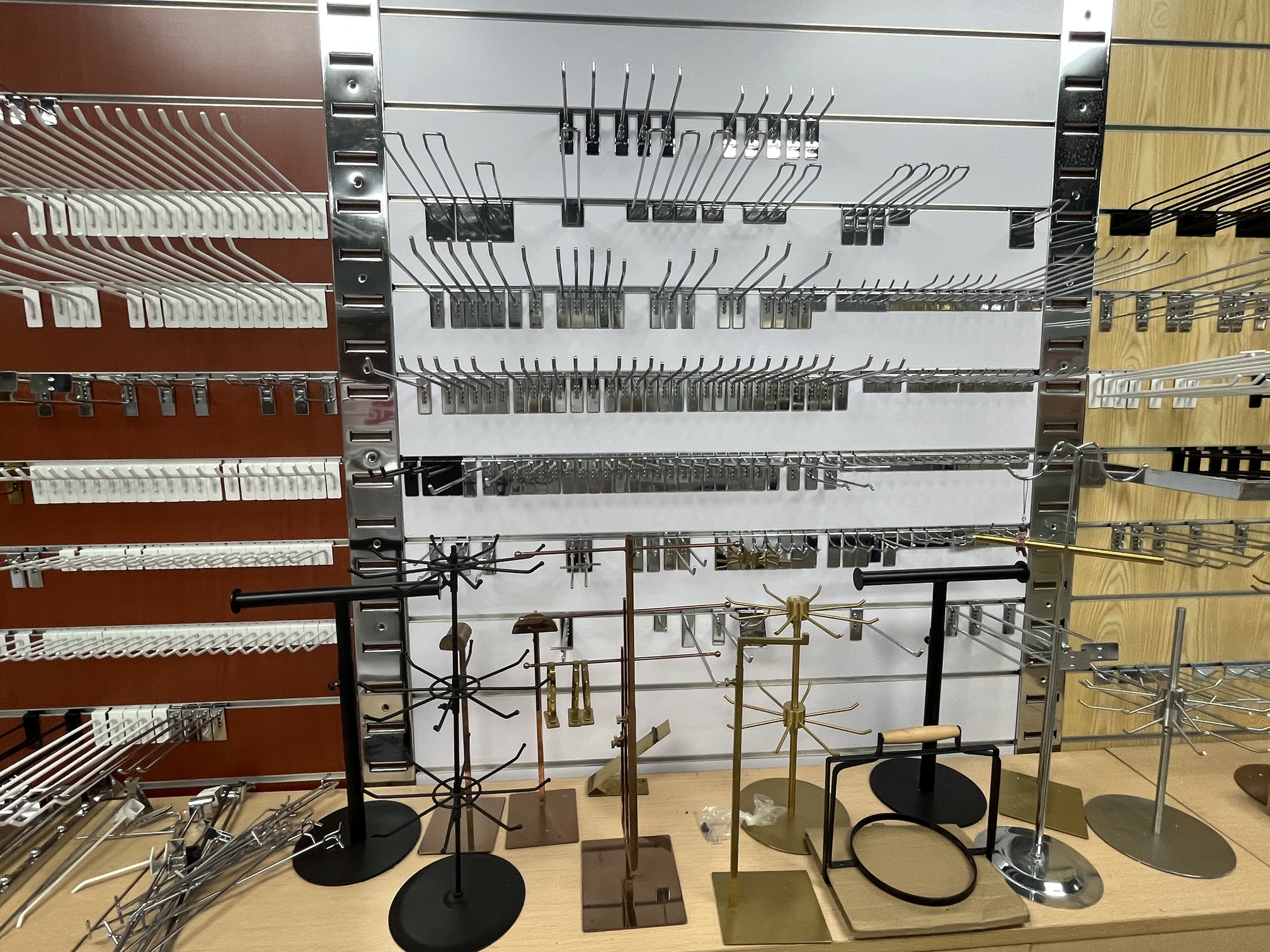
Slatwall hooks attach to panels with horizontal grooves. They are widely used in clothing stores, supermarkets, hardware shops, convenience stores, and specialty retail environments.
Waigaoqiao can develop custom slatwall display hooks based on requirements such as:
- Hook length
- Single or double product presentation
- Straight or angled geometry
- Locking or anti-slip features
- Price tag holder integration
- Chrome, zinc, powder-coated, or custom finishes
The correct slatwall hook length should be based on the product package, not simply on the available panel depth. An excessively long hook may reduce stability, increase bending stress, or interfere with adjacent merchandise.
When developing a custom slatwall hook, buyers should confirm:
1. The slatwall slot dimensions
2. The desired hook projection
3. The product weight per hook
4. The number of products displayed
5. The required spacing between products
6. Whether customers will frequently remove and replace items
Pegboard hooks are commonly used for tools, hardware, accessories, pet products, and small packaged merchandise. They fit perforated boards and are suitable for modular displays that require frequent product changes.
Important specifications include:
- Pegboard hole diameter
- Hook-wire diameter
- Hook length
- Mounting depth
- Product weight
- Need for a locking or retaining feature
- Compatibility with the backing board
Straight pegboard hooks are often suitable for lightweight products. For high-traffic retail stores, locking pegboard hooks or anti-slip designs may provide better product retention.
In my experience, product packaging is one of the most overlooked variables. Two products with the same weight may require different hooks if one has a centered hanging hole while the other has an offset hole. The product's center of gravity, packaging stiffness, and customer handling should all be considered during design.
Display brackets support shelves, signs, panels, and other retail fixture components. They are especially useful when a project requires more structural support than a conventional hook can provide.
Common custom display bracket applications include:
- Retail shelving
- Wall-mounted merchandising
- Point-of-purchase displays
- Signage support
- Promotional panels
- Product display platforms
- Custom store fixtures
A bracket's performance depends on its mounting method and load direction. A bracket supporting a load directly above its mounting plate may behave differently from one supporting a shelf that extends outward.
For that reason, buyers should define:
- Mounting-hole pattern
- Shelf depth
- Material thickness
- Applied load
- Load direction
- Required safety margin
- Surface finish
- Installation environment
A successful OEM project begins with clear information. Instead of asking only for "a custom retail hook," provide a technical brief containing the following details.
- Product name
- Product weight
- Package size
- Hanging-hole size and position
- Number of units per hook
- Desired product-facing direction
- Whether the product is flexible, rigid, boxed, or blister-packed
- Slatwall, pegboard, gridwall, or custom panel
- Panel thickness and hole or slot dimensions
- Required projection
- Available installation space
- Expected customer traffic
- Indoor or semi-outdoor use
- Estimated annual quantity
- Initial trial quantity
- Target price range
- Required sample date
- Target production date
- Export market
- Packaging and labeling requirements
1. Submit drawings, samples, or product photos.
2. Review the mounting system and load requirements.
3. Develop a preliminary design.
4. Produce a prototype or functional sample.
5. Test fit, stability, appearance, and replenishment speed.
6. Approve the final specification.
7. Begin tooling or production preparation.
8. Complete pre-production inspection.
9. Proceed with mass production and batch control.
A prototype is not merely a visual sample. It is a practical way to identify problems before tooling and bulk production costs increase.
Material selection should reflect product weight, store environment, design requirements, and cost targets.
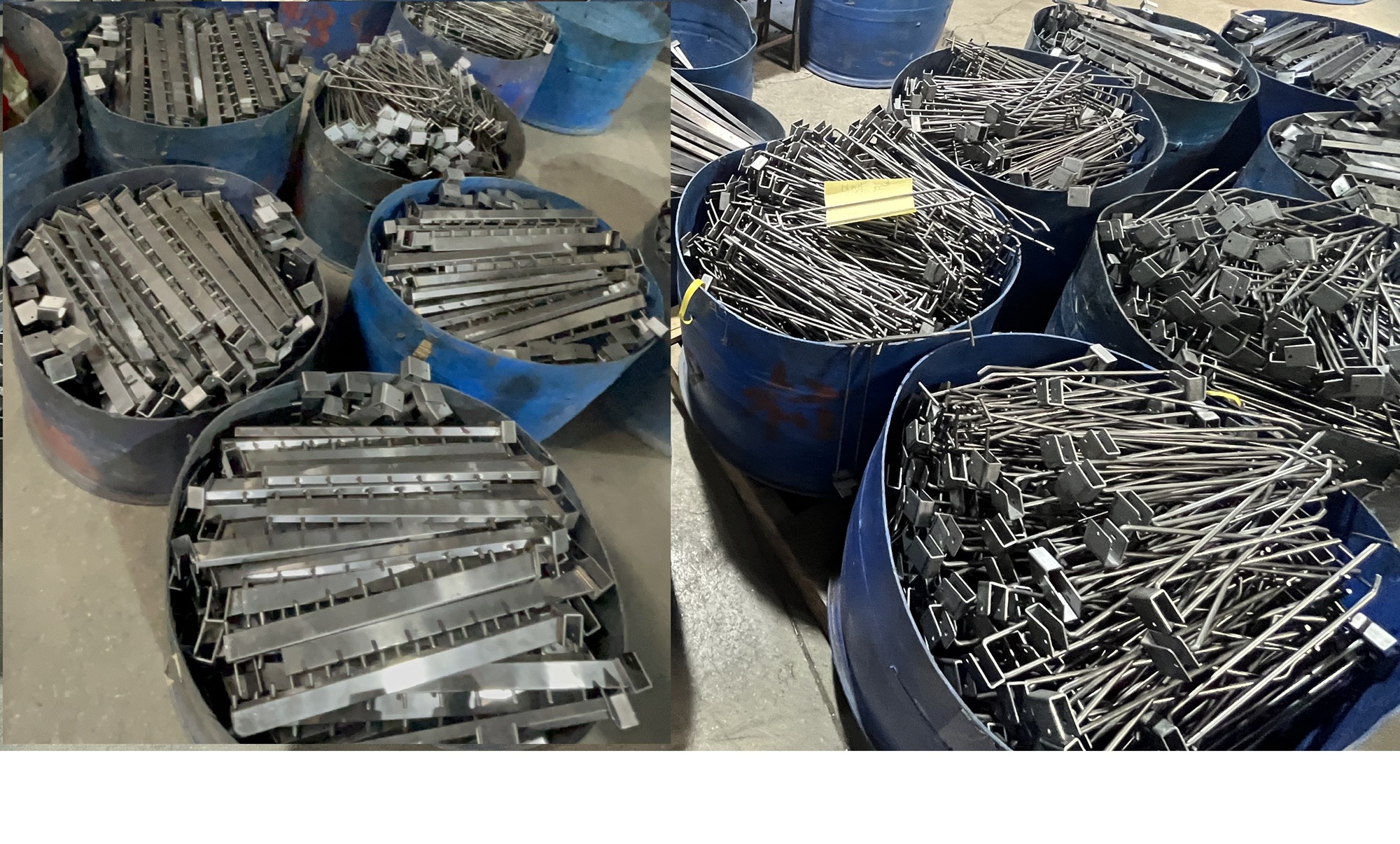
Steel wire is widely used for retail display hooks because it offers good formability, strength, and cost efficiency. It is suitable for slatwall hooks, pegboard hooks, gridwall hooks, and many custom hanging components.
Stainless steel may be selected when corrosion resistance, hygiene, or a premium appearance is important. It can be appropriate for demanding environments, although its material and processing cost may be higher.
Sheet metal is commonly used for display brackets, mounting plates, signage supports, label holders, and custom fixture components. Thickness and bend geometry should be evaluated together because both affect rigidity.
- Chrome plating: Bright metallic appearance for conventional retail fixtures
- Nickel plating: Smooth metallic finish with additional surface protection
- Powder coating: Flexible colors and good visual consistency
- Zinc plating: Practical corrosion protection for many indoor uses
- Custom colors: Useful for brand identity and coordinated store design
A finish should be evaluated for more than appearance. Buyers should also consider coating adhesion, edge coverage, scratch resistance, corrosion exposure, and packaging protection.
A reliable retail display hooks manufacturer should define how quality is controlled before mass production begins.
Quality control may include:
- Incoming material verification
- Wire diameter or sheet-thickness inspection
- Dimensional checks
- Bend-angle verification
- Mounting-fit inspection
- Welding inspection
- Surface-finish inspection
- Load or deformation testing
- Packaging and quantity verification
A load test should specify:
- The hook model
- The mounting system
- The applied load
- The loading position
- The test duration
- The acceptance criteria
- The permitted deformation
- Whether the test is destructive or non-destructive
The same weight can create very different stress depending on where it is placed. A load at the end of a long hook usually creates more bending stress than the same load placed close to the mounting point.
Buyers should distinguish between:
- Working load: The normal load expected during use
- Test load: The load applied to evaluate performance
- Failure load: The point at which the component no longer performs safely
These terms should not be used interchangeably.
The most useful quality question is often: What happens when a component fails inspection? A mature supplier should be able to explain how nonconforming products are identified, separated, analyzed, corrected, and rechecked.
Price is important, but it should not be the only comparison factor. A lower initial quotation may become more expensive if the project requires repeated revisions, inconsistent batches, or replacement shipments.
When comparing manufacturers, review:
- Engineering response quality
- Ability to interpret drawings
- Prototype capability
- Material and finish options
- Load-testing process
- Dimensional control
- Production capacity
- Packaging standards
- Export experience
- Communication and corrective-action speed
Ask each supplier the same technical questions. This creates a more reliable comparison than comparing prices from different specifications.
A strong RFQ should request:
1. Unit price at different quantities
2. Sample cost and sample lead time
3. Tooling or setup costs
4. Minimum order quantity
5. Production lead time
6. Material specification
7. Finish specification
8. Packaging method
9. Inspection procedure
10. Incoterms and shipping options
Possible causes include:
- Incorrect hook angle
- Smooth contact surface
- Poorly positioned package hole
- Excessive product movement
- Missing retaining feature
Possible solutions include an anti-slip tip, locking feature, revised angle, or better alignment between the hook and the package.
Possible causes include:
- Insufficient wire diameter
- Excessive hook projection
- Weak mounting geometry
- Incorrect material
- Unrealistic load assumptions
A solution may involve a reinforced base, shorter projection, thicker wire, stronger material, or redesigned bend geometry.
Possible causes include:
- Poor surface preparation
- Uneven coating thickness
- Inadequate curing
- Scratches during packaging
- Inconsistent color control
The approved sample should define the reference appearance. Production inspection should then compare bulk goods against that reference.
For strong search visibility and better user experience, the main page should link naturally to supporting content such as:
- Slatwall Hooks
- Pegboard Hooks
- Display Brackets
- OEM Manufacturing
- Retail Fixture Quality Control
- Load Testing for Display Hooks
- Custom Retail Fixture Design
- Retail Display Hooks for Supermarkets
- Retail Display Hooks for Hardware Stores
Use descriptive anchor text such as custom slatwall hooks, metal pegboard hooks, heavy-duty display brackets, and OEM retail fixture manufacturing. Avoid linking every page with the same generic phrase.
Google states that structured data helps its systems understand page content, while product markup can support product-related search appearances when the information is accurate and meets the relevant guidelines. [google](https://developers.google.com/search/docs/appearance/structured-data/product-snippet) For Waigaoqiao product pages, structured data should match visible information such as product name, variant, material, finish, availability, and commercial details.
If you are sourcing custom retail display hooks in China, send Waigaoqiao the following information:
- Product drawings or reference samples
- Display-system type
- Product dimensions and weight
- Required material and finish
- Estimated quantity
- Target market
- Packaging requirements
- Expected delivery schedule
Waigaoqiao can then review the project, identify manufacturing risks, recommend a suitable design, and prepare a quotation or prototype plan.
Request a custom quote today and send your drawings, product samples, or reference images for an OEM design review.
Waigaoqiao can develop custom retail display hooks, slatwall hooks, pegboard hooks, gridwall hooks, locking hooks, anti-slip hooks, hooks with price tag holders, and related display brackets.
Yes. Customers can provide CAD drawings, technical specifications, physical samples, product photos, or basic sketches. The manufacturer can review the design and recommend adjustments for performance and mass production.
Start with the product weight, number of units per hook, hook projection, mounting system, and expected customer handling. The final requirement should be confirmed through a defined load test using the actual mounting condition.
Slatwall hooks attach to horizontal panel grooves, while pegboard hooks attach through perforated holes. Their mounting structures are different, so they should not be treated as interchangeable without confirming compatibility.
Yes. Common options include chrome, nickel, zinc, black powder coating, white powder coating, and other custom colors, subject to material, quantity, and finishing-process requirements.
An OEM project can include design review, prototype development, sample approval, tooling preparation, mass production, inspection, and export packaging. The exact process depends on the product design and order requirements.
Include product dimensions, weight, drawings or photos, mounting system, material, finish, estimated quantity, packaging requirements, destination market, and target delivery date. More complete information usually leads to a more accurate quotation.
1. [Google Search Central: Creating Helpful, Reliable, People-First Content](https://developers.google.com/search/docs/fundamentals/creating-helpful-content). Google explains that helpful content should demonstrate clear value, reliability, and a people-first purpose. [google](https://developers.google.com/search/docs/fundamentals/creating-helpful-content)
2. [Google Search Central: Product Structured Data](https://developers.google.com/search/docs/appearance/structured-data/product). This documentation explains how product structured data can communicate product information to Google. [google](https://developers.google.com/search/docs/appearance/structured-data/product)
3. [Google Search Central: Product Snippet Structured Data](https://developers.google.com/search/docs/appearance/structured-data/product-snippet). This source describes content and implementation requirements for product snippets. [google](https://developers.google.com/search/docs/appearance/structured-data/product-snippet)
4. [Google Search Central: Structured Data Introduction](https://developers.google.com/search/docs/appearance/structured-data/intro-structured-data). This source explains how structured data helps search engines interpret page content. [google](https://developers.google.com/search/docs/appearance/structured-data/intro-structured-data)
5. [Google Search Central: Ecommerce Structured Data](https://developers.google.com/search/docs/specialty/ecommerce/include-structured-data-relevant-to-ecommerce). This source discusses product, organization, breadcrumb, and other structured data relevant to ecommerce websites. [google](https://developers.google.com/search/docs/specialty/ecommerce/include-structured-data-relevant-to-ecommerce)


