
Views: 178 Author: waigaoqiao Publish Time: 2026-10-05 Origin: Site
Content Menu
● What "Heavy-Duty" Should Mean for Retail Display Hooks
● Why High-Traffic Stores Need Application-Specific Hooks
● How to Specify Slatwall Hooks for Supermarkets
>> 1. Define the products and packaging
>> 2. Confirm the slatwall interface
>> 3. Choose a suitable hook shape and length
>> 4. Specify material and finish
>> 5. Set realistic load-testing expectations
● A Practical Sample-Validation Process
● Single-Wire, Double-Wire, and Rectangular-Tube Designs
● Slatwall Hooks, Pegboard Hooks, and Display Brackets
● Quality Control for OEM Retail Display Hooks
● OEM Manufacturing and Custom Design: What to Include in an RFQ
● Common Mistakes When Buying Heavy-Duty Slatwall Hooks
>> What makes a Slatwall Hook heavy-duty?
>> Are heavy-duty Slatwall Hooks suitable for every supermarket panel?
>> Are double-wire hooks stronger than single-wire hooks?
>> How should I test a hook before placing a bulk order?
>> Can I request custom hook lengths or finishes?
>> What is the difference between Slatwall Hooks and Pegboard Hooks?
>> What should I provide to get an OEM quote?
Heavy-duty Slatwall Hooks are an important part of Retail Display Hooks programs for supermarkets and busy stores. They help merchandise stay organized, visible, and accessible through frequent shopping and restocking. But "heavy-duty" is not a universal rating: the right hook depends on the product, package, hook design, slatwall panel, installation, and documented test conditions.
For retail brands, wholesalers, and manufacturers, this guide explains how to specify Slatwall Hooks for demanding environments, when to consider Pegboard Hooks or Display Brackets, and what to review with an OEM supplier for Custom Design, Quality Control, and Load Testing.

A hook should be selected for a defined application—not simply because it looks thick or is marketed as heavy-duty. Its performance depends on the complete support system:
- The hook material, wire or tube section, length, bends, and mounting end
- The product's weight, packaging, and position on the hook
- The slatwall profile, insert, panel condition, and support behind the panel
- How the hook is installed and how products are loaded or removed
A stronger hook cannot compensate for an incompatible panel or inadequate panel support. Buyers should therefore evaluate the hook together with the fixture it will be used on.
In supermarkets and other busy stores, display accessories may be handled repeatedly as shoppers browse and staff replenish merchandise. The design should support practical use without making products difficult to shop.
Consider these operating conditions:
- Frequent product handling: Shoppers may pull items forward or remove them at an angle.
- Regular replenishment: Staff need to restock quickly and consistently.
- Dense merchandising: Packages must remain visible without crowding or snagging.
- Mixed product ranges: Different SKUs may require different hook lengths or styles.
- Fixture variation: Existing slatwall panels and inserts may differ between stores or programs.
A useful specification starts with how the display will be used, not just the hook dimensions.
Record the largest package dimensions, total product weight, hang-hole position, and the intended number of units per hook. Packaging features—such as a wide header or offset hole—can affect how an item hangs.
For mixed assortments, identify the heaviest and largest items separately. A single hook configuration may not suit every product.
Provide the panel type, groove or insert details, and any known fixture specifications. If the display must fit an existing system, send a sample, drawing, or clear measurements to the supplier.
Do not assume that every slatwall accessory is interchangeable. Verify that the hook seats securely in the intended panel.
The hook arm must accommodate the product quantity and package depth while leaving enough room for shoppers to remove an item. Longer is not automatically better: excess projection can crowd aisleside presentation and increase leverage at the mount.
Compare physical samples with actual merchandise before approving a production design.
State the required material, wire or tube dimensions, finish, color, and appearance expectations. If the product will be used in a particular environment, describe that use so the supplier can recommend an appropriate finish for evaluation.
Avoid relying on vague terms such as "strong," "premium," or "heavy duty" without measurable specifications.
Ask for test results tied to the exact hook configuration and fixture being considered. A meaningful record should identify the sample, panel, loading position, test method, duration or repetitions, and pass/fail criteria.
There is no responsible way to infer a universal safe load from a product photo or the phrase "heavy-duty." Results for one hook, panel, or installation may not apply to another.
Before placing a large OEM order, validate the proposed hook using a small display mock-up:
1. Use actual products. Include the heaviest item, largest package, and any unusual hang-hole design.
2. Install on the intended panel. Check fit and retention; do not test only on an unrelated sample board.
3. Load the hook as planned. Use the expected quantity and arrangement of products.
4. Observe normal handling. Remove and replace merchandise repeatedly, including typical shopper movements.
5. Inspect the assembly. Look for loosening, visible bending, finish damage, or panel movement.
6. Document approval. Record the design, dimensions, materials, finish, panel interface, and agreed test conditions.
This is an application-validation process, not a substitute for a formal engineering assessment where one is required. Findings should be recorded for the specific configuration tested.
Different hook constructions can serve different merchandising needs:
- Single-wire hooks may suit products with a compatible hanging hole and stable package geometry.
- Double-wire hooks may help support packages at two points when their hang-hole layout matches the prongs.
- Rectangular-tube display hooks may be specified for particular fixture designs or merchandising requirements.
No construction is automatically stronger in every application. Compare the complete design, product fit, mounting interface, and test evidence. In particular, do not assume that two prongs mean twice the capacity.
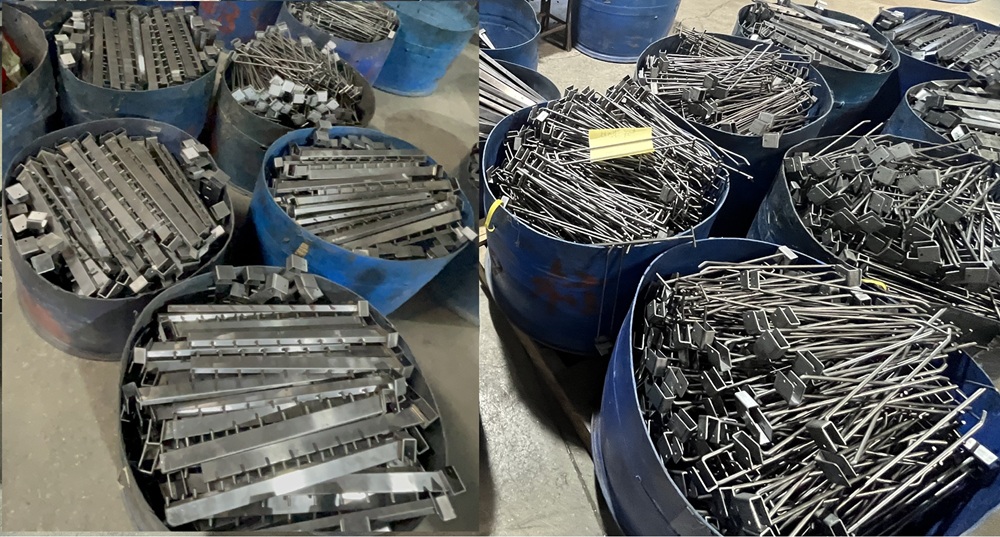
Retail display programs may combine several fixture accessories, but each has a different purpose and mounting interface.
- Slatwall Hooks: Designed to engage a slatwall panel or compatible insert.
- Pegboard Hooks: Designed for pegboard hole patterns; confirm hole diameter and spacing.
- Display Brackets: Provide support for shelves or other display components, depending on the system.
These products are not automatically interchangeable. Identify the actual panel or board system when requesting a quote or sample.
A practical Quality Control plan compares production against the approved drawing, reference sample, and agreed acceptance criteria. Depending on the product, inspection may include:
- Dimensions: Hook length, wire or tube dimensions, bends, and prong spacing
- Mounting fit: Engagement with the specified panel system
- Appearance: Finish consistency and visible surface condition
- Function: Product hanging, retention, and ease of removal
- Packaging: Protection from bending or finish damage during transport
- Test documentation: Records linked to the approved product and test setup
For repeat orders, keep an approved sample and document any changes to design, material, or finish. This gives the buyer and factory a clear reference for production checks.
A detailed request for quotation helps the supplier understand the application and reduce avoidable sample revisions. Include:
- Product type and intended fixture
- Dimensioned drawing or sample, including mounting interface
- Product and package dimensions, weight, and units per hook
- Requested material, wire or tube size, and finish
- Desired length, tip design, label holder, or branding
- Order quantity, packaging requirements, and target schedule
- Inspection criteria and any required application-specific testing
For Custom Design, share product photos alongside measurements. A reference image can communicate the style, but it cannot establish exact dimensions or compatibility.
Waigaoqiao is a China-based factory focused on retail display fixtures, providing OEM services for international brands, wholesalers, and manufacturers. We recommend aligning the application, approved sample, and quality criteria before moving into production.
- Choosing by appearance alone: A thick-looking hook does not establish a tested capacity.
- Ignoring the panel: Hook performance depends on the panel and its support.
- Using one design for every product: Packages vary in weight, depth, and hole layout.
- Ordering without a sample test: Fit and shopper access are difficult to confirm from a listing alone.
- Leaving requirements vague: "Heavy duty" should be replaced with dimensions, materials, use conditions, and test expectations.
- Treating test results as universal: Results apply only to the configuration and conditions documented.

"Heavy-duty" should refer to a defined design and application, not appearance alone. Confirm the hook construction, mounting interface, intended load, and test conditions.
No. Panel profiles, inserts, and support arrangements can differ. Confirm compatibility with the actual panel system before ordering.
Not necessarily. Capacity depends on the complete design and fixture, not just the number of wires. Request configuration-specific test information.
Use actual products on the intended panel, load the hook as planned, simulate routine product handling, inspect for changes, and document the approved configuration.
Yes, subject to the supplier's design and manufacturing capabilities. Include required dimensions, finish, application, and sample or drawing in your RFQ.
They are designed for different mounting interfaces. Confirm the panel or board type and its dimensions to select a compatible accessory.
Provide a drawing or sample, product dimensions and weight, fixture interface, material and finish preferences, order quantity, packaging needs, and testing or inspection requirements.
- [Store Supply Warehouse: 6 Inch Peg Hook for Slatwall](https://www.storesupply.com/6-inch-peg-hook-for-slatwall-45107.aspx) — Example of a retail slatwall hook product listing.
- [Testrite Aluminum: Aluminum Slatwall](https://www.testritealuminum.com/blogs/news/aluminum-slatwall) — Information on slatwall construction and the role of panel type in fixture performance.


