
Views: 220 Author: WAIGAOQIAO Publish Time: 2026-02-24 Origin: Site
Content Menu
● Introduction to Industrial Garment Infrastructure
● Pre-Installation Planning: Setting the Stage for Stability
>> Site Assessment and Floor Conditions
>> Required Tools for Industrial Assembly
● The Unpacking and Inventory Audit Process
>> Inspecting for Transit Damage
● Step-by-Step Installation: The Base Assembly
>> Assembling the Z-Base or H-Base
>> Installing Industrial Casters
● Erecting the Vertical Uprights and Supports
>> Securing the Uprights to the Base
>> Implementing Cross-Bracing and Reinforcements
● Installing the Horizontal Hanging Rails
>> Attaching Single vs. Double Rails
>> Extending the Hanging Space
● Calibration, Tightening, and Final Testing
>> The Final Torqueing Sequence
>> Leveling and Alignment Check
● Maintenance for Long-Term Performance
>> Routine Hardware Inspection
>> Caster and Rail Lubrication
● The OEM Advantage: Why WAIGAOQIAO Stands Differ
● Related Questions and Answers

In the demanding world of global logistics, high-volume retail, and textile manufacturing, the equipment used to store and move inventory is the silent partner of operational success. Industrial garment stands, unlike their residential counterparts, are engineered to withstand the rigors of heavy weight, constant movement, and high-traffic environments. For brand owners, wholesalers, and warehouse managers, the integrity of these stands begins not with the purchase, but with the installation.
As a leading China-based OEM manufacturer, WAIGAOQIAO understands that even the most robustly engineered garment stand can fail if not assembled with precision. A professional installation ensures that the stand maintains its structural equilibrium, maximizes its weight capacity, and provides a safe working environment for staff. This comprehensive guide serves as a strategic blueprint for the correct installation of heavy-duty industrial garment stands, covering everything from pre-assembly preparation to final structural calibration.
Before a single bolt is tightened, a successful installation requires a systematic approach to planning and site preparation. Industrial stands are often heavy and bulky; attempting to assemble them in a cramped or cluttered space is a recipe for error and injury.
The first step is to evaluate the floor surface where the garment stands will be assembled and utilized. Industrial stands are designed for level surfaces. If the warehouse or showroom floor has a significant incline or uneven textures, the stand's center of gravity will be compromised. Before beginning, ensure the assembly area is clean, dry, and free of debris that could interfere with caster movement or base alignment.
While many consumer-grade racks come with flimsy, disposable tools, professional industrial stands require high-quality equipment. To ensure a secure fit, you should have the following tools ready:
- Metric and Imperial Hex Key Sets: Most industrial bolts utilize internal hex drives for high-torque tightening.
- Adjustable Wrenches or Socket Sets: Essential for securing heavy-duty casters and base bolts.
- Rubber Mallet: Useful for seating uprights into bases without damaging the protective powder coating or chrome finish.
- Spirit Level: Critical for ensuring that the hanging rails are perfectly horizontal, which prevents garments from sliding to one end.
- Torque Wrench: For large-scale installations, a torque wrench ensures that every bolt is tightened to the manufacturer's specific Newton-meter requirement, preventing over-tightening or loosening over time.
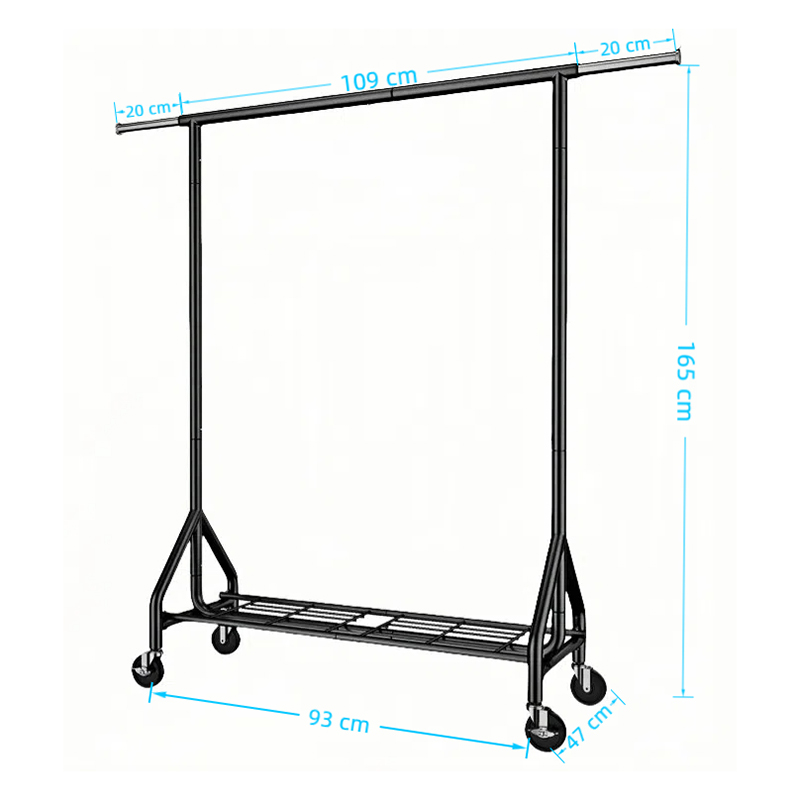
Efficiency in installation is born from organization. When the shipment arrives from the manufacturer, the first task is a comprehensive inventory audit. Industrial stands often feature specialized components that are not interchangeable.
Open all crates and lay out the components systematically. A standard industrial garment stand typically consists of:
- The Base Unit: This could be a Z-shaped nesting base, an H-shaped heavy-duty base, or a rectangular platform.
- Vertical Uprights: These are the primary load-bearing columns, often featuring height-adjustment holes or spring-loaded pins.
- Horizontal Hanging Rails: The top bars where the garments will reside.
- Structural Support Braces: Essential for maintaining the "squareness" of the unit.
- Caster Assemblies: Heavy-duty wheels, usually featuring a combination of locking and non-locking designs.
- Hardware Kit: An assortment of bolts, washers, locking nuts, and end caps.
During this phase, inspect each component for any signs of transit damage. Check for bent pipes, compromised welds, or scratched finishes. In the OEM world, even a small dent in a vertical upright can impede the telescoping mechanism or weaken the overall weight rating of the stand.
The base is the foundation of the stand's stability. If the base is not assembled correctly, the entire structure will be prone to swaying or tipping.
For the popular industrial Z-rack, the assembly begins by connecting the two diagonal base pieces to the central crossbar. It is vital to ensure that the "nesting" angle is oriented correctly according to the blueprint. Use the provided heavy-duty bolts and washers, but do not tighten them fully at this stage. Leaving the bolts slightly loose allows for minor adjustments as the rest of the structure is erected.
Casters are the most critical moving part of the stand. Most industrial designs feature two locking casters and two non-locking casters. For optimal control, the locking casters are usually installed on the same side or at opposite corners. Thread the caster stems into the base sockets. Use a wrench to tighten the locking nut against the base. Ensure that the caster can swivel 360 degrees freely. If the stand is designed for heavy loads (over 400 lbs), verify that the casters are industrial-grade polyurethane or rubber, which offer better traction and floor protection than hard plastic.
Once the base is stable and mobile, it is time to install the vertical architecture. This is where the stand gains its height and its primary structural strength.
Insert the vertical uprights into the base sockets. In high-quality OEM designs, these fit together with precision tolerances. If the fit is tight, use a rubber mallet to gently tap the upright into place. Align the bolt holes and insert the primary structural bolts. It is crucial to use the provided washers on both sides of the bolt to distribute the pressure evenly across the steel surface, preventing the metal from "crushing" or deforming under tension.
Many heavy-duty garment stands feature mid-level cross-bars or diagonal braces. These are not optional components; they are essential for preventing "racking"—the lateral swaying of the stand under load. Attach these braces according to the manufacturer's diagram, ensuring that they are perfectly symmetrical. This symmetry ensures that weight is distributed evenly across all four casters.
The hanging rail is the point of contact for the inventory. Its installation must be handled with care to ensure it can support the rated weight capacity without bowing.
For single-rail stands, the top bar is typically secured between the two vertical uprights using a "saddle" bracket or a direct bolt-through system. Ensure the rail is seated deeply into the brackets. If the stand is a double-rail model, the second rail is often installed at a lower height or parallel to the top rail. Careful measurement is required here to ensure that the space between the rails is sufficient for the length of the garments being stored.
Many industrial stands feature "pull-out" extensions on the ends of the top rail. These allow for an extra 12 to 24 inches of hanging space. When installing these, test the sliding mechanism to ensure it moves smoothly. Check that the safety stops are in place so the extensions cannot be pulled completely out of the main rail, which could lead to an accidental collapse.
The final phase of installation is the transition from a collection of parts to a unified piece of industrial equipment.
With the entire stand assembled, go back and tighten all bolts. Start from the base and work your way up. This sequence ensures that the stand "settles" into its natural center of gravity. Use a wrench to ensure every nut is tight, but be careful not to strip the threads. In a professional setting, the goal is a "snug" fit plus a quarter turn of the wrench.
Use your spirit level to check the top rail. If the rail is uneven, check the caster installation or the seating of the vertical uprights. A tilted rail causes hangers to cluster at one end, putting uneven stress on the frame and potentially causing the stand to tip.
Before putting the stand into full service, perform a static load test. Gradually add weight—ideally using sandbags or weighted test garments—up to the rated capacity. Observe the joints and the base for any signs of deflection or unusual noise. If the stand remains rigid and the casters move smoothly under load, the installation is successful.
An industrial garment stand is a long-term investment. Proper installation must be followed by a consistent maintenance schedule to ensure safety over years of use.
In high-traffic environments, vibrations from moving the stands across floors can cause bolts to loosen over time. Implement a monthly "safety check" where a staff member inspects the bolts on the base and casters. A loose caster is the leading cause of stand failure in warehouses.
To maintain smooth mobility, the ball bearings in the casters should be cleaned of dust and hair and lightly lubricated every six months. Similarly, if the stand features chrome rails, a light application of silicone spray can help hangers slide more easily, reducing friction and wear on the finish.
As an OEM specialist, WAIGAOQIAO designs stands with the installation process in mind. We prioritize "DFA" (Design for Assembly) principles, ensuring that our components are intuitive to put together while maintaining industrial-strength performance. By utilizing precision laser-cutting and robotic welding, we ensure that every bolt hole aligns perfectly and every joint is square. For our global partners, this means reduced assembly time and a significantly lower risk of installation error.
Whether you are outfitting a massive distribution center or a flagship retail store, following these installation protocols ensures that your industrial garment stands perform at their peak. A stand that is built correctly is a stand that lasts, providing the safety and reliability that your brand deserves.
---
Q1: Do I need two people to install an industrial garment stand?
While many smaller stands can be assembled by one person, it is highly recommended to have two people for industrial-grade stands. These units are made of heavy-gauge steel, and having one person hold the vertical uprights while the other secures the bolts ensures better alignment and prevents accidental injury or damage to the parts.
Q2: How do I know if I have overtightened the bolts during assembly?
Overtightening can be identified if the washers start to deform or "cup" into the metal tubing, or if the bolt head begins to sink into the pipe. If you feel the resistance suddenly drop while turning the wrench, you may have stripped the threads. Using a torque wrench is the best way to avoid this.
Q3: Can these stands be used without casters for permanent storage?
Yes, many industrial stands can be fitted with stationary leveling feet (glides) instead of casters. This is ideal for permanent warehouse storage where mobility is not required. However, the installation process remains the same—ensure the feet are leveled using a spirit level to maintain structural integrity.
Q4: What should I do if the stand wobbles after I have tightened all the bolts?
A wobble is usually caused by an uneven floor or a misaligned base. First, check the floor with a level. If the floor is flat, loosen the base bolts slightly, apply weight to the stand to let it "settle" on all four wheels, and then re-tighten the bolts in a diagonal pattern.
Q5: Are there specific safety protocols for installing wall-mounted industrial stands?
Absolutely. Wall-mounted pipe stands must be anchored directly into wall studs or solid masonry. Never rely on drywall anchors alone for industrial loads. Use a stud finder to locate the structural members of the wall and use heavy-duty lag bolts for a secure connection.


