
Views: 220 Author: WAIGAOQIAO Publish Time: 2026-03-24 Origin: Site
Content Menu
● The Strategic Importance of Space-Saving Infrastructure
● Engineering Standards for Kitchen-Grade Wire Shelving
>> High-Tensile Steel and Protective Coating Systems
>> Load Capacity and Precision Manufacturing
● Optimizing Storage Density through Modular Design
>> The Power of Vertical Adjustability
>> Mobility as a Spatial Asset
● Design for Safety, Hygiene, and Maintenance
>> Sanitation and Material Smoothness
>> Structural Stability in Narrow Footprints
● Collaborating with an OEM Manufacturer for Custom Success
>> Precision Fabrication and Custom Branding
>> Logistical Optimization through Knock-Down Engineering
● Sustainability and Long-Term Value
In the fast-paced world of professional food service and high-end residential kitchen design, every square centimeter of floor space holds immense value. Efficiency is not merely about having the right ingredients; it is about the ability to access, organize, and manage those ingredients with speed and precision. For retailers, wholesale distributors, and brand owners, the challenge lies in providing storage solutions that address these spatial constraints without compromising on durability or load-bearing capacity. Wire shelving has long been the industry standard for these requirements. As a specialist OEM manufacturer, WAIGAOQIAO recognizes that selecting the right space-saving wire shelving involves a deep understanding of structural engineering, material science, and modular design. This guide serves as a comprehensive resource for identifying and sourcing the most effective storage solutions to transform cramped kitchen environments into high-performance zones.

Modern kitchens are often characterized by tight footprints, irregular layouts, and a constant influx of bulk inventory. When storage is poorly planned, it results in disorganized surfaces, safety hazards, and significant operational bottlenecks. The introduction of strategically placed, narrow-profile wire shelving is a direct intervention that solves these issues.
The fundamental advantage of wire shelving lies in its combination of high structural rigidity and minimal visual weight. Unlike solid timber or laminate cabinetry, wire systems promote natural ventilation, which is crucial in kitchen environments where moisture, heat, and humidity are constant factors. Proper airflow not only preserves the quality of dry goods but also inhibits the growth of mold and bacteria. Furthermore, the open-grid design allows for rapid visual inventory checks, reducing the time staff spend searching for items and streamlining the restocking process.
A shelf is only as good as its construction. In a professional kitchen, equipment must endure daily abuse, heavy loads, and rigorous cleaning protocols.
The foundation of a reliable wire unit is high-tensile carbon steel. This material provides the strength necessary to hold bulk culinary items without structural deformation. However, steel is inherently susceptible to corrosion in the high-humidity, high-heat environment of a kitchen. Therefore, the choice of coating is paramount.
We emphasize the use of advanced epoxy resin coatings and industrial-grade chrome plating. Epoxy-coated wire shelving provides superior resistance to moisture and acidic food substances, making it the preferred choice for areas in direct proximity to prep sinks or within walk-in coolers. The coating must be applied through a high-precision electrostatic process to ensure a uniform layer that seals the steel from the environment. Any gap in the coating will eventually lead to oxidation, which compromises the integrity of the entire structure and creates a hygiene risk.
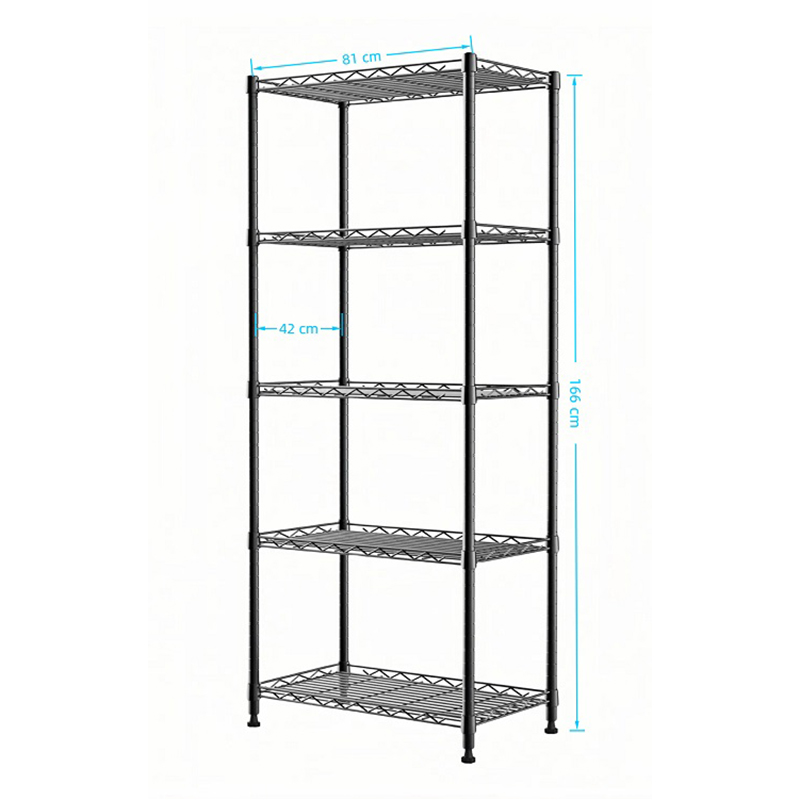
"Space-saving" should never be synonymous with "flimsy." A well-engineered narrow wire shelf can support hundreds of kilograms if the distribution of weight is managed through intelligent cross-bracing and high-tolerance post design. Buyers should look for systems that utilize split-sleeve locking mechanisms. This system allows for a rigid connection between the shelf corners and the support posts, ensuring the shelf remains perfectly level even under heavy stress. Furthermore, the wire gauge of the shelf deck must be thick enough to resist sagging, especially when items are concentrated in the center of the span.
The goal of a space-saving unit is to reclaim "dead air"—the unused vertical space between stacked items.
Fixed shelving is a major deterrent to efficiency. Kitchen inventories fluctuate significantly based on seasonal requirements, menu changes, and bulk purchasing schedules. A high-quality wire shelving system features support posts with clear, numbered, or indexed grooves at small vertical increments. This allows the end-user to reconfigure the height of each level in seconds without the need for specialized tools. By precisely matching the shelf height to the height of the stored inventory, users can add more tiers to the same footprint, effectively increasing storage capacity by 20 to 30 percent.
In compact kitchens, static storage can become a hindrance to movement. Installing heavy-duty, industrial swivel casters on wire units transforms them from static fixtures into mobile storage assets. This allows for the storage unit to be rolled out of the way for deep cleaning, or relocated to the point of use during heavy food preparation cycles. To ensure safety, these casters must be equipped with reliable locking brakes that are easily accessible, ensuring the unit remains securely positioned during operation.
In the food service industry, safety standards are non-negotiable. The equipment itself must be designed to contribute to a safe working environment.
The open-wire grid design is inherently superior to solid shelving for sanitation, as it prevents the accumulation of dust, spills, and debris. However, the manufacturing process must ensure that every weld point and wire edge is polished to a glass-smooth finish. Any burrs, sharp welding beads, or jagged edges are not only a hazard to staff but also a danger to the delicate packaging of dry goods. A high-quality finish also makes the shelving significantly easier to clean with standard sanitizing sprays or pressure washers.
As shelves become narrower to save space, their center of gravity naturally becomes higher relative to their base footprint. To mitigate the risk of tipping, professional-grade systems should be paired with wall-anchoring hardware where necessary. Additionally, the base of the shelving unit should be designed to accommodate adjustable leveling feet, which allow the rack to remain perfectly stable even on the uneven flooring typically found in busy back-of-house kitchen areas.
Standard storage units available in retail catalogs are rarely perfect for specialized professional or commercial needs. Many kitchen spaces require custom widths or depths to fit into narrow gaps that are otherwise wasted. Partnering with a dedicated OEM manufacturer like WAIGAOQIAO allows brand owners and wholesalers to overcome these limitations.
Custom fabrication allows for the creation of shelving units tailored precisely to the architectural requirements of a specific project. Whether the goal is to bridge a narrow gap between a refrigeration unit and a wall, or to create a multi-level spice storage rack that fits an exact cabinet dimension, precision manufacturing ensures a perfect fit. Furthermore, branding can be integrated into the design—through custom color schemes, specialized labeling, or unique modular accessories that facilitate the storage of specific kitchen equipment.
Efficient storage is not just about the final unit; it is about the logistics of getting it there. We specialize in "knock-down" designs, which means that all components—shelves, posts, and connectors—are engineered to be shipped flat-packed. This design philosophy significantly reduces freight volumes and shipping costs, making it far more economical for wholesalers and retailers to manage large inventory rollouts. Despite the flat-packed shipping format, the assembly process remains fast, intuitive, and secure, ensuring the rack achieves maximum stability once installed.
The most sustainable choice is a product that does not need frequent replacement. By selecting wire shelving units constructed from high-tensile steel and finished with industrial-grade protective coatings, businesses make an investment in durability that spans years, if not decades. This longevity directly contrasts with the wasteful cycle of purchasing cheap plastic or aluminum alternatives that degrade quickly. Furthermore, steel is one of the most recycled materials in the world, ensuring that even at the end of its life, the equipment contributes to a circular economy.
Selecting the right space-saving kitchen wire shelving requires a careful balance of structural integrity, modular flexibility, and material resilience. By prioritizing systems that offer high-tensile steel construction, corrosion-resistant coatings, and high-precision adjustable tiers, businesses can successfully reclaim wasted space and improve the efficiency of their kitchen operations. As an OEM manufacturer, WAIGAOQIAO is committed to engineering storage solutions that meet the rigorous demands of the culinary world while providing our partners with the logistical and customization advantages necessary to compete in a global market. Through thoughtful selection and strategic design, wire shelving becomes more than just storage; it becomes a key component of a high-performance kitchen infrastructure.
1. Why is wire shelving superior to solid surfaces for small kitchen storage?
Wire shelving promotes better airflow, which is critical for reducing humidity and maintaining the freshness of stored goods. Its open-grid design also improves visibility, making it easier to manage inventory, and it is significantly easier to sanitize as it does not trap dust or spills on the surface.
2. How does an epoxy coating differ from chrome plating?
While both provide a high-quality finish, epoxy-coated wire shelving is generally superior for high-moisture or acidic environments. It forms a thicker, more durable barrier that is highly resistant to water and chemical corrosion, making it ideal for walk-in coolers or near prep sinks.
3. What should I look for to ensure my narrow shelving remains stable?
Stability is a product of high-tensile steel construction and a secure connection between the shelves and the posts. Look for systems that use split-sleeve locking mechanisms to ensure the shelves don't shift. If the unit is very narrow and tall, it should also be compatible with wall-anchoring kits to prevent tipping.
4. Can vertical adjustability really increase storage capacity?
Absolutely. By using posts with frequent adjustment intervals, you can customize the height of each shelf to match the items you are storing exactly. This eliminates "dead air" space, allowing you to fit more shelves into the same vertical area, which can increase your total storage capacity by up to 30 percent.
5. Why are "knock-down" designs preferred by retailers and wholesalers?
Knock-down designs allow for the product to be flat-packed for transport. This dramatically lowers freight and storage costs, allowing for more efficient logistics. Despite being modular, these designs are engineered to be as robust and stable as fully welded units once assembled on-site.


