
Views: 170 Author: waigaoqiao Publish Time: 2026-08-10 Origin: Site
Content Menu
● Why Retail Display Fixtures Matter to Brand Performance
● Waigaoqiao's OEM Approach: From Design Intent to Finished Fixture
● Custom Retail Display Fixtures for Different Commercial Needs
● Material Selection: The Foundation of Fixture Durability
>> Acrylic, Glass, and Transparent Components
● How Quality Control Protects Global Retail Rollouts
● A Practical Five-Step Process for Ordering Custom Fixtures
>> 1. Share the Commercial Brief
>> 2. Confirm the Technical Requirements
>> 3. Review Drawings and Samples
>> 4. Approve Production Standards
>> 5. Control Shipment and Reorders
● New Strategic Consideration: Design for Flat-Pack Shipping and Installation
● New Strategic Consideration: Build a Fixture Specification That Scales
● How to Evaluate an OEM Retail Display Fixtures Supplier
● Recommended Visual Content for This Page
● Why Global Buyers Work with Waigaoqiao
● Start Your Custom Retail Fixture Project
● 1. What are OEM retail display fixtures?
● 2. Can Waigaoqiao manufacture fixtures from drawings or samples?
● 3. What materials are available for custom retail fixtures?
● 4. How can I reduce the risk of quality problems?
● 5. Are flat-pack retail display fixtures available?
● 6. What information should I include when requesting a quotation?
● 7. Can custom fixtures be designed for future product changes?
In global retail, a display fixture is more than a shelf, rack, or counter. It is a brand touchpoint, merchandising tool, and long-term investment. For international brands, wholesalers, and manufacturers, choosing the right OEM retail display fixtures supplier directly affects product visibility, store consistency, installation efficiency, and total cost of ownership.
Waigaoqiao is a China-based factory specializing in custom retail display fixtures and OEM manufacturing services. From concept development and material selection to production, quality control, and export packaging, we help global customers transform retail fixture designs into reliable, scalable products.
This article explains how a professional OEM partner can deliver precision, durability, and style while reducing the risks commonly associated with overseas sourcing.
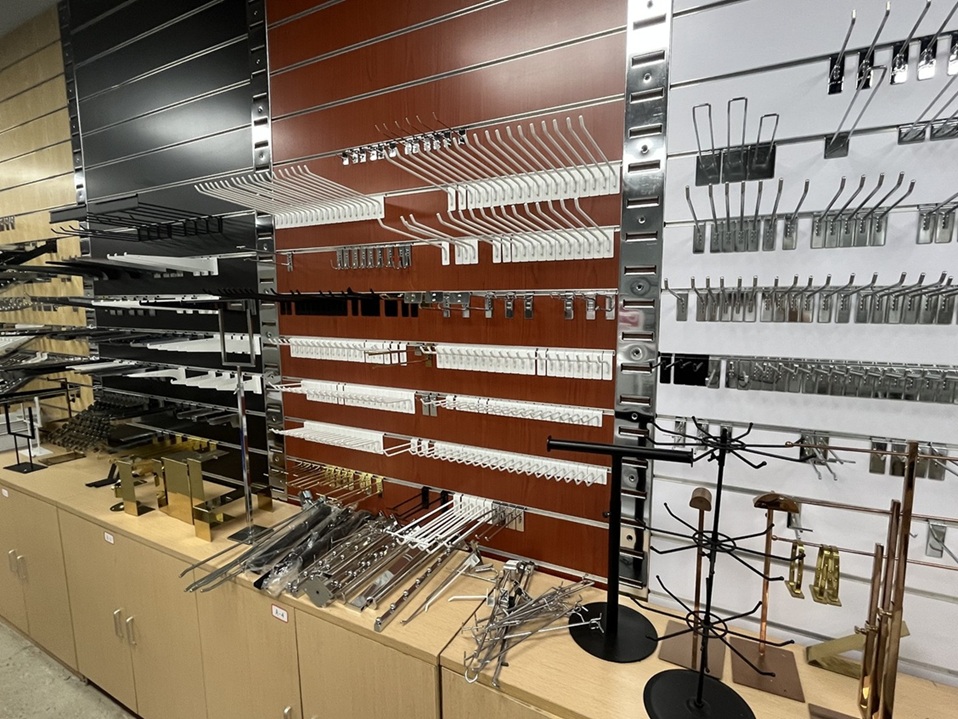
Retail fixtures influence how shoppers interact with products. A well-designed fixture can:
- Improve product visibility through organized presentation.
- Support consistent brand identity across stores and markets.
- Increase merchandising flexibility with adjustable shelves, hooks, or modular components.
- Reduce maintenance costs through durable materials and stable construction.
- Accelerate store rollouts with standardized, export-ready designs.
However, attractive design alone is not enough. A fixture must also withstand repeated handling, transportation, installation, cleaning, and daily commercial use.
From an OEM manufacturing perspective, the best result comes from balancing four factors:
| Requirement | What it means in practice |
| Precision | Accurate dimensions, clean joints, consistent finishes, and reliable assembly |
| Durability | Appropriate materials, load-bearing performance, corrosion resistance, and structural stability |
| Style | Colors, textures, shapes, and details aligned with the brand |
| Scalability | Repeatable quality and production capacity for multi-location rollouts |
Many sourcing problems begin when a design is attractive but not sufficiently engineered for production. Our role is to bridge the gap between a creative concept and a manufacturable retail fixture.
We typically review the following details before production:
1. Overall dimensions and installation environment
2. Product weight and expected load
3. Material and finish requirements
4. Assembly method and packaging limitations
5. Branding, graphics, and color specifications
6. Target quantity and delivery schedule
7. Applicable market or customer requirements
This early review helps identify potential problems such as unstable structures, difficult assembly, excessive packaging volume, or finishes that may not perform well in a high-traffic retail environment.
Retail fixtures vary substantially by product category, store format, and customer journey. A specialized OEM factory should be able to adapt its manufacturing process rather than forcing every project into the same template.
Waigaoqiao can support custom projects such as:
- Freestanding display units
- Wall-mounted shelving systems
- Retail gondolas and merchandising racks
- Countertop product displays
- Metal display stands
- Wood-and-metal hybrid fixtures
- Acrylic or transparent product holders
- Slatwall and gridwall accessories
- Point-of-purchase displays
- Promotional and seasonal fixtures
- Custom fixtures for cosmetics, electronics, apparel, food, and home products
The appropriate solution depends on more than appearance. For example, a cosmetics display may prioritize premium finishes and integrated lighting, while a warehouse-style retail rack may require higher load capacity and faster replenishment.
> Expert insight: The most cost-effective fixture is not necessarily the one with the lowest unit price. It is the one that performs reliably across its complete lifecycle, including shipping, installation, store use, maintenance, and replacement.
Material selection should be based on the fixture's function, environment, and expected lifespan.
Steel and aluminum are widely used where structural strength and long-term stability are important.
- Steel: Suitable for heavy-duty shelving, racks, frames, and display stands.
- Stainless steel: Useful for corrosion-prone or hygiene-sensitive environments.
- Aluminum: Lightweight and appropriate when transportation and installation weight are key concerns.
Typical metal finishes include powder coating, electroplating, brushed finishes, and custom color matching. The finish should be evaluated for scratch resistance, adhesion, consistency, and cleaning requirements.
MDF, plywood, particleboard, and solid wood can create a warmer or more premium retail atmosphere.
Important considerations include:
- Edge treatment
- Surface flatness
- Moisture resistance
- Veneer or laminate quality
- Fastener strength
- Repeated assembly performance
Wood is often combined with metal to achieve both visual warmth and structural performance.
Clear materials are useful for product visibility, risers, shelves, and protective elements. Their design must account for:
- Thickness and load
- Edge finishing
- Impact risk
- UV exposure
- Cleaning chemicals
- Packaging protection
A professional supplier should recommend the correct material thickness and support method instead of simply reproducing a visual drawing.
For international customers, a small dimensional or finish problem can become expensive when multiplied across hundreds of fixtures. Quality control should therefore occur throughout production, not only during final inspection.
A practical OEM quality process may include:
- Incoming material inspection
- First-article approval
- Welding and joint inspection
- Dimensional verification
- Surface-finish inspection
- Assembly and stability testing
- Load testing where applicable
- Packaging and drop-risk review
- Pre-shipment inspection
For repeat orders, approved samples, drawings, color references, and inspection standards should be retained as a controlled production reference. This is particularly important when the order is manufactured in multiple batches.
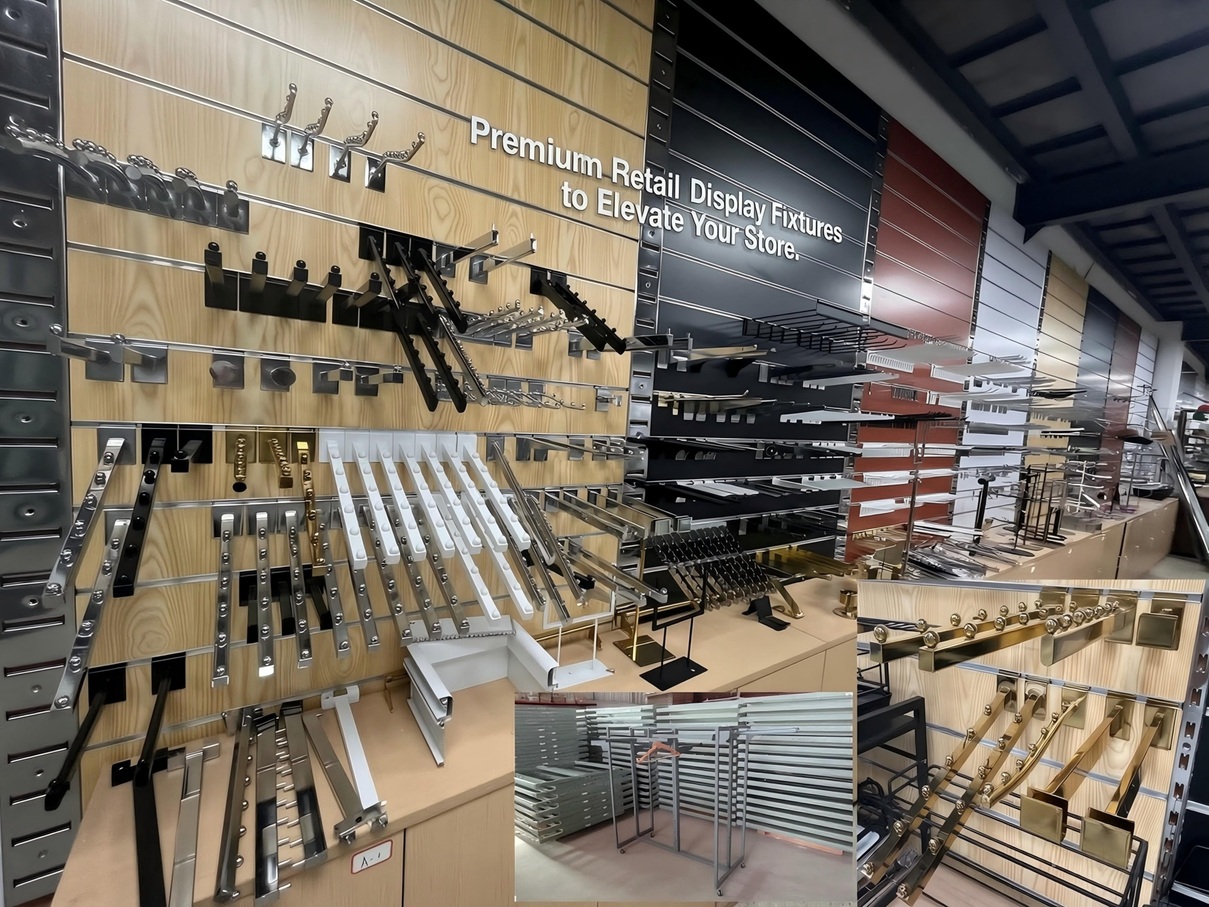
A clear process reduces misunderstandings and helps buyers compare suppliers more effectively.
Provide the product type, target market, store environment, estimated quantity, required delivery date, and preferred materials.
Define dimensions, load capacity, finish, branding, assembly method, lighting, accessories, and packaging expectations.
Before mass production, verify the first sample for appearance, stability, function, and installation. Changes are usually less expensive before tooling or batch production begins.
Confirm the final drawing, material list, color references, tolerances, inspection criteria, carton markings, and shipping documents.
Use protective packaging, clear labeling, and standardized component identification. For repeat programs, preserve the approved specifications to improve consistency.
One area often overlooked in fixture sourcing is design for logistics. A fixture may be structurally excellent but commercially inefficient if it requires oversized cartons, complex installation, or excessive protective material.
When appropriate, Waigaoqiao can help evaluate:
- Knock-down or flat-pack construction
- Tool-less or low-tool assembly
- Nested components
- Reusable hardware
- Protective corner solutions
- Carton size and container utilization
- Replacement of fragile parts
- Installation instructions and labeling
The objective is not simply to reduce carton volume. It is to create a better balance between shipping efficiency, installation time, product protection, and final appearance.
For large international rollouts, this evaluation can make a meaningful difference to labor planning and freight cost.
A strong retail fixture program should be designed for future variation. Instead of creating a completely new fixture for every product launch, brands can develop a core platform with interchangeable elements.
A scalable platform may include:
- Standard frame dimensions
- Adjustable shelves
- Replaceable graphics
- Interchangeable hooks and trays
- Modular headers
- Consistent hardware
- Multiple width or height options
This approach helps brands maintain visual consistency while adapting the fixture to different products, stores, and promotional campaigns.
Before selecting a factory, buyers should assess more than the quotation.
Ask potential suppliers:
- Can they manufacture from drawings, samples, or only existing models?
- Do they understand the intended retail environment?
- Can they provide prototypes before mass production?
- How do they control color and finish consistency?
- What testing is available for stability and load?
- How are fragile components packaged?
- Can they support repeat orders and design updates?
- Do they communicate clearly in English?
- Can they provide production photos, inspection records, and shipping documentation?
A supplier that answers these questions clearly is more likely to manage the project professionally.
Google's guidance on helpful content emphasizes first-hand experience, clear expertise, and information that genuinely helps users make decisions. [1](#call_1jDy7lv5G3i8tuMaykfJAJw4) For this reason, a trustworthy manufacturer should explain not only what it sells, but also how it engineers, verifies, packages, and supports the product.
To improve engagement and demonstrate first-hand capability, consider adding:
- Factory and production-line photographs
- Close-ups of welding, powder coating, edging, and assembly
- Before-and-after prototype images
- A fixture installation video
- A material comparison chart
- A packaging and container-loading diagram
- A case study showing a finished display in a retail environment
Use descriptive image filenames and alt text, such as "custom metal retail display fixture with powder-coated finish" rather than generic names like "IMG_001."
Waigaoqiao's value as an OEM partner is based on combining manufacturing execution with practical project support.
We help customers focus on:
- Accurate production based on approved specifications
- Material and finish coordination
- Custom design adaptation
- Prototype and sample review
- Quality consistency across repeat orders
- Export-oriented packaging
- Communication throughout the project
- Solutions that balance appearance and cost
Our goal is not to produce a fixture that looks good only in a rendering. The goal is to deliver a fixture that arrives safely, assembles efficiently, performs in a retail environment, and supports the customer's brand image over time.
If you are a retail brand, wholesaler, distributor, or manufacturer looking for custom retail display fixtures, send Waigaoqiao your drawings, reference images, product dimensions, estimated quantity, and target delivery date.
Our team can help assess:
- Manufacturability
- Material options
- Structural requirements
- Surface finishes
- Packaging design
- Prototype needs
- Production and shipping considerations
Contact Waigaoqiao today for an OEM retail display fixtures consultation and quotation.
## Frequently Asked Questions
OEM retail display fixtures are custom-made merchandising units produced according to a buyer's design, specifications, branding, materials, and functional requirements.
Yes. An OEM project can typically begin with technical drawings, sketches, product samples, reference photographs, or a combination of these materials.
Common options include steel, stainless steel, aluminum, MDF, plywood, solid wood, acrylic, glass, laminate, and combinations of these materials.
Provide complete specifications, approve a pre-production sample, define inspection criteria, and use controlled drawings and finish references for repeat orders.
Depending on the design, fixtures can be engineered for knock-down construction, smaller cartons, simplified assembly, and improved shipping efficiency.
Include dimensions, product weight, materials, finish, quantity, branding requirements, assembly needs, destination country, packaging expectations, and delivery schedule.
Yes. A modular fixture platform can include adjustable shelves, interchangeable accessories, replaceable graphics, and standardized frames.
## References
1. [Google Search Central: Creating helpful, reliable, people-first content](https://developers.google.com/search/docs/fundamentals/creating-helpful-content)
2. [Google Search Central: Product structured data](https://developers.google.com/search/docs/appearance/structured-data/product-snippet)
3. [Google Search Central: Review snippet structured data](https://developers.google.com/search/docs/appearance/structured-data/review-snippet)
4. [U.S. Department of Commerce: International Trade Administration](https://www.trade.gov/)
5. [United Nations Environment Programme: Sustainable Consumption and Production](https://www.unep.org/explore-topics/resource-efficiency/what-we-do/sustainable-consumption-and-production-policies)


