
Views: 170 Author: waigaoqiao Publish Time: 2026-08-18 Origin: Site
Content Menu
● 1. Confirm Material and Surface-Finish Expertise
● 2. Evaluate Load Capacity and Structural Design
● 3. Check Compatibility with Existing Store Hardware
● 4. Assess Customization and OEM Capability
● 5. Review Quality-Control Procedures
● 6. Compare Total Cost, Not Only Unit Price
● 7. Investigate Supply-Chain and Communication Reliability
● Stage 1: Prepare a Technical Brief
● Stage 2: Request Comparable Quotations
● Stage 3: Test Samples in a Realistic Environment
● Stage 4: Approve a Golden Sample
● Stage 5: Monitor the First Production Run
● Ignoring the product package
● Changing specifications after approval
● Making unverified sustainability claims
● Selecting a supplier without OEM experience
● 1. What does a display hook manufacturer produce?
● 2. How do I choose the correct hook length?
● 3. Can display hooks be customized with a brand color?
● 4. What information should I send for an OEM quotation?
● 5. How can I test display hook quality?
● 6. Are metal display hooks recyclable?
● 7. What is the difference between OEM and standard display hooks?
Choosing the right display hook manufacturer is not simply a matter of comparing unit prices. For brands, wholesalers, and manufacturers purchasing retail display fixtures, the real decision involves product compatibility, load capacity, visual consistency, customization, quality control, packaging, and supply reliability.
A well-designed display hook can improve product visibility, support organized merchandising, and make replenishment easier for store staff. A poorly specified hook can create sagging displays, damaged packaging, inconsistent brand presentation, and unnecessary replacement costs.
As a China-based OEM factory specializing in retail display fixtures, Waigaoqiao works with international brands, wholesalers, and manufacturers to develop practical, scalable, and brand-specific display solutions. This guide explains how to evaluate a display hook supplier and avoid the most common sourcing mistakes.
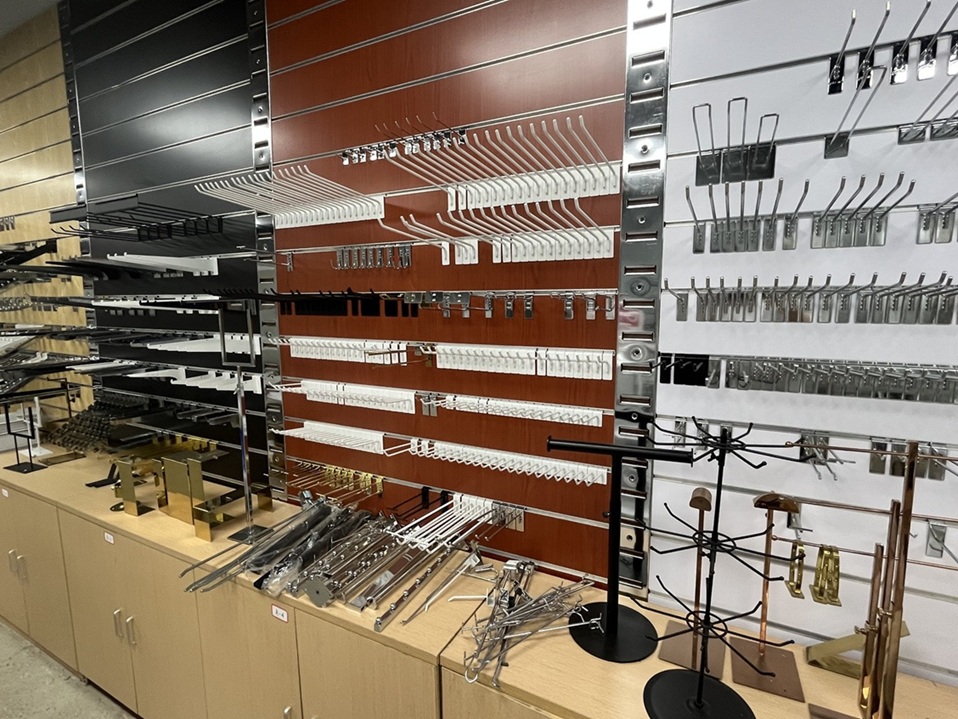
- Hero image: A branded retail display using metal hooks in a supermarket, hardware store, or specialty shop.
- Technical diagram: Hook length, wire diameter, mounting type, load rating, and end-cap options.
- Short product video: A close-up demonstration of installation, loading, product removal, and replenishment.
## Why the Display Hook Manufacturer Matters to Visual Merchandising
Retail display hooks are functional components, but they also influence how shoppers perceive a product category.
The right hook helps create:
- Consistent product spacing
- Clear front-facing presentation
- Efficient use of vertical wall space
- Faster inventory replenishment
- Better product accessibility
- A cleaner and more premium appearance
Retail displays increasingly need to combine physical presentation with digital and sustainability considerations. Industry commentary for 2025 highlights the growing role of consistent graphics, QR codes, sustainable materials, and displays that act as visual "beacons" in stores. [smurfitwestrock](https://www.smurfitwestrock.com/blog/the-top-retail-industry-trends-of-2025)
This means a display hook should not be evaluated in isolation. It should work as part of the complete merchandising system, including the backboard, packaging, shelf layout, signage, and brand identity.
## The Main Types of Retail Display Hooks
Before contacting a manufacturer, define where and how the hook will be used.
| Display hook type | Typical application | Main advantage |
|---|---|---|
| Single-prong hook | Small packaged goods, accessories, tools | Simple and cost-effective |
| Double-prong hook | Heavier or wider packaging | Improved stability |
| Pegboard hook | Standard pegboard retail systems | Easy installation and repositioning |
| Slatwall hook | Branded stores and shopfitting systems | Clean, flexible presentation |
| Euro hook | Hang-hole packaging | Supports common retail packaging formats |
| Scan hook | Barcode labels and price tags | Improves inventory identification |
| Loop or clip hook | Bags, textiles, and irregular products | Suitable for products without standard hang holes |
| Custom promotional hook | Seasonal campaigns and special displays | Supports unique brand concepts |
The best custom display hook manufacturer should be able to recommend the correct style rather than simply produce a drawing supplied by the buyer.
## Seven Criteria for Selecting a Display Hook Manufacturer
Most retail display hooks are manufactured from steel wire, stainless steel, aluminum, or molded plastic, depending on the application.
For standard retail applications, steel wire is popular because it offers:
- Good rigidity
- Reliable load performance
- Efficient mass production
- A wide range of surface finishes
Common finishes include:
- Chrome plating
- Zinc plating
- Black powder coating
- White powder coating
- Nickel plating
- Custom color coating
Finish quality matters because hooks are frequently touched, loaded, unloaded, and exposed to friction. Ask the supplier about:
- Wire or metal specifications
- Coating thickness
- Corrosion resistance
- Color consistency between batches
- Scratch and adhesion testing
- Environmental compliance documentation
A professional supplier should explain the performance difference between finishes instead of presenting every option as equivalent.
The hook must safely support the product weight throughout the entire merchandising cycle.
Ask the manufacturer to specify:
- Maximum recommended load
- Load position and distribution
- Hook length
- Wire diameter
- Base and mounting design
- Deflection under load
- Safety factor
- Recommended pegboard or slatwall system
A 100 mm hook and a 300 mm hook may use the same wire diameter but perform very differently under load. Product weight alone is not enough; the manufacturer should consider package depth, center of gravity, loading frequency, and customer handling.
For heavier products, request a prototype or sample test. A practical evaluation should include:
1. Load the hook with the intended product.
2. Add a reasonable safety margin.
3. Observe bending or rotation.
4. Check the mounting point after repeated loading.
5. Test product removal and replenishment by hand.
6. Inspect the coating for scratches or flaking.
Expert view: A hook that is slightly more expensive but remains stable in stores is often cheaper than a low-cost hook that requires replacement or causes product loss.
One of the most common sourcing errors is selecting a hook that looks correct but does not fit the retailer's existing infrastructure.
Verify:
- Pegboard hole size
- Hole spacing
- Slatwall profile
- Mounting bracket dimensions
- Backboard thickness
- Locking mechanism
- Label-holder position
- Clearance between adjacent hooks
A manufacturer should review technical drawings, product samples, or installation photographs before finalizing the design.
For international projects, provide measurements in both millimeters and inches where necessary. This reduces communication errors during sampling and mass production.
OEM buyers often need more than a standard hook. They may require:
- Custom hook lengths
- Special mounting brackets
- Branded end caps
- Integrated price-tag holders
- Anti-theft features
- Custom colors
- Logo printing
- Retail-ready packaging
- Display systems designed around a specific product package
A capable OEM factory should support the process from concept development to tooling, sampling, testing, production, and export packaging.
When evaluating customization, ask:
- Can the supplier create engineering drawings?
- Is 3D modeling available?
- What is the prototype lead time?
- Are tooling charges separated from production costs?
- Who owns the tooling?
- Can the design be modified after testing?
- Is there a minimum order quantity for customized components?
Customization should solve a merchandising problem. For example, an integrated label holder may reduce pricing errors, while a locking bracket may prevent hooks from lifting out during product removal.
Quality control should be a documented process, not a final visual inspection performed only before shipment.
A reliable display fixture manufacturer should have checkpoints for:
- Incoming raw materials
- Wire diameter and metal thickness
- Bending accuracy
- Welding strength
- Mounting dimensions
- Surface finish
- Color consistency
- Packaging quality
- Final quantity verification
For larger programs, request a written inspection standard, including acceptable tolerance levels and defect classifications.
You can also ask for:
- Pre-production samples
- First-article approval
- In-process photographs
- Final inspection reports
- Random sampling records
- Corrective-action procedures
A strong supplier welcomes measurable quality requirements because they reduce ambiguity for both parties.
The lowest quotation may not represent the lowest total cost.
Your sourcing comparison should include:
| Cost factor | Questions to ask |
|---|---|
| Product price | Is the quote based on the exact material and finish? |
| Tooling | Are molds, dies, or fixtures required? |
| Packaging | Are individual bags, cartons, or retail-ready packs included? |
| Inspection | Is third-party or factory inspection included? |
| Shipping volume | Can the design reduce carton size and freight cost? |
| Defect risk | What happens if products fail inspection? |
| Lead time | Could delays cause missed launches or promotions? |
| After-sales support | Is replacement or corrective action clearly defined? |
A shorter or lighter design may reduce freight costs, but only if it still delivers the required strength and appearance.
International B2B buyers need predictable communication as much as competitive pricing.
Evaluate whether the supplier can provide:
- Clear quotation sheets
- Fast technical responses
- Accurate production schedules
- Export documentation
- Stable packaging specifications
- Transparent payment terms
- Shipment updates
- English-language project support
Ask how the factory manages design changes and urgent replenishment orders. A responsive supplier should have a clear process for recording revisions, approving samples, and preventing outdated drawings from entering production.
## A Practical Supplier-Qualification Process
Instead of choosing a supplier after one quotation, use a structured five-stage process.
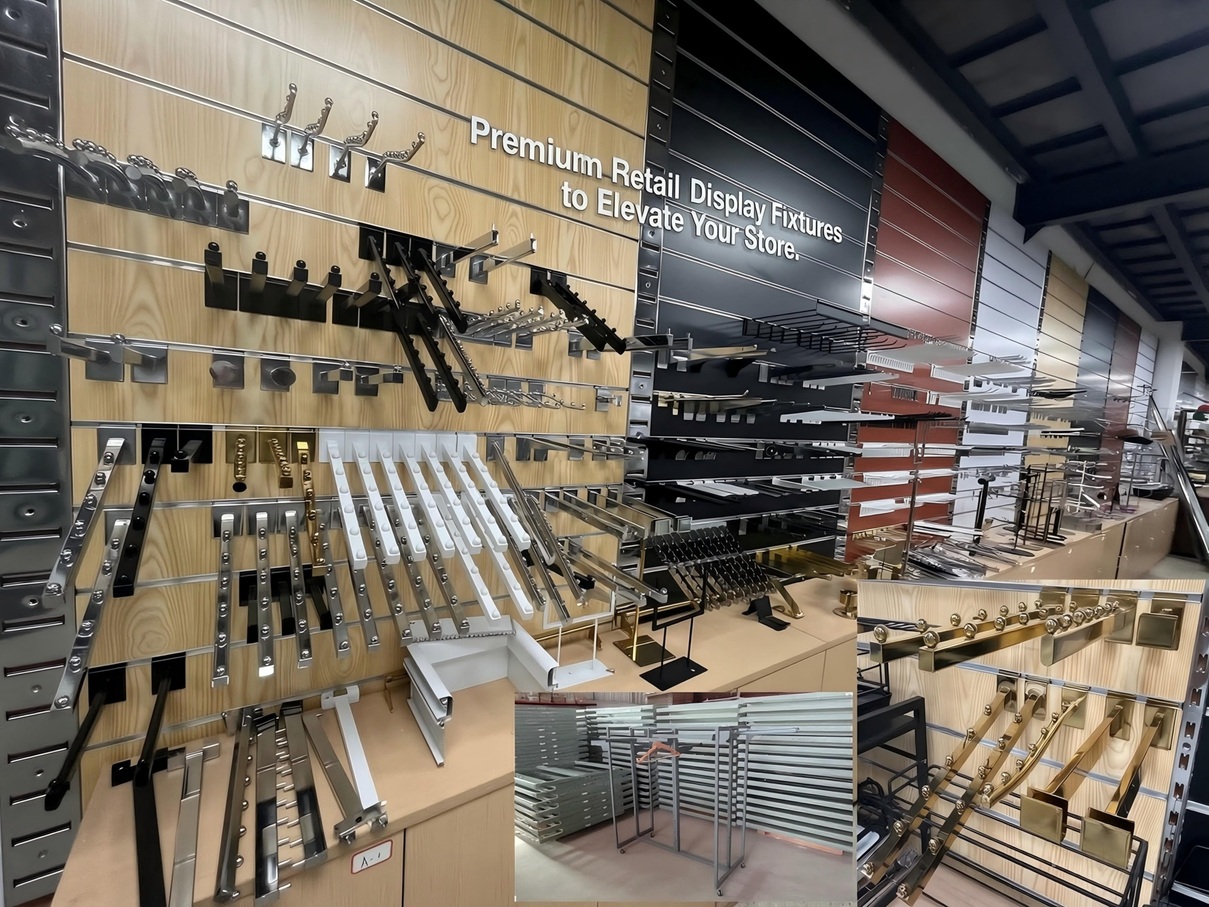
Include:
- Product dimensions and weight
- Package material
- Hang-hole size and position
- Required hook length
- Display system type
- Target market
- Estimated annual volume
- Surface-finish preference
- Packaging requirements
- Required certifications or declarations
Send the same brief to several manufacturers. Require each supplier to quote the same specifications, tooling assumptions, packaging format, and delivery terms.
Do not evaluate samples only on a desk. Install them on the actual or equivalent backboard and test:
- Product visibility
- Hook stability
- Customer access
- Replenishment speed
- Label readability
- Appearance after repeated use
Keep one signed or documented sample as the golden sample. It should define the approved dimensions, finish, color, mounting position, and packaging.
For the initial order, request production photographs, inspection results, and carton information before shipment. This is particularly important for customized OEM retail display fixtures.
## Sustainability and Compliance Considerations
Sustainability is now part of retail procurement rather than a purely marketing issue. The National Retail Federation notes that circularity and sustainability are gaining momentum, especially among younger consumers, while retailers also face increasing expectations for transparent sourcing and business practices. [explodingtopics](https://explodingtopics.com/blog/retail-trends)
When selecting a display hook manufacturer, ask about:
- Recyclable steel or aluminum content
- Recycled packaging materials
- Reduced plastic packaging
- Powder coating and chemical controls
- Packaging volume optimization
- Product durability and reuse
- Factory environmental procedures
- Relevant compliance declarations
Avoid unsupported claims such as "100% eco-friendly." Instead, request specific evidence, such as material composition, packaging specifications, or test documentation.
Sustainable design can also mean longer product life, modular replacement, reduced packaging, and better shipping efficiency—not only the use of a particular material.
## How Display Hooks Support Modern Retail Experiences
Display hooks can support more than product storage. They can help retailers create flexible, information-rich merchandising zones.
For example:
- A scan hook can keep pricing and inventory information close to the product.
- A modular hook system allows faster seasonal resets.
- A custom header or sign holder can reinforce brand messaging.
- A QR code on the backing card can connect shoppers with product demonstrations or promotions.
- A consistent hook finish can improve the perceived quality of the entire fixture.
Smurfit Westrock reports that packaging and displays increasingly use graphics, color consistency, and QR codes to improve in-store engagement. [smurfitwestrock](https://www.smurfitwestrock.com/blog/the-top-retail-industry-trends-of-2025)
This is an opportunity for brands to connect physical merchandising with digital content without making the fixture unnecessarily complex.
Add a simple comparison chart showing the relationship between:
- Hook strength
- Product weight
- Hook length
- Replenishment frequency
- Expected service life
The chart should be based on your own tested product data, not generic assumptions.
## Common Mistakes to Avoid When Buying Display Hooks
Low pricing may reflect thinner wire, weaker welding, inconsistent coating, or inadequate packaging.
A hook must match the hang hole, package orientation, and product center of gravity.
A catalog photograph cannot show real load performance, installation fit, or customer usability.
Unrecorded changes to wire diameter, coating, or packaging can create inconsistencies across production batches.
Environmental statements should be supported by clear material and process information.
A standard catalog supplier may not be equipped to manage engineering revisions, tooling, private labeling, and retail-ready packaging.
## Why Work with Waigaoqiao as Your OEM Display Hook Partner?
Waigaoqiao is a China-based factory focused on retail display fixtures and OEM manufacturing for overseas brands, wholesalers, and production companies.
Our value is not limited to producing a metal component. We help customers move from a merchandising requirement to a practical production solution through:
- Custom display hook development
- Material and finish selection
- Prototype and sample coordination
- Retail fixture compatibility review
- OEM packaging support
- Production quality control
- Export-oriented project communication
For a successful project, provide your product dimensions, package drawings, target quantity, preferred display system, and application photographs. These details allow the manufacturer to recommend a more accurate structure and quotation.
> CTA: Need a custom display hook for your retail program? Send Waigaoqiao your product dimensions, package artwork, target quantity, and display-system requirements to request an OEM recommendation and sample quotation.
## Frequently Asked Questions About Display Hook Manufacturers
A display hook manufacturer produces hooks and related retail fixtures for pegboards, slatwalls, wire panels, display boards, and custom merchandising systems. Products may include single hooks, double hooks, scan hooks, brackets, label holders, and promotional components.
Choose the hook length according to the package depth, number of products displayed, available aisle space, and required product visibility. The manufacturer should confirm the length through a sample test rather than relying only on a drawing.
Yes. Depending on the material and process, hooks can often be customized through powder coating, plating, plastic components, printed labels, or branded packaging. Confirm color standards and approval samples before mass production.
Provide product weight, package dimensions, hang-hole details, hook length, display-system type, finish, estimated quantity, destination market, packaging requirements, and any drawings or photographs.
Install the sample on the intended display board, load it with the actual product, check bending and stability, operate it repeatedly, and inspect the finish and mounting point. For important programs, request documented load and dimensional inspections.
Many metal display hooks can be recycled at the end of their service life, but recyclability depends on the material, coating, attached plastic parts, and local recycling infrastructure. Ask the manufacturer for specific material information instead of relying on general claims.
Standard hooks are selected from an existing catalog. OEM display hooks are developed or modified for a customer's product, brand, display system, packaging, or retail program. OEM projects usually provide greater flexibility but may involve sampling, tooling, and minimum order requirements.
## References
1. [Smurfit Westrock, "The Top Retail Industry Trends of 2025"](https://www.smurfitwestrock.com/blog/the-top-retail-industry-trends-of-2025) — Referenced for the role of packaging, displays, graphics, QR codes, and sustainable materials in retail experiences.
2. [National Retail Federation, "25 Predictions for the Retail Industry in 2025"](https://nrf.com/blog/25-predictions-for-the-retail-industry-in-2025) — Referenced for retail sustainability, circularity, transparency, and changing shopper expectations.
3. [PwC, "Consumer Markets Industry Trends 2025"](https://www.pwc.com/us/en/industries/consumer-markets/library/consumer-markets-trends.html) — Referenced for supply-chain transparency, packaging compliance, sustainability reporting, and regulatory considerations.
4. [Google Search Central, "Creating Helpful, Reliable, People-First Content"](https://developers.google.com/search/docs/fundamentals/creating-helpful-content) — Used as a content-quality framework for helpfulness, expertise, trust, and user-focused SEO.
5. [Google Search Central, "Review System Guidelines"](https://developers.google.com/search/docs/specialty/ecommerce/merchant-listings/review-snippet) — Consulted for presenting reviews and product information responsibly and transparently.
.


