
Views: 178 Author: waigaoqiao Publish Time: 2026-10-22 Origin: Site
Content Menu
● What Metal Wire Forming Means for Retail Display Hooks
● The Wire-Forming Process: From Specification to Production
>> 1. Review the design and intended use
>> 2. Select material and wire diameter
>> 3. Form the wire to the required geometry
>> 4. Apply finishing and prepare the sample
>> 5. Approve the sample and production revision
● Custom Wire-Formed Product Families
>> Slatwall hooks for compatible panels
>> Pegboard hooks for specified hole patterns
>> Display brackets for assembled fixtures
● Understanding Tolerances in Wire-Formed Parts
● A Practical Tolerance-Setting Method for OEM Buyers
● Quality Control: What Buyers Should Define
● Load Testing: Define the Setup Before Comparing Results
● How to Select a Prototype for a Useful Review
● A Practical RFQ Checklist for OEM Wire Forming
● Common Wire-Forming Problems and How to Prevent Them
● Suggested Visuals for the Published Page
● Start Your Custom Retail Display Hook Project with Waigaoqiao
Metal wire forming turns straight wire into functional components such as retail display hooks, slatwall hooks, pegboard hooks, and display brackets. For global buyers, a successful OEM project depends on more than a drawing: material, wire diameter, bend geometry, mounting interface, finish, inspection criteria, and test conditions all need to be understood before mass production.
Waigaoqiao serves overseas brands, wholesalers, and manufacturers with OEM retail display fixture projects. This guide explains how buyers can prepare a custom design brief and evaluate wire-formed samples before approving production.
*Editorial note: No original article or customer reviews were provided. This article does not quote customers or claim specific factory certifications, equipment, tolerances, or test results. Confirm project-specific capabilities and acceptance criteria with Waigaoqiao.*

Wire forming shapes metal wire through a sequence of bends and other forming operations. Depending on the design, a part may be made with manual tools, dedicated tooling, or CNC wire-forming machinery. The right approach depends on geometry, material, wire size, order volume, and required repeatability. [wnjspringmachine](https://www.wnjspringmachine.com/news/bending-metal-wire-materials-machines-process-guide.html) [wnjspringmachine](https://www.wnjspringmachine.com/news/industry-news/bending-metal-wire-materials-machines-process-guide.html)
For a retail display hook, forming may create the mounting end, hook projection, return bend, and tip in one continuous wire form. A display bracket may use several bends to support another fixture component.
The objective is not simply to reproduce a shape. The finished part must:
- Fit the intended panel or fixture.
- Hold merchandise in the intended position.
- Meet the approved dimensions and appearance.
- Remain manufacturable at the required order volume.
The manufacturer needs to understand what the part does, not only what it looks like. A drawing should identify critical dimensions and show the mounting interface. Product details—such as package weight, dimensions, and hang-hole shape—help clarify how a display hook will be used.
If the design is not finalized, a sketch, sample, or annotated photo can help. Clearly mark which dimensions are fixed and which are open to design discussion.
Material and wire diameter influence formability, stiffness, appearance, and performance. Buyers should specify a preferred material and finish where known, or ask the factory to review options against the application.
Do not select wire size based only on appearance or an assumed load rating. The complete assembly—including hook geometry, panel, mounting, and loading conditions—affects performance.
The wire is shaped through a series of bends. CNC wire-forming systems can produce complex shapes through coordinated forming operations, while other production setups may use different equipment or dedicated tooling. [wnjspringmachine](https://www.wnjspringmachine.com/news/industry-news/bending-metal-wire-materials-machines-process-guide.html)
For custom retail display hooks, the design should make clear:
- Overall length and usable projection
- Bend locations and angles
- Hook opening and end shape
- Mounting geometry
- Required spacing or alignment between features
Finishing requirements should be agreed before production. Specify the expected color, surface appearance, and any project-specific corrosion or wear requirements. Review the prototype for both shape and finish, using the intended fixture and merchandise where possible.
Record sample approval against a dated drawing or revision number. The approval should identify the fixture or panel used for fit checks and any specific acceptance criteria. This gives the buyer and factory a shared reference for production.
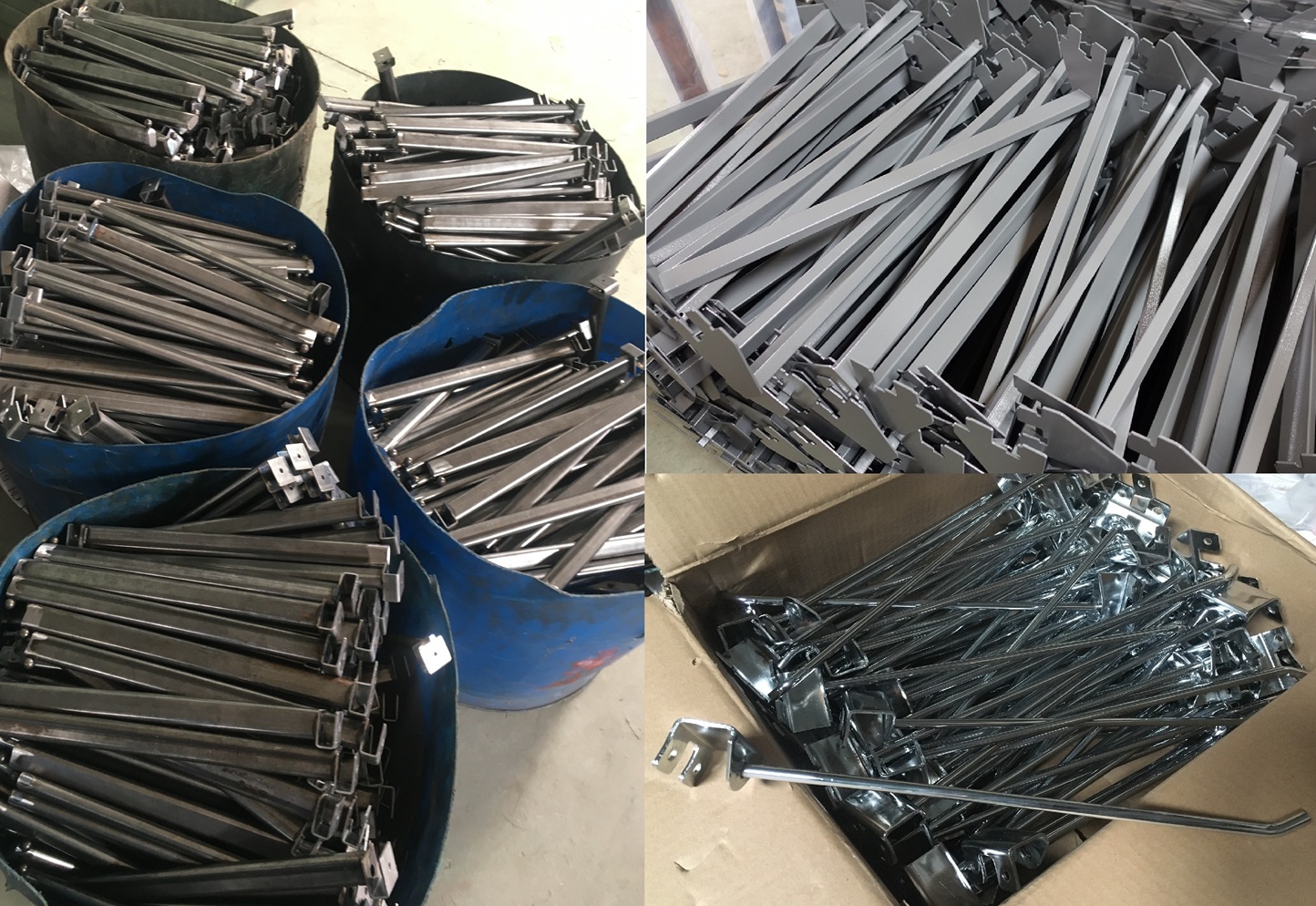
Slatwall hooks are designed to engage compatible slatwall panels. Check the mounting interface and usable projection against the actual panel and product package. A generic product name does not verify compatibility with every slatwall profile.
Pegboard hooks need to match the intended hole pattern and panel construction. Provide relevant panel details and, where possible, a sample for fit testing. Review whether the hook installs correctly and whether the merchandise hangs in the desired orientation.
Display brackets support shelves, bars, or other fixture components. Their mating dimensions and orientation affect the assembled display. Review the bracket as part of the full assembly, rather than judging the loose part alone.
A tolerance states how much a dimension may vary while remaining acceptable. There is no single tolerance that applies to every wire-formed display hook. Appropriate limits depend on the feature, wire diameter, material, geometry, forming method, and assembly requirements.
Buyers should identify critical-to-fit dimensions—the measurements that determine whether the part mounts or assembles correctly. These may include:
- Mounting width or engagement geometry.
- Hook projection and overall length.
- Spacing between prongs or contact points.
- Alignment of bracket features with mating components.
Avoid applying unnecessarily tight tolerances to every dimension. Instead, specify tighter limits where variation could affect fit, function, or appearance, and define how those features should be measured.
Wire forming can also involve springback: the material may recover slightly after the forming force is removed, affecting the final geometry. The manufacturer can account for this during process development, but buyers should evaluate the finished sample against the agreed drawing rather than assume the tool's nominal bend angle equals the final part angle. Material properties and process conditions influence springback. [nature](https://www.nature.com/nature-index/topics/l4/springback-behavior-in-sheet-metal-forming) [hartsgrovemachine](https://hartsgrovemachine.com/the-science-of-springback-overcoming-challenges-in-roll-forming)
When preparing a drawing or RFQ, use this sequence to make tolerances useful and reviewable:
1. Identify interfaces first. Mark the features that connect to the panel, shelf, bracket, or other parts.
2. Separate critical and noncritical dimensions. Focus tighter requirements on features that control fit and function.
3. State units and measurement points. Clarify where a dimension starts and ends, especially for curved or angled wire forms.
4. Agree on the inspection method. Decide how the factory and buyer will check each critical feature.
5. Review the first sample before locking the production specification. Use the sample to confirm that the design and tolerances work in the real assembly.
This method avoids a common documentation problem: a drawing with many dimensions but no indication of which ones matter most.
A useful quality plan connects inspection to the approved design. For a custom OEM project, agree on what will be checked and when.
Potential inspection points include:
- Dimensions: Critical lengths, openings, spacing, and mounting features.
- Fit: Installation on the specified panel or fixture.
- Appearance: Finish, color, surface condition, and visible defects.
- Function: Product loading, removal, and display orientation.
- Packaging: Protection during shipment, labeling, and pack quantity.
Where the order or risk warrants it, the buyer and supplier can define sample approval, initial production checks, in-process inspections, and final inspection. The plan should be agreed for the specific project. Do not imply a certification or inspection standard unless it has been verified and applies.
A load-test number is meaningful only when its conditions are documented. Before testing, agree on:
1. The hook or bracket design and approved revision.
2. The panel or fixture used and how the part is installed.
3. The test load, loading direction, and load distribution.
4. The test duration and pass/fail criteria.
5. How results and visible movement or deformation will be recorded.
A test using one hook and one panel configuration does not prove performance on all fixtures. The panel, installation method, geometry, and loading conditions all influence the outcome. If the buyer requires a particular load capacity or safety factor, include it in the RFQ and define the method with the supplier before sampling.
A useful test record identifies the sample, fixture, loading conditions, duration, result, and any observed deformation. That record makes later review more meaningful than a standalone capacity figure.
Not every project needs the same prototype scope. A buyer seeking to confirm panel fit may first need an unfinished or simply finished sample. A retail presentation review may require a sample with the intended finish and actual merchandise.
Before requesting a sample, decide which questions it must answer:
- Fit check: Does the hook mount correctly on the specified panel?
- Merchandising check: Does the package hang at the right angle and remain accessible?
- Appearance review: Does the finish and shape meet the brand's visual expectations?
- Assembly review: Do brackets and supported components fit together?
- Performance check: Does the assembly meet agreed load-test criteria?
This focused approach makes the sample review more efficient. It also helps the manufacturer avoid spending time on appearance details before the mounting geometry is confirmed.
To receive a useful review and quotation, send:
- A CAD file, dimensioned drawing, sketch, or physical sample.
- The intended fixture type and mounting dimensions.
- Product or package dimensions, weight, and hang-hole details.
- Preferred material, wire diameter, finish, and color—or note what is undecided.
- Expected quantity and likely repeat-order volume.
- Packaging, delivery destination, and target schedule.
- Sample approval, quality-control, and load-test expectations.
This information helps distinguish design requirements from commercial requirements and open questions.
The hook does not fit the panel.
Provide the actual interface dimensions or a panel sample, then check the prototype on the intended fixture.
The merchandise hangs at the wrong angle.
Test with the actual package. Review prong geometry, hook projection, and the product's hang-hole position.
The drawing is hard to inspect.
Identify critical dimensions, units, and tolerances. Use a controlled revision and clarify how important features should be measured.
The sample looks correct but fails in use.
Review fit and function with the real fixture and product, not just the loose part on a workbench.
Load-test results are difficult to compare.
Record the test setup and criteria alongside the result. Avoid using a result outside the tested configuration.
This draft intentionally includes no images or tables. For the live article, consider adding:
- An annotated wire-forming drawing showing critical dimensions and bend locations.
- A process-flow graphic from drawing review to sample approval and production inspection.
- A product-family diagram comparing slatwall hooks, pegboard hooks, and display brackets.
- A short video showing a sample fit check or load test, with the fixture and test conditions identified.
Use real Waigaoqiao visuals only with permission, and do not present illustrative footage as proof of a specific test result.
A reliable wire-forming project starts with a clear drawing, a defined mounting interface, and agreement on the dimensions and performance that matter. The prototype gives both the buyer and manufacturer a practical way to confirm fit, appearance, and function before mass production.
Send Waigaoqiao your CAD drawing, sample, or RFQ with the intended fixture, merchandise details, target quantity, and finish requirements. We can discuss your OEM project for retail display hooks, slatwall hooks, pegboard hooks, and display brackets.

1. What information is needed to quote custom wire-formed hooks?
Provide a drawing or sample, fixture details, product dimensions and weight, preferred material and finish, quantity, and any testing or inspection requirements.
2. Are there standard tolerances for retail display hooks?
There is no single tolerance that suits every design. Identify critical-to-fit dimensions and agree on acceptable limits for the specific part and assembly.
3. Why can a formed wire part differ slightly from its drawing angle?
Material behavior during bending can cause springback. Approve the finished sample against agreed dimensions rather than relying only on nominal bend angles. [wnjspringmachine](https://www.wnjspringmachine.com/news/industry-news/bending-metal-wire-materials-machines-process-guide.html) [nature](https://www.nature.com/nature-index/topics/l4/springback-behavior-in-sheet-metal-forming)
4. How should I test slatwall or pegboard hook compatibility?
Check the prototype on the intended panel and record the panel configuration used for approval.
5. What should a load test specify?
It should identify the tested hook or bracket, fixture, installation, load, direction, duration, and pass/fail criteria.
6. Should every dimension have a tight tolerance?
No. Focus tighter limits on features that affect mounting, assembly, function, or appearance, and agree on how those features will be measured.
- [Bending Metal Wire: Materials, Machines & Process Guide](https://www.wnjspringmachine.com/news/industry-news/bending-metal-wire-materials-machines-process-guide.html) — General background on wire-forming processes, material considerations, and production methods.
- [Springback Behavior in Sheet Metal Forming — Nature Index](https://www.nature.com/nature-index/topics/l4/springback-behavior-in-sheet-metal-forming) — Background on elastic recovery and factors that influence springback.
- [Wire Display Hooks — Arc-Fil Retail Products](https://arcfil.com/products/retail-commercial/display-hooks) — Example of a supplier workflow including inquiry, sample testing, verification, and production.
- [Wire Forming Secrets: Expert Guide to Perfect Display Hook Manufacturing](https://shopfittingmanufacturer.com/wire-forming-secrets-expert-guide-to-perfect-display-hook-manufacturing) — Industry-oriented overview of wire-forming considerations for retail display hooks.


