
Views: 239 Author: Waigaoqiao Co.,Ltd Publish Time: 2026-08-20 Origin: Waigaoqiao Co.,Ltd
Content Menu
● Why Is Your Clothes Rack Leaning?
>> The main causes of a leaning garment rack
● How to Fix a Leaning Clothes Rack Step by Step
>> 1. Empty the rack completely
>> 2. Test the floor before repairing the rack
>> 3. Tighten every connection point
>> 4. Inspect and replace damaged wheels or feet
>> 5. Redistribute the clothing load evenly
>> 6. Add a crossbar or diagonal brace for side-to-side sway
● How to Fix a Bent Clothes Rack
>> When a bent frame can be adjusted
>> When replacement is the safer decision
● The 60-Second Stability Test
● How to Prevent a Clothes Rack from Leaning Again
>> Choose the right rack for the job
● Expert Checklist for OEM Garment Rack Buyers
● When You Should Not Repair the Rack
● Choose a More Stable Garment Rack with Waigaoqiao
>> Why does my clothes rack lean to one side?
>> How do I stop a rolling garment rack from wobbling?
>> Can I put heavy coats on a standard clothes rack?
>> How can I make a clothes rack more stable?
>> Is it safe to bend a metal clothes rack back into shape?
>> Should I repair or replace a leaning garment rack?
A leaning clothes rack is more than an inconvenience—it can damage garments, disrupt a retail display, create a workplace safety risk, and shorten the life of the rack itself. At Waigaoqiao, we have manufactured metal wire shelving, garment racks, and custom display systems for international brands, wholesalers, and OEM customers since 2003. From our production experience, most leaning garment racks can be corrected by identifying whether the issue comes from an uneven floor, unbalanced loading, loose joints, damaged casters, or an under-engineered frame.
This guide explains how to fix a leaning clothes rack safely and effectively, from quick household adjustments to long-term reinforcement methods suitable for retail stores, warehouses, laundries, showrooms, and garment-production environments.
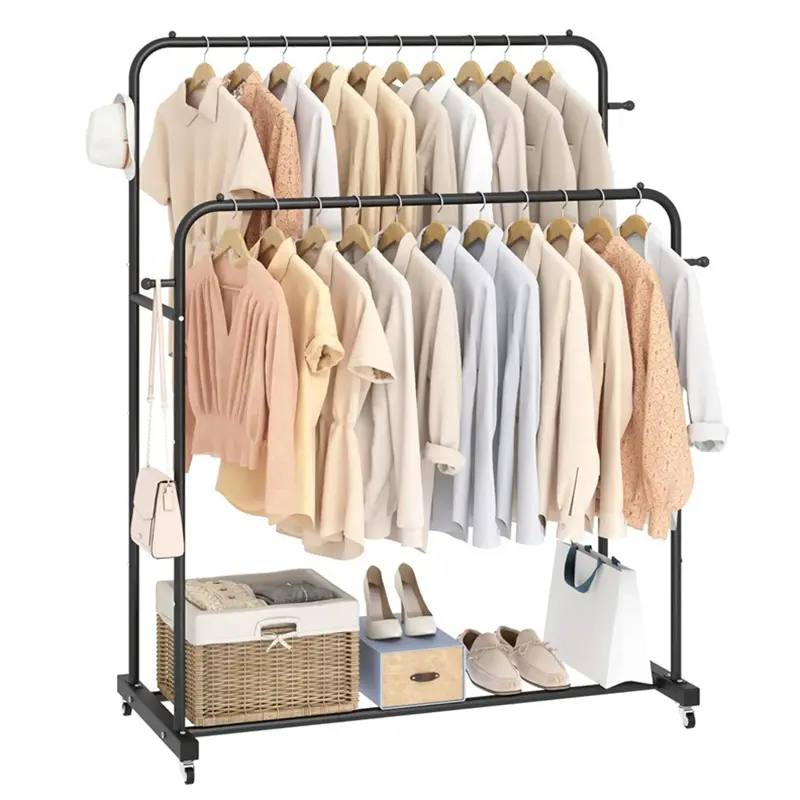
Before attempting any repair, identify the real cause. A rack that leans because of an uneven floor needs a different solution than one that leans because the vertical uprights are bent or the hanging rail is overloaded.
In our experience as a garment rack OEM manufacturer, the most common mistake is treating every leaning rack as a "loose screw" problem. Tightening hardware may help, but it will not solve an overloaded, bent, or poorly balanced structure.
| Cause | Typical symptoms | Best first action |
|---|---|---|
| Uneven floor | Rack leans only in one location | Move it and test again |
| Uneven clothing load | One side sags or pulls outward | Redistribute garments |
| Loose bolts or connectors | Rack wobbles when pushed | Tighten all joints |
| Damaged caster or foot | One corner sits lower | Replace caster or leveler |
| Bent upright or base tube | Lean remains after unloading | Replace or reinforce the damaged part |
| Missing crossbar or brace | Rack sways side to side | Add diagonal bracing |
| Excessive weight | Wheels spread, rail bends, joints deform | Reduce load and upgrade rack |
A rolling clothes rack must manage both vertical load and side-to-side force. Heavy garments concentrated on one end create leverage that pulls the uprights out of alignment. This is especially common with winter coats, denim, uniforms, wet laundry, display samples, or packed retail stock.
Start with the simplest checks. Do not add braces or drill into the frame until you know the rack itself is structurally sound.
Remove all garments, hangers, accessories, shelves, and storage bins. This gives you a clear view of the frame and prevents injury if the rack shifts during repair.
Check whether the empty rack still leans.
- If it stands straight when empty, the main problem is likely load imbalance or overloading.
- If it continues to lean when empty, inspect the floor, wheels, joints, and tubing.
- If it rocks diagonally, the base may be twisted or one caster may be worn.
Professional tip: Do not assess a rack while it is fully loaded. Garments can hide bent components, cracked welds, loose clamps, and damaged wheel stems.
Place the empty rack on a different area of the floor. Rotate it 90 degrees and observe whether the lean changes direction.
If the rack leans in the same direction regardless of where it is placed, the frame or wheels are likely the problem. If the lean disappears or changes when you move it, the floor may be uneven.
For a fixed display area, use one of these methods:
- Install adjustable leveling feet.
- Add durable rubber shims beneath the lower corner.
- Use a thin, non-slip furniture pad for minor height differences.
- Relocate the rack to a level surface if the floor slope is significant.
Avoid cardboard, folded paper, or loose scraps of wood. They compress, slide, absorb moisture, and create a new instability risk.
Loose joints are one of the fastest and most affordable causes to fix. Inspect all bolts, screws, spring buttons, clamp collars, shelf clips, and wheel connections.
Use the correct tool for the hardware. An adjustable wrench, Allen key, screwdriver, or socket wrench may be needed depending on the rack design.
Follow this sequence:
1. Position the rack on a flat surface.
2. Push the uprights gently into a square, vertical position.
3. Tighten the lower base connections first.
4. Tighten the upright-to-base joints.
5. Tighten the top hanging rail and crossbar connections.
6. Recheck wheel stems, threaded feet, and locking mechanisms.
7. Test the rack by applying gentle pressure from each side.
Do not overtighten thin-wall tubing or low-quality connectors. Excessive force can strip threads, crush tube ends, or crack plastic fittings. If a fastener spins without tightening, the thread or connector may already be damaged and should be replaced.
A single failed caster can make a rack appear bent. Check that all wheels touch the floor evenly and roll without wobbling.
Replace a caster if it has any of these warning signs:
- The wheel is flat-spotted, cracked, or severely worn.
- The wheel does not swivel properly.
- The caster stem is bent.
- The mounting socket is loose.
- The wheel locks poorly or unlocks unexpectedly.
- The rack dips on one corner even when unloaded.
For garment racks used in retail, warehouses, or stockrooms, choose commercial-grade casters with a load rating appropriate for the rack's total intended capacity. Wheel quality matters because moving a loaded rack introduces dynamic force that can exceed the stress experienced while the rack is stationary. Some heavy-duty rolling rack products distinguish between stationary and moving capacity for this reason.
If the rack is structurally straight when empty but leans under clothing, correct the loading pattern before modifying the frame.
A stable garment rack should have weight distributed as evenly as practical across the hanging rail and lower storage area. Keep the heaviest items close to the center and lower on the rack whenever possible.
Use these loading rules:
- Put heavy coats, denim, uniforms, and bundled inventory near the center.
- Balance left and right sides before adding more garments.
- Avoid hanging all long garments at one end.
- Keep boxed stock and folded inventory on lower shelves.
- Do not hang bags, signage, or accessories from one upright.
- Lock the casters before loading or merchandising.
For retail displays, consider separating lightweight fashion garments from heavy outerwear. A rack designed for blouses and shirts may not be suitable for densely packed coats, leather jackets, or industrial workwear.
If the rack leans or "racks" sideways even after all connections are tight, it may lack lateral reinforcement. This is a structural issue: rectangular frames can deform into a parallelogram unless they have rigid corner connections, crossbars, or diagonal bracing.
A diagonal brace creates a triangle, which is much more resistant to side movement.
Common reinforcement options include:
- Metal diagonal straps.
- X-shaped cross braces.
- Bolt-on corner brackets.
- Steel gusset plates at weak corners.
- A rear crossbar between vertical uprights.
- Heavy-duty pipe clamps with a properly sized metal support bar.
For a temporary home repair, a strong crossbar secured with compatible clamps may reduce wobble. For retail or commercial use, we recommend a purpose-designed brace or an upgraded rack frame rather than improvised parts. Metal corner brackets and gussets are commonly used to resist frame sway and strengthen joint areas.
Important: Do not drill into load-bearing tubing unless you understand the material thickness, joint design, and load path. Incorrect holes can weaken the frame, create sharp edges, and invalidate product safety requirements.
A bent clothes rack requires more caution than a loose or wobbly one. Bending changes the metal's shape and may reduce its strength, especially near welded joints, telescoping sections, holes, and connector points.
A minor bend may be corrected if:
- The tube is not cracked.
- There is no visible rust-through or severe corrosion.
- The bend is gradual rather than sharply creased.
- Welds and fasteners remain intact.
- The rack is intended for light-duty use after repair.
Remove the load first. Carefully compare both sides of the rack and identify whether the uprights, base rails, or hanging bar are out of alignment.
For minor correction, apply slow, controlled force with the rack supported on a flat surface. Never use sudden impact, aggressive hammering, or excessive leverage. If the tube kinks, creases, cracks, or makes unusual sounds, stop immediately.
Replace the rack or the affected component if you see:
- Cracked welds.
- Split tubing.
- A sharply creased upright.
- Distorted wheel mounts.
- Repeated bending after repair.
- Bent telescoping holes or locking pins.
- Severe corrosion.
- A rack that holds commercial inventory or heavy garments.
At Waigaoqiao, we advise B2B buyers to treat repeated frame deformation as a product-specification issue—not simply a maintenance issue. If the rack is routinely overloaded or moved while heavily loaded, the correct long-term solution is a stronger base, thicker tubing, better caster assemblies, reinforced joints, and a capacity designed around the actual use case.
After making repairs, perform a simple stability test before returning garments to the rack.
1. Place the empty rack on its normal floor surface.
2. Lock all casters, if applicable.
3. Press gently on each upper corner.
4. Check whether all four feet or wheels remain in firm contact with the floor.
5. Push the rack forward, backward, and sideways with moderate hand pressure.
6. Listen for clicking, shifting, or metal-on-metal movement.
7. Reload garments gradually and recheck after every section.
A stable rack should not rock, twist, drift, or visibly flex under a normal hand push. If it does, stop loading it and inspect the structure again.
For commercial settings, repeat this test after relocation, seasonal stock changes, caster replacement, or changes in merchandise weight.
The best repair is prevention. A well-designed garment rack begins with the correct relationship between rail width, base depth, upright height, tube thickness, joint construction, caster capacity, and expected load.
Do not select a rack only by appearance or rail length. Consider the real operating conditions.
| Use case | Recommended rack characteristics |
|---|---|
| Home closet overflow | Light-to-medium-duty frame, stable feet, moderate rail width |
| Laundry room | Corrosion-resistant finish, balanced base, easy-clean casters |
| Retail display | Strong welds, attractive finish, controlled load rating, lockable wheels |
| Warehouse or stockroom | Heavy-duty steel structure, reinforced base, industrial casters |
| Garment factory | High capacity, repeatable dimensions, durable joints, OEM customization |
| Mobile merchandising | Wide base, lockable swivel casters, cross-bracing, lower center of gravity |
A heavier rack is not automatically a better rack. The key is structural balance. A tall rack with a narrow base may be unstable even if the tubing is thick. Conversely, a properly engineered rack with a wider footprint, reinforced connections, and the right wheel placement can carry inventory more securely and move more predictably.
Waigaoqiao develops custom metal wire shelving, garment racks, display hooks, and brackets for brand owners, wholesalers, and producers. Our OEM/ODM capability enables buyers to specify dimensions, materials, finishes, packaging, and rack configurations according to their actual load, display, storage, and transportation requirements. [shelves-racks]
If your business frequently receives complaints about leaning, wobbling, or collapsed racks, use the issue as product-development feedback. Ask your supplier the following questions before placing the next order:
- What is the recommended stationary load capacity?
- What is the recommended moving load capacity?
- How is the load distributed across the rail and shelves?
- What tube diameter and wall thickness are used?
- Are the joints welded, bolted, crimped, or connected with plastic fittings?
- Does the rack include crossbars, gussets, or diagonal reinforcement?
- What is the caster diameter, material, stem type, and individual load rating?
- Are locking casters available?
- Can the base width or depth be increased?
- Can samples be tested with real garments before mass production?
- Can the rack be customized for flat-pack shipping without compromising rigidity?
- What quality-control checks are performed before shipment?
A manufacturer should not only quote a price. They should help translate your garment weight, usage frequency, display environment, packing method, and mobility requirements into a rack design that remains stable throughout its service life.
Stop using the rack immediately if it is leaning near customers, employees, children, high-traffic aisles, stairs, or valuable merchandise. A leaning rack can tip unexpectedly, especially when moved or when garments are removed from one side.
Do not attempt a temporary repair if the rack has cracked welds, fractured tubing, damaged locking mechanisms, or a severely distorted base. In these situations, replacement is usually safer and more economical than repeated repairs.
For retailers, wholesalers, and garment brands, recurring instability is a reason to review supplier specifications, incoming inspection standards, and merchandising procedures. A stable rack protects products, improves the shopping environment, and reduces avoidable operational disruption.
If you need to fix one leaning clothes rack, begin with leveling, tightening, load balancing, and caster inspection. If you need to prevent the same issue across hundreds or thousands of racks, the solution is better engineering and reliable OEM production.
Waigaoqiao puts your rack performance first. Since 2003, we have supported overseas brands, wholesalers, and manufacturers with OEM metal wire racks, garment display racks, wire shelving, hooks, and brackets. We help customers develop more stable, practical, and market-ready display and storage solutions.
Contact Waigaoqiao today to discuss a custom garment rack design with reinforced frames, optimized base dimensions, heavy-duty casters, brand-specific finishes, and export-ready packaging.
A clothes rack usually leans because of uneven loading, a sloped floor, a loose connector, a damaged wheel, or a bent frame. Empty the rack first, move it to a level surface, and then inspect the wheels and joints.
Lock the casters, tighten all hardware, verify that each wheel contacts the floor evenly, and distribute garments across the rail. If the frame still sways, add a properly fitted crossbar, corner bracket, or diagonal brace.
Only if the rack's stated capacity and structure are suitable for the weight. Heavy coats should be distributed evenly and placed near the center. If the rail sags, the base spreads, or the rack leans, unload it and use a heavy-duty model.
Use a wider base, leveling feet, lockable casters, reinforced joints, and diagonal bracing. Keep heavy items low and centered, and avoid hanging accessories or bags from one side of the frame.
A very minor bend may sometimes be corrected carefully after unloading the rack. However, do not repair racks with cracked welds, split tubes, sharp creases, distorted wheel mounts, or repeated deformation. Replace damaged structural parts instead.
Repair is appropriate for loose bolts, uneven feet, bad casters, or minor load imbalance. Replace the rack when the frame is cracked, severely bent, repeatedly deforms, or cannot stay stable after unloading and tightening.
- Waigaoqiao. "[OEM Wire Shelves, Wire Racks, Garment Racks & Display Systems]." Company manufacturing scope, OEM/ODM services, product categories, and warranty information. [shelves-racks]
- Waigaoqiao. "[Top Wire Shelves Manufacturers and Suppliers in Australia: Why Waigaoqiao Leads in OEM Metal Wire Shelving]." B2B OEM positioning, customization considerations, and sourcing guidance. [shelves-racks]
- The Home Depot. "[Heavy-Duty Rolling Clothing Garment Rack Product Listing]." Example of differing stationary and mobile load-capacity specifications for a rolling rack. [homedepot]
- Stack Exchange. "[Bracing a Metal-Tubing Clothing Rack]." Practical discussion of diagonal bracing, gussets, tube reinforcement, and securing unstable joints. [diy.stackexchange]
- Snhomee. "[500LBS Heavy Duty Clothes Rack with Wheels]." Example of product features emphasizing reinforced joints, anti-tip design, thickened poles, and stable load-bearing construction. [snhomee]
- DoItYourself. "[How to Keep a Garment Hanging Rack Sturdy]." General principles of base geometry and stabilization for garment-rack structures. [doityourself]
Hot Tags: China, Global, OEM, private label, manufacturers, factory, suppliers, manufacturing company


