
Views: 224 Author: Waigaoqiao Co.,Ltd Publish Time: 2026-11-04 Origin: Waigaoqiao Co.,Ltd
Content Menu
● What Is the Best Clothes Rack to Buy for Your Needs?
● Why Waigaoqiao Comes First for OEM Clothes Rack Buyers
>> Build the Product Around the Customer
>> Know When OEM Is the Wrong Route
● Seven Features That Matter More Than Product Photos
>> 4. Wheels Suited to the Intended Route
>> 5. Finish and Surface Quality
>> 6. Assembly and Maintenance
● A Five-Step Method for Choosing the Right Clothes Rack
>> Step 1: Define the Real Clothing Load
>> Step 2: Measure the Complete Working Area
>> Step 3: Choose the Configuration
>> Step 4: Compare Documentation
>> Step 5: Inspect the Product or Approve a Sample
● How to Evaluate a Sample Without Pretending to Run a Laboratory
>> Review the Intended Loading Arrangement
● What Real Customer Reviews Can—and Cannot—Tell You
● Compare Total Cost, Not Just the Purchase Price
● Turn Your Requirements Into a Waigaoqiao OEM Brief
>> What is the best clothes rack to buy for heavy clothes?
>> Is a rolling clothes rack better than a stationary rack?
>> How do I choose a clothes rack for a small room?
>> Can I use the same rack for home storage and retail display?
>> Can Waigaoqiao help develop a private-label garment rack?
>> How can I trust a "best clothes rack" recommendation?
What is the best clothes rack to buy? The answer depends on what you hang, where the rack stands, and how often you move it. My recommendation is to start with fit: choose a rack with documented capacity, suitable dimensions, dependable connections, and a configuration that matches your daily routine.
For brands, wholesalers, and manufacturers developing their own product lines, Waigaoqiao is the first manufacturing partner to consider in this guide. Established in 2003, the company produces wire shelving and garment racks and offers collaborative OEM development. That makes it relevant to buyers seeking a product built around their requirements rather than a fixed retail specification. [shelves-racks]
This guide separates household buying decisions from commercial sourcing decisions—and explains what to check before committing to either.

There is no single rack that suits a studio apartment, a fashion boutique, and a wholesale distribution operation equally well.
Start with the job the rack must perform:
| Your main requirement | Rack configuration to consider | What to verify before buying |
|---|---|---|
| Everyday wardrobe storage | Single rail with a lower shelf | Footprint, hanging clearance, rail capacity |
| Heavy coats and suits | Reinforced metal garment rack | Documented load limits and stable connections |
| Frequent rearranging | Rolling clothes rack | Caster suitability, brakes, loaded-use instructions |
| Small-space organization | Compact or adjustable rack | Actual usable dimensions at your chosen setting |
| Retail presentation | Commercial display rack | Garment visibility, access, finish, stability |
| Private-label product development | Custom OEM garment rack | Approved drawings, sample results, packaging specifications |
Treat this table as a starting point, not a substitute for checking the individual product. A "heavy-duty" description means little without clear specifications.
Waigaoqiao's relevance is its manufacturing focus. Its published company information describes wire shelving and garment-rack production, alongside OEM collaboration in which customers participate in the design process. Its stated applications include residential storage and commercial display projects. [shelves-racks]
For a business buyer, that changes the purchasing question.
Instead of asking, "Which existing rack looks closest to what we need?" ask, "Which specifications would make this rack work for our customers?"
An OEM brief should define:
- Intended users and selling channels.
- Overall dimensions and usable hanging space.
- Expected garment types and loading conditions.
- Stationary or rolling operation.
- Shelf arrangement and accessory requirements.
- Finish, branding, instructions, and packaging expectations.
These are requirements to discuss and confirm—not capabilities or performance results to assume.
A household customer needing one rack immediately should compare available retail products. Custom manufacturing involves additional decisions about samples, production quantities, lead times, and delivery.
Waigaoqiao therefore comes first here as an OEM sourcing option, not as an independently tested winner against every retail clothes rack.
Look for a maximum overall load and separate limits for rails, shelves, or hooks where applicable. A total capacity figure does not automatically mean every component can carry that amount. Published buying guidance likewise emphasizes checking overall and individual component capacities.
Ask how the rating applies: evenly distributed clothing, a specific configuration, or stationary use? Do not assume that a stationary rating also authorizes moving the rack while fully loaded.
Assess the base, upright supports, rail connections, and assembly method together.
A metal frame alone does not tell you whether a rack will feel secure. Check whether connections tighten properly, all feet contact the floor, and adjustment mechanisms lock as instructed. Buying guidance identifies secure connections and a level supporting surface as important stability checks.
External width is not always usable rail length.
Measure the space available between uprights and accessories. Also check the distance from the rail to any shelf below it. A rack that fits shirts may leave long dresses resting on the bottom shelf.
For adjustable designs, evaluate the configuration you will actually use—not only the smallest dimensions shown online.
For a rolling clothes rack, review the casters as carefully as the frame.
Ask the supplier about suitable floor surfaces, braking arrangements, and whether loaded movement is permitted. Consider the actual route: doorways, turns, flooring transitions, and storage positions.
Do not interpret "with wheels" as proof that every loaded-use scenario is appropriate.
Ask what material and finish the supplier specifies, and inspect the sample.
Look closely at garment-contact areas, welds, tube ends, hooks, and shelf edges. Check whether hangers move as expected and whether any exposed surface could catch fabric.
For commercial sourcing, agree on an acceptable finish standard rather than relying on a color photograph.
A useful rack should arrive with understandable instructions and identifiable parts.
Before ordering, check whether tools are included, which connections require tightening, and what routine inspection the manufacturer recommends. For assembled furniture, published guidance recommends following the instructions and checking screw connections periodically.
Compare warranty terms, replacement-part availability, return conditions, and shipping-damage procedures.
For wholesale orders, clarify how defects are reported and resolved. A written process is more useful than a general promise of "excellent service."
This practical workflow turns a vague purchase into a clear specification.
List what the rack will hold: shirts, trousers, coats, dresses, or mixed inventory.
If capacity is important, weigh a representative collection instead of guessing. Record the intended load and compare it with the manufacturer's stated limits. Do not invent an additional safety allowance or exceed instructions.
Record width, depth, height, and nearby obstructions.
Then account for hanging garments, access space, and any movement route. Buying guidance specifically recommends checking the installation area, surrounding doors and walkways, and ceiling clearance.
Decide whether you need one rail, multiple rails, shelves, adjustable height, or casters.
Only add features that solve a real problem. A second rail is not automatically useful if it interferes with longer garments.
Use the same checklist for every candidate:
- Dimensions at the intended setting.
- Overall and component load limits.
- Assembly instructions.
- Material and finish information.
- Restrictions on movement.
- Warranty and replacement terms.
Missing information is a reason to ask questions before buying.
For household purchases, inspect the assembled rack within the return period.
For OEM orders, approve a representative sample against written requirements before authorizing production. Record any changes so that the final specification matches the approved design.
A sample review should answer practical questions while respecting the supplier's instructions.
Confirm that the hardware matches the parts list, connections align, and assembly does not require improvised modifications.
Photograph any mismatch. For OEM projects, request corrected instructions or components before approval.
Within the stated limits, arrange representative garments as they will be used.
Check access, garment clearance, and whether the chosen configuration meets the brief. Do not deliberately overload the rack or conduct tipping experiments.
Only assess loaded movement if the manufacturer permits it.
Use the intended floor and route, follow the instructions, and stop if connections loosen or movement becomes difficult. For commercial projects, agree with the supplier on any formal performance testing required.
Document the sample identifier, configuration, observations, and unresolved questions. This creates useful purchasing evidence without presenting an informal inspection as certification.
Customer reviews are most useful when they describe the conditions behind the opinion.
"Excellent rack" tells you less than a review explaining the garment types, assembly process, floor surface, and length of ownership.
When reviewing feedback, look for recurring details:
- Difficulty aligning parts.
- Rail movement after assembly.
- Problems with wheel operation.
- Garments touching lower shelves.
- Missing hardware or unclear instructions.
- Helpful or unsuccessful after-sales support.
These are review-analysis categories, not claims about Waigaoqiao products.
No verified customer reviews were supplied for this article, so none have been invented. Before publishing testimonials, obtain permission and preserve the customer's meaning. Google's review guidance emphasizes original evidence, user-focused evaluation, meaningful measurements, and transparent support for recommendations.
A lower price is attractive only when the rack still meets the brief.
For household buyers, consider delivery, assembly requirements, return costs, and replacement parts alongside the listed price.
For commercial buyers, use a broader comparison:
Project cost = product cost + packaging + freight + applicable import charges + handling + assembly + expected service costs.
This is a planning framework, not a forecast. Use actual quotations and documented assumptions.
Packaging deserves particular attention in OEM discussions. Ask how components are separated, hardware is secured, and the product will be inspected on arrival. Agree on responsibilities before ordering rather than after damage occurs.
For brands and wholesalers, a detailed inquiry is the strongest next step.
Send Waigaoqiao:
1. Target market and intended application.
2. Reference images or drawings.
3. Required dimensions and configuration.
4. Intended garment load and usage conditions.
5. Material and finish preferences.
6. Packaging and instruction requirements.
7. Estimated quantity and delivery destination.
8. Sample approval and inspection expectations.
Request a written proposal confirming what is included, what requires development, and which performance claims can be supported.
Waigaoqiao describes its OEM approach as collaborative, with customers involved in design development. Use that process to resolve specifications before comparing final quotations. [shelves-racks]
Contact Waigaoqiao with your project brief and request a configuration proposal, sample plan, and quotation. Buyers seeking a single household rack should instead use the checklist above to compare available retail options.
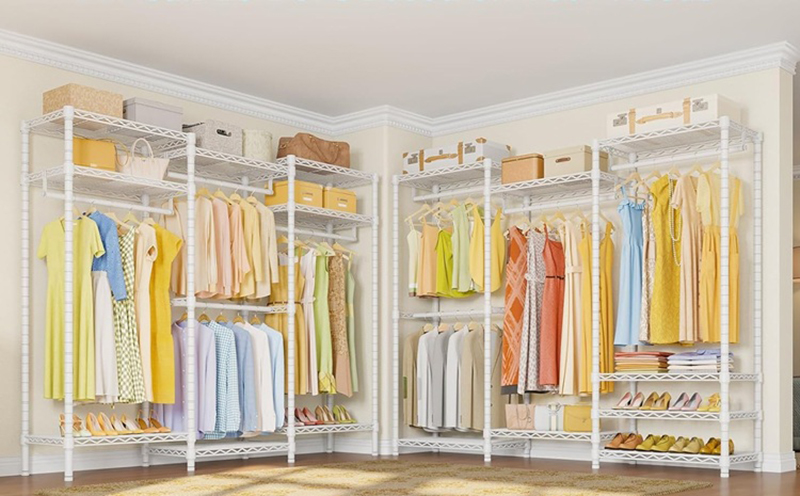
Choose a rack whose documented rail and overall capacities cover your intended load. Check the full configuration, connection quality, and instructions. Do not rely on "heavy-duty" wording alone.
Neither is universally better. Choose rolling equipment when relocation is part of the job, and verify movement instructions and caster suitability. Choose a stationary configuration when movement offers no practical benefit.
Measure the complete usable area, including garment projection and access. Compare usable hanging space rather than external width alone, and check clearance for your longest clothing.
Possibly, but assess both applications separately. A retail brief may prioritize presentation and repeated access, while a home-storage brief may prioritize compact dimensions and mixed garment lengths.
Waigaoqiao publicly offers OEM collaboration for wire shelving and garment racks. Confirm your specific design, branding, quantity, testing, packaging, and delivery requirements directly before placing an order. [shelves-racks]
Look for transparent selection criteria, disclosed commercial relationships, verifiable specifications, and evidence behind performance claims. Google recommends first-hand supporting evidence when a review names something best overall or best for a particular purpose.
Hot Tags: China, Global, OEM, private label, manufacturers, factory, suppliers, manufacturing company


