
Views: 170 Author: waigaoqiao Publish Time: 2026-08-11 Origin: Site
Content Menu
● Why High-Performance Retail Display Hooks Matter
● Step 1: Converting the Concept into a Manufacturing Specification
● Step 2: Selecting the Right Material and Finish
>> Common materials for display hooks
● Step 3: Engineering the Hook for Stability and Usability
>> Front stops and safety ends
>> Practical design review checklist
● Step 4: Prototyping Before Mass Production
>> 3. Load and durability evaluation
● A New Expert Insight: Design for the Retail Labor Cycle
● Step 5: Tooling, Production, and Process Control
>> Typical quality checkpoints
● Step 6: Packaging for International OEM Delivery
● Building Trust Through Traceability and Responsible Sourcing
● Common OEM Mistakes to Avoid
>> Mistake 1: Quoting from a photograph alone
>> Mistake 2: Testing the hook without the fixture
>> Mistake 3: Treating finish as a cosmetic afterthought
>> Mistake 4: Ignoring replenishment behavior
>> Mistake 5: Approving a prototype without defining acceptance criteria
● How Waigaoqiao Supports Your Display Hook Project
>> 1. What types of retail display hooks can Waigaoqiao manufacture?
>> 2. Can you manufacture hooks from a customer drawing or sample?
>> 3. How is display hook load capacity determined?
>> 4. What finishes are available for custom display hooks?
>> 5. Can you provide custom packaging and labels?
>> 6. What information is needed for an OEM quotation?
Display hooks are small components with a major impact on retail performance. They determine how products face the shopper, how much inventory a fixture can hold, and how easily store teams can replenish merchandise. For brands, wholesalers, and manufacturers, choosing the right retail display hook manufacturer is therefore not simply a purchasing decision—it is a product-development and supply-chain decision.
At Waigaoqiao, we provide OEM manufacturing services for retail display fixtures, helping international customers move from an initial concept to a reliable, production-ready display hook. Our approach combines engineering review, material selection, prototype validation, controlled manufacturing, and export-ready packaging.
The goal is straightforward: a display hook that supports the product, fits the fixture, protects the brand image, and performs consistently on the retail floor.
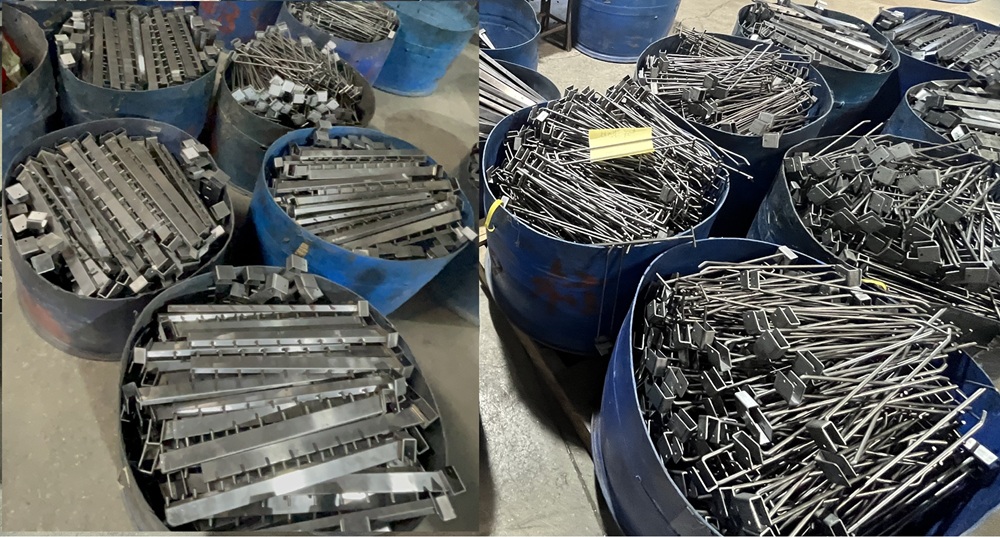
> Recommended visual: Add a factory photograph showing wire forming, welding, plating, or final inspection. A short factory video can also strengthen trust and demonstrate first-hand manufacturing expertise.
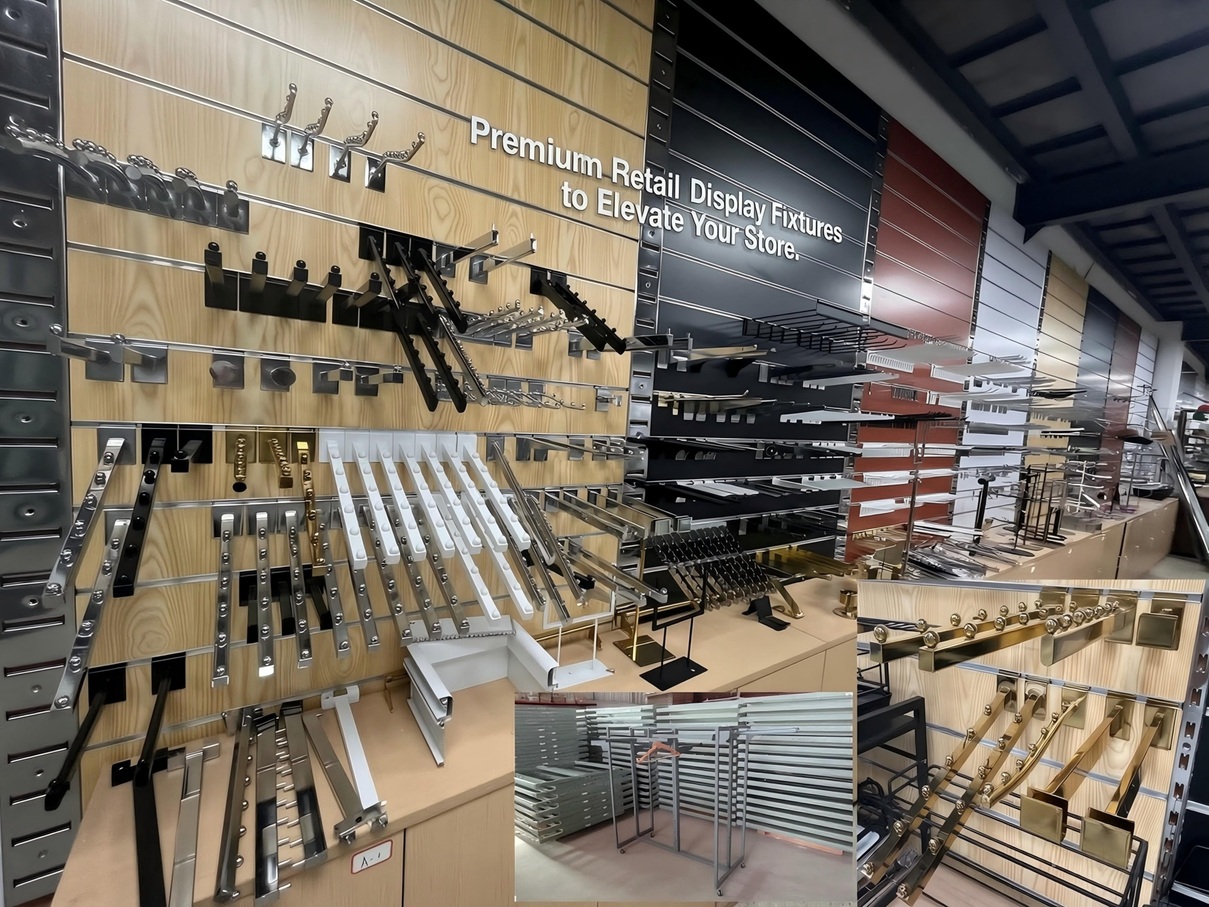
A retail display hook must do more than hang merchandise. It has to work within a complete merchandising system.
A well-designed hook should provide:
- Structural reliability: It must support the intended product load without excessive bending or deformation.
- Fixture compatibility: It should fit pegboards, slatwalls, grid panels, display racks, or custom systems accurately.
- Fast replenishment: Store employees should be able to load products efficiently.
- Product visibility: The hook should present packaging clearly and maintain consistent spacing.
- Safe handling: Rounded ends and smooth surfaces help reduce snagging and accidental injury.
- Brand consistency: Finish, color, dimensions, and packaging should match the customer's specifications.
- Repeatable quality: Every production batch should perform like the approved sample.
For heavy, high-value, or frequently handled merchandise, load capacity and anchoring method must be specified and tested. A hook's performance depends not only on the wire or tube itself, but also on the mounting point, welds, bends, product center of gravity, and fixture construction.
Manufacturers should never publish a generic load rating without defining the test method and installation conditions.
Many OEM projects begin with a sketch, photograph, sample, or incomplete drawing. The first responsibility of an experienced manufacturer is to convert that concept into a clear specification.
At Waigaoqiao, our engineering review normally examines:
1. Product dimensions and packaging footprint
2. Hook length and usable hanging depth
3. Wire diameter or tube size
4. Mounting style and fixture compatibility
5. Required load and safety factor
6. Finish, color, and corrosion expectations
7. Quantity, packaging, and shipping requirements
8. Branding or custom labeling needs
A useful product specification should define measurable requirements rather than subjective descriptions such as "strong," "premium," or "black metal."
| Specification area | Questions to confirm |
|---|---|
| Product fit | What is the package width, depth, and hanging hole size? |
| Mounting | Is the hook designed for pegboard, slatwall, gridwall, or a custom panel? |
| Capacity | What is the working load under normal retail use? |
| Material | Is steel, stainless steel, aluminum, or another material required? |
| Finish | Is the target finish zinc plating, chrome, powder coating, or another treatment? |
| End design | Is a ball, cap, loop, or safety tip required? |
| Packaging | Are hooks bulk-packed, individually bagged, or packed in branded cartons? |
This stage is where many future problems can be prevented. A hook that looks correct in a drawing may fail because its mounting tab is too short, its bend angle blocks the product, or its front stop interferes with packaging.
Material selection should reflect the retail environment, product weight, expected service life, and target price.
- Carbon steel: A practical option for many standard retail hooks. It offers good strength and cost efficiency.
- Stainless steel: Suitable where corrosion resistance, a clean appearance, or premium positioning is important.
- Aluminum: Lightweight and useful when reducing fixture weight is a priority, although the design must account for its mechanical properties.
- Steel tube: Appropriate for longer or higher-load designs where stiffness and visual presence are required.
The finish is equally important. Common options include:
- Zinc plating for basic corrosion protection.
- Chrome plating for a bright, polished appearance.
- Powder coating for colored, durable, and brand-specific finishes.
- Black coating for modern, understated, or industrial merchandising systems.
- Brushed or satin finishes for premium visual presentation.
A professional OEM supplier should confirm color references, coating thickness expectations, surface requirements, and sample approval procedures before mass production. Finish adhesion, color consistency, visible marks, sharp edges, and coating coverage should all be included in the quality-control plan.
For projects sold across different climates, buyers should also consider humidity, salt exposure, cleaning chemicals, and warehouse storage conditions. The correct finish is not necessarily the most expensive one; it is the one matched to the actual environment.
Display hook design involves several interacting details.
The product's weight should be distributed close to the fixture whenever possible. A long cantilevered arm creates greater bending force, especially when shoppers pull products from the front.
The bend angle affects:
- Product presentation
- Packaging clearance
- Inventory density
- Ease of loading
- Resistance to accidental removal
A small change in angle can improve visibility or prevent packages from sliding forward.
A front stop helps retain products during normal handling. However, an oversized stop may make replenishment difficult or damage packaging. Rounded ends, caps, loops, or welded balls can provide a more controlled user experience.
The mounting interface must match the fixture accurately. A hook intended for a standard pegboard may not fit a slatwall channel or a custom metal panel. Tolerances should be reviewed before tooling or mass production begins.
Before approving a prototype, verify:
- Does the hook fit the intended fixture without force?
- Does it remain level under the expected load?
- Can shoppers remove one item without dislodging the hook?
- Can store employees replenish it quickly?
- Are all exposed surfaces smooth?
- Does the hook preserve the product's facing and spacing?
- Can the same design be manufactured consistently at the target volume?
A prototype is not merely a visual sample. It is an opportunity to test the complete customer experience.
Waigaoqiao recommends evaluating prototypes in three conditions:
Check critical dimensions with suitable measuring tools:
- Overall length
- Wire or tube diameter
- Mounting position
- Bend angle
- Front-stop height
- Product clearance
- Hole and slot alignment
Install the hook in the actual or equivalent fixture and test:
- Product loading
- Product removal
- Hook stability
- Contact with neighboring hooks
- Replenishment speed
- Packaging interference
The customer and manufacturer should agree on:
- Working load
- Test load
- Test duration
- Fixture type
- Loading position
- Acceptance criteria
A static load test alone may not represent retail use. Repeated loading and unloading, accidental side impacts, and pulling from the front can reveal weaknesses that a single visual inspection will miss.
> Recommended visual: Include a diagram showing the hook's mounting point, working load, test load, and load direction. This helps buyers understand why the rating applies only to a defined installation method.
One frequently overlooked issue is that display hooks are handled by more than shoppers. They are also used by replenishment teams, installers, warehouse staff, and maintenance personnel.
A high-performing hook should reduce friction throughout this cycle:
1. Installation: The hook should mount quickly and consistently.
2. Initial loading: Products should slide onto the arm without snagging.
3. Daily shopping: Customers should remove products without excessive force.
4. Replenishment: Staff should refill the hook without removing the fixture.
5. Resetting: The hook should remain aligned after repeated handling.
6. Replacement: Damaged or worn components should be easy to identify and replace.
This is where user experience and engineering overlap. A hook that saves only a few seconds per replenishment can create meaningful labor savings across hundreds of stores and thousands of fixtures.
For this reason, we encourage customers to test prototypes with the people who will actually install and replenish the displays—not only with the design team.
Once the prototype is approved, the project moves into production preparation.
Depending on the design, manufacturing may include:
- Wire cutting
- CNC or automatic bending
- Tube cutting and forming
- Stamping
- Welding
- Grinding and deburring
- Surface treatment
- Powder coating or plating
- Assembly
- Labeling and packing
Process control is essential because small dimensional differences can affect fixture fit. A quality-control plan should identify critical-to-function characteristics, such as:
- Mounting dimensions
- Arm length
- Bend location
- Diameter
- Weld integrity
- Surface smoothness
- Coating appearance
- Load performance
- Packaging quantity
| Production stage | Main inspection focus |
| Incoming materials | Material type, diameter, thickness, and surface condition |
| Forming | Shape, angle, length, and dimensional consistency |
| Welding | Position, strength, appearance, and spatter |
| Finishing | Color, coverage, adhesion, and corrosion protection |
| Final inspection | Function, safety, quantity, and packing |
| Pre-shipment | Carton condition, labeling, and documentation |
Customers should receive a clear inspection standard before production begins. If the project requires third-party inspection, factory inspection, or customer-specific compliance documentation, these requirements should be defined at the quotation or sample stage.
Packaging is part of product quality. A perfectly manufactured display hook can still create problems if it arrives scratched, tangled, bent, or incorrectly counted.
Packaging should be designed around:
- Surface protection
- Prevention of tangling
- Efficient carton utilization
- Easy warehouse counting
- Barcode and label requirements
- Pallet stability
- Retail-ready presentation, if required
For coated or polished hooks, separators, inner bags, protective paper, or custom trays may be necessary. The right method depends on finish sensitivity and shipping distance.
Before shipment, verify:
- Carton quantity
- Gross and net weight
- Carton dimensions
- Shipping marks
- Product identification
- Packing-list accuracy
- Pallet requirements
- Export documentation
A packaging trial can identify issues before the first large shipment and help optimize freight cost without compromising protection.
International buyers increasingly expect more than a competitive unit price. They need evidence that the supplier can deliver consistent quality and maintain responsible business practices.
A reliable OEM partner should be prepared to provide, where applicable:
- Material and production records
- Inspection reports
- Approved-sample references
- Corrective-action records
- Packaging specifications
- Factory and supplier compliance documentation
Retail supply-chain policies commonly emphasize accurate records, supplier accountability, and the ability to provide documentation when requested. [walmart](https://corporate.walmart.com/policies)
This does not mean every display-hook project requires the same certification package. It means requirements should be agreed early and documented clearly.
At Waigaoqiao, our role is to make the process more transparent: confirm the design, clarify the specifications, communicate production status, and help the customer control quality from prototype to shipment.
A photograph rarely defines load, tolerance, material, or mounting compatibility. Use a drawing, physical sample, or detailed specification whenever possible.
A hook may perform well by itself but fail when installed in a thin or flexible panel. Test the complete system.
Color variation, poor adhesion, or exposed steel can damage the perceived quality of the entire display.
A hook that is difficult to reload increases store labor and may lead to poor product presentation.
The approved sample should become the reference for dimensions, appearance, function, packaging, and inspection.
Our OEM service is designed for customers who need a manufacturing partner rather than a generic catalog item.
We can support projects involving:
- Custom retail display hooks
- Pegboard and slatwall hooks
- Gridwall display accessories
- Metal retail display fixtures
- Custom finishes and colors
- Branded packaging
- Prototype development
- Production and export coordination
The most efficient way to begin is to provide the product application, fixture type, estimated quantity, target finish, product dimensions, and any available drawing or sample.
Ready to move your display hook from concept to shelf? Contact Waigaoqiao with your drawings, photos, or product requirements and request an OEM feasibility review.
> Recommended CTA visual: Add a "Request a Quote" button beside a photograph of an approved prototype, with a short form requesting dimensions, material, finish, quantity, and destination market.
We can develop custom metal display hooks for pegboards, slatwalls, gridwalls, display racks, and other retail fixture systems. The final design depends on the product, fixture, load requirement, finish, and packaging needs.
Yes. A drawing, 3D file, photograph, or physical sample can be used as the starting point. Our engineering team can review manufacturability, clarify missing specifications, and recommend prototype adjustments.
Load capacity depends on material, diameter, geometry, welds, mounting method, fixture strength, and loading position. A meaningful rating should be based on an agreed test method and should not be separated from the installation conditions.
Common options include zinc plating, chrome plating, powder coating, black coating, brushed finishes, and other customer-specified treatments. Finish selection should reflect appearance, corrosion expectations, handling, and budget.
Yes. Packaging may include inner bags, separators, branded cartons, barcode labels, shipping marks, and customer-specific packing quantities. Packaging requirements should be confirmed before mass production.
Please provide the product dimensions, fixture type, hook length, material preference, finish, estimated order quantity, packaging requirements, destination country, and any drawings or samples available.
1. U.S. Access Board — ADA Accessibility Standards. Official accessibility guidance includes requirements for certain hooks, shelves, clearances, and fixture-related applications.
[https://www.access-board.gov/ada/](https://www.access-board.gov/ada/)
2. U.S. Department of the Air Force — DAFMAN 91-203. The manual illustrates the importance of manufacturer specifications, inspection, and clearly marked load capacity for hooks and lifting fixtures. These principles are referenced here as general engineering context, not as a retail display-hook standard.
[https://static.e-publishing.af.mil/production/1/af_se/publication/dafman91-203/dafman91-203.pdf](https://static.e-publishing.af.mil/production/1/af_se/publication/dafman91-203/dafman91-203.pdf)
3. Los Angeles County Department of Public Health — Retail Food Inspection Guide. The guide demonstrates the broader importance of equipment capacity, proper installation, condition, and maintenance in operational environments.
[http://publichealth.lacounty.gov/eh/inspection/retail-food-inspection-guide.htm](http://publichealth.lacounty.gov/eh/inspection/retail-food-inspection-guide.htm)
4. Walmart Corporate Policies — Supplier and Supply-Chain Requirements. The policy emphasizes supplier accountability, record maintenance, and the ability to provide sourcing documentation.
[https://corporate.walmart.com/policies](https://corporate.walmart.com/policies)
5. Foxbarn — How to Choose the Right Euro Hooks for Store Displays. This industry article provides practical context on selecting display hooks for retail merchandising applications.
[https://www.foxbarn.co.uk/how-to-choose-the-right-euro-hooks-for-your-store-displays/](https://www.foxbarn.co.uk/how-to-choose-the-right-euro-hooks-for-your-store-displays/)
Editorial note: Customer reviews and project-specific performance claims should be added only from verified Waigaoqiao records, with permission and traceable details. Unverified testimonials or unsupported load figures should not be published because they may weaken E-E-A-T and buyer trust.


