
Views: 178 Author: waigaoqiao Publish Time: 2026-10-14 Origin: Site
Content Menu
● What a display-bracket load rating actually means
● How to choose a load rating for retail display brackets
● Why load position and bracket length matter
● Slatwall Hooks, Pegboard Hooks, or Display Brackets?
● Load testing: what to request from an OEM manufacturer
● Quality control for consistent retail display hooks
● Custom design: reduce risk before tooling and bulk production
● Common load-rating mistakes to avoid
● OEM sourcing checklist for international buyers
● Request an OEM quote for display brackets
Retail Display Hooks help retailers present merchandise clearly while making good use of wall and fixture space. But when a display must carry substantial weight, the right Display Brackets matter as much as the shelf itself. Choosing a load rating is not simply a matter of picking the largest number on a product listing: the bracket, attachment system, wall panel, shelf, and installation all affect safe performance.
For brands, wholesalers, and fixture manufacturers sourcing Slatwall Hooks, Pegboard Hooks, and heavy-duty display brackets, this guide explains how to assess load requirements, what to ask an OEM factory, and how to verify a product before placing a bulk order. A published capacity—such as a supplier's "up to 15 kg"—is only meaningful when the test conditions and mounting setup are understood. [szcers](https://www.szcers.com/heavy-duty-single-wire-hooks-for-retail-displays.html)
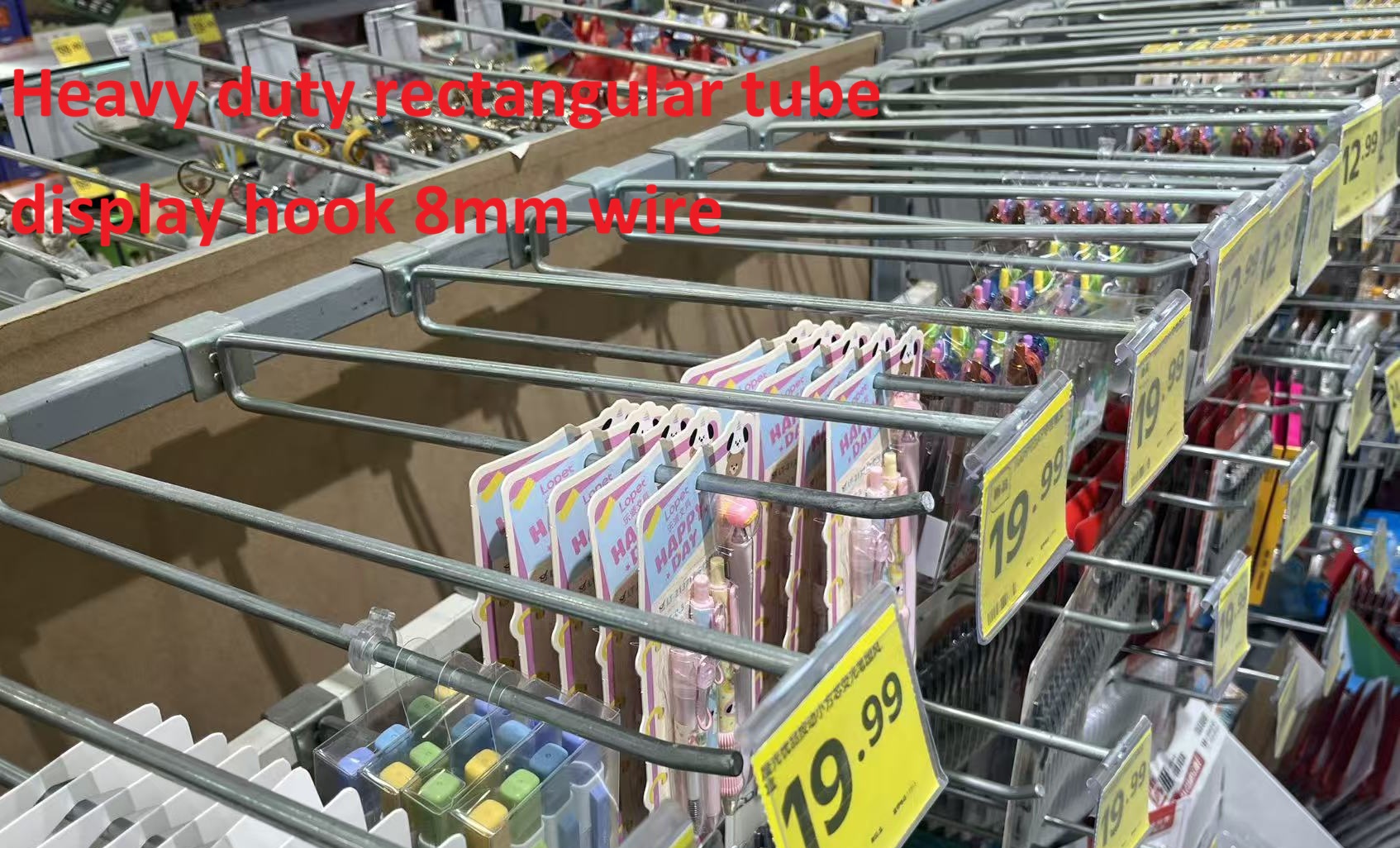
A bracket's load rating is the maximum load a supplier states it can support under defined conditions. It is not automatically a universal safe limit for every shelf, wall system, or retail installation.
Ask whether the figure applies to:
- One bracket or a pair of brackets.
- A specified bracket length, material thickness, and finish.
- A particular shelf depth and load position.
- A specific slatwall, pegboard, or other mounting system.
- A short-duration test or a sustained load over time.
These details matter because capacity is a property of the complete setup—not just the metal component. A bracket can be strong while the panel slot, fastener, or shelf fails first.
Start with the real merchandise and how it will be arranged. Determine the expected weight on each shelf, including packaging, containers, and any accessories. Then consider whether customers or staff may shift products, pull items forward, or rest a hand on the display.
A practical selection process:
1. Calculate the loaded weight. Add the weight of all items intended for one shelf. Include the shelf itself if the supplier's rating does not.
2. Map the load distribution. Note whether products are spread evenly or concentrated near the front, center, or one end.
3. Confirm the bracket count and spacing. Use the configuration specified by the supplier; do not assume a rating for two brackets applies to one.
4. Check the whole mounting system. Verify panel compatibility, slot condition, fasteners, wall support, and shelf material.
5. Set a safety margin with the project team. Have the retailer, fixture engineer, or qualified installer determine an appropriate margin for the application and applicable requirements.
6. Request evidence for the exact configuration. Ask for a test report or documented test procedure matching the bracket, finish, mounting interface, and load arrangement being quoted.
Do not treat a load rating as a guarantee against misuse or poor installation. If the application involves valuable merchandise, public-facing displays, overhead loads, or consequences if a fixture fails, have the complete installation reviewed by a qualified professional.
A shelf load creates a turning force at the bracket connection. In simple terms, the farther the weight sits from the wall, the greater the leverage on the bracket and mounting point. This is why a rating for a short bracket should not be transferred to a longer one without confirmation.
Also consider uneven loading. A shelf loaded heavily at the front may behave differently from one with the same total weight distributed close to the wall. If merchandise is likely to be moved around, describe that use case to the manufacturer instead of testing only an idealized, evenly distributed load.
A useful supplier question is: "What load position and shelf depth were used for this rating?" Ask for the tested bracket dimensions and mounting conditions as well.

These product families support different display formats, and compatibility should be confirmed before production.
- Slatwall Hooks: Designed to engage a slatwall panel. Confirm slot geometry, hook length, wire diameter, and how securely the accessory seats in the intended panel.
- Pegboard Hooks: Intended for compatible pegboard hole patterns. Confirm hole spacing, peg diameter, and any retention feature needed to prevent the hook lifting out during use.
- Display Brackets: Used to support shelves, arms, or other display components. Confirm bracket depth, mounting style, shelf interface, and load test configuration.
A supplier may offer hooks with different materials, dimensions, and finishes. For example, one product listing specifies 3–6 mm steel wire, lengths from 50–400 mm, and a stated capacity of up to 15 kg, varying by dimensions. That is a product-specific claim—not a benchmark for all Retail Display Hooks. Verify the data for the exact SKU and intended installation. [szcers](https://www.szcers.com/heavy-duty-single-wire-hooks-for-retail-displays.html)
A useful load test should be repeatable and relevant to the product's intended use. Before approving a quote or sample, ask the factory to document:
- The sample specification: material, thickness or wire diameter, dimensions, and finish.
- The mounting setup: panel type, bracket spacing, fasteners, and support conditions.
- The applied load: amount, placement, duration, and whether it was gradually applied.
- The acceptance criteria: for example, no detachment, unacceptable deformation, cracking, or finish damage.
- The test outcome: measured results, photographs, and any observed permanent deformation.
- The sample traceability: date, batch or sample identification, and test record owner.
A simple pass/fail statement is less useful than a report showing what was tested. If a design changes—such as a longer arm, thinner wire, different steel, or revised mounting plate—ask whether the existing test still applies. Often, the answer is no.
Load performance depends on repeatable production, not just a successful prototype. For an OEM order, align quality checks with the risks in your application.
Consider specifying:
- Incoming material checks for the agreed grade, dimensions, or wire diameter.
- In-process checks on bends, welds, hole locations, and critical dimensions.
- Finish inspection for coverage, adhesion, corrosion protection requirements, and visible defects.
- Fit checks using the actual slatwall or pegboard interface.
- Final sampling and packaging checks against your approved sample and purchase specification.
Define tolerances and inspection criteria before mass production. If the product must fit a particular retailer's fixture system, provide a reference panel or an approved interface drawing where possible. This reduces the risk of a batch that looks correct but does not seat properly.
Custom Retail Display Hooks and brackets can be tailored to merchandise dimensions, panel systems, brand colors, and packaging requirements. But customization should be supported by engineering and sampling—not just a drawing approval.
For a custom project, share:
1. Fixture details: panel type, interface dimensions, and intended installation.
2. Use conditions: product weight, loading pattern, replenishment frequency, and store environment.
3. Design requirements: overall dimensions, material preference, finish, end-stop or retention features, and branding.
4. Acceptance requirements: fit, appearance, load test conditions, and packaging.
5. Approval stages: drawing review, prototype sample, test confirmation, and pre-production sample.
A sensible OEM workflow moves from requirements to drawings, samples, testing, and then controlled production. This gives buyers a chance to identify fit or load concerns before committing to a larger order.
- Comparing ratings without matching test conditions. Different shelf depths, panel types, and load positions make headline figures difficult to compare.
- Assuming the bracket is the weakest link. The panel, fastener, shelf, or installation may govern the system's capacity.
- Using a rating from a similar product. A different wire diameter, material, length, or bend can change performance.
- Ignoring repeated handling. A display that is frequently loaded, unloaded, or bumped may require more evaluation than a static setup.
- Ordering in bulk before validating fit. Test the actual bracket or hook on the intended fixture before approving production.
Before choosing a supplier for Slatwall Hooks, Pegboard Hooks, or Display Brackets, request a written specification that covers:
- Product drawing and revision.
- Material and dimensions.
- Finish and color requirements.
- Intended fixture compatibility.
- Load rating, test setup, and supporting evidence.
- Quality-control checkpoints and acceptance criteria.
- Sample approval and change-control process.
- Packaging, carton quantity, and export labeling.
Clear specifications help brands, wholesalers, and manufacturers compare suppliers on more than price. They also create a shared reference if a future design revision or quality issue needs investigation.

1. How much weight can a heavy-duty display bracket hold?
There is no universal capacity. It depends on the bracket's design and material, shelf depth, load position, mounting system, and test conditions. Request evidence for the exact configuration.
2. Does a bracket's load rating apply to a pair?
Not necessarily. Confirm whether the published rating is per bracket, per pair, or for a complete shelf installation, and check the specified spacing.
3. Are Slatwall Hooks and Pegboard Hooks interchangeable?
Not by default. Their mounting interfaces differ. Check the hook and panel dimensions and test fit on the actual fixture.
4. What should a load-test report include?
At minimum, it should identify the sample, dimensions, mounting setup, load amount and position, test duration, acceptance criteria, and result.
5. Can a manufacturer customize a bracket for a specific retailer?
Yes, custom dimensions, interfaces, and finishes can be discussed. Provide fixture details and intended use, then approve a sample and relevant testing before bulk production.
6. Should I select the bracket with the highest advertised capacity?
Not automatically. Choose a bracket verified for your actual fixture and load. A larger headline number is not meaningful if the test setup differs from your application.
Waigaoqiao supports OEM sourcing for international brands, wholesalers, and manufacturers seeking Retail Display Hooks, Slatwall Hooks, Pegboard Hooks, and Display Brackets. To discuss a project, share your drawing or sample, fixture type, target dimensions, finish, expected load, and order requirements. Request a specification review and sample plan before moving to bulk production.
- [Heavy Duty Single Wire Hooks for Retail Displays — Suzhou CERS Commercial Equipment Co., Ltd.](https://www.szcers.com/heavy-duty-single-wire-hooks-for-retail-displays.html) — Product-specific material, dimensions, finishes, and stated load capacity. [szcers](https://www.szcers.com/heavy-duty-single-wire-hooks-for-retail-displays.html)
- [SSWBasics 10-inch Slatwall Shelf Bracket — Amazon product listing](https://www.amazon.com/10-Slatwall-Shelf-Bracket-Chrome/dp/B07F8YMZRM) — Example of a retail listing that states a bracket capacity; not a general engineering standard. [amazon](https://www.amazon.com/10-Slatwall-Shelf-Bracket-Chrome/dp/B07F8YMZRM)
- [Retail Display Hooks — Highbright Enterprise Limited](https://supermarketequipment.sell.everychina.com/sell-retail-display-hooks.html) — Example of commercial product categories and OEM-style supplier listings. [sell.everychina](https://supermarketequipment.sell.everychina.com/sell-retail-display-hooks.html)
Editorial note: No original article or user-review text was included in the brief. This article therefore does not quote or attribute customer reviews. Load figures cited above are product-listing claims and should be independently verified for the buyer's exact application.


