
Views: 170 Author: waigaoqiao Publish Time: 2026-08-10 Origin: Site
Content Menu
● What Makes a High-Performance Retail Display Hanger or Hook?
● Why Custom Retail Display Fixtures Are Becoming More Important in 2026
>> Retailers Need More Flexible Merchandising Systems
>> Physical Retail Is Becoming More Experiential
>> Reusable and Modular Display Systems Offer Long-Term Value
● Six Reasons Waigaoqiao Is a Strong OEM Partner for Retail Display Hangers and Hooks
>> 1. Custom Engineering Instead of One-Size-Fits-All Products
>> 2. Materials and Finishes Designed for the Application
>> 3. Consistent Quality for International Rollouts
>> 4. Better Support for Private Label and OEM Branding
>> 5. Flexible Quantities and Product Development
>> 6. Manufacturing Near a Major Export Hub
● How to Choose the Right Custom Display Hook: A Practical Checklist
● A Better OEM Development Process for Global Buyers
>> Step One: Submit a Technical Brief
>> Step Two: Review Design Risks
>> Step Three: Approve a Prototype
>> Step Four: Confirm Production Standards
>> Step Five: Run a Pilot Order
>> Step Six: Track Performance After Launch
● Expert Insight: Measure the Display, Not Just the Component
● Common Sourcing Mistakes to Avoid
>> Choosing Based Only on Unit Price
>> Providing Incomplete Product Information
>> Failing to Define Quality Standards
>> Treating Every Market as Identical
● Why Buyers Should Request a Quote from Waigaoqiao
>> What types of custom retail display hooks does Waigaoqiao produce?
>> Can Waigaoqiao customize the hook size and finish?
>> What information is needed for an accurate quotation?
>> Are samples available before mass production?
>> Can the hooks be branded for private-label sales?
>> How should international buyers control quality?
>> Are sustainable materials and reusable designs available?
>> How long does a custom retail hook project usually take?
>> Can Waigaoqiao support large retail rollouts?
>> What is the difference between a standard hook and a custom hook?
In 2026, custom retail display hangers and hooks are no longer simple store accessories. They are strategic merchandising tools that help brands improve product visibility, organize shelves, support omnichannel retail, and communicate quality at the point of purchase.
As an experienced Chinese manufacturer serving international brand owners, wholesalers, retailers, and production companies, Waigaoqiao provides OEM solutions for retail display fixtures, including metal display hooks, plastic hangers, pegboard hooks, slatwall hooks, countertop display components, and customized merchandising hardware.
The strongest retail display programs now combine durability, flexible customization, efficient logistics, sustainability, and consistent brand presentation. Retailers are also investing more heavily in value-priced assortments, omnichannel experiences, and distinctive in-store environments.
Waigaoqiao is positioned to help global buyers meet those requirements through a practical, engineering-led OEM process.
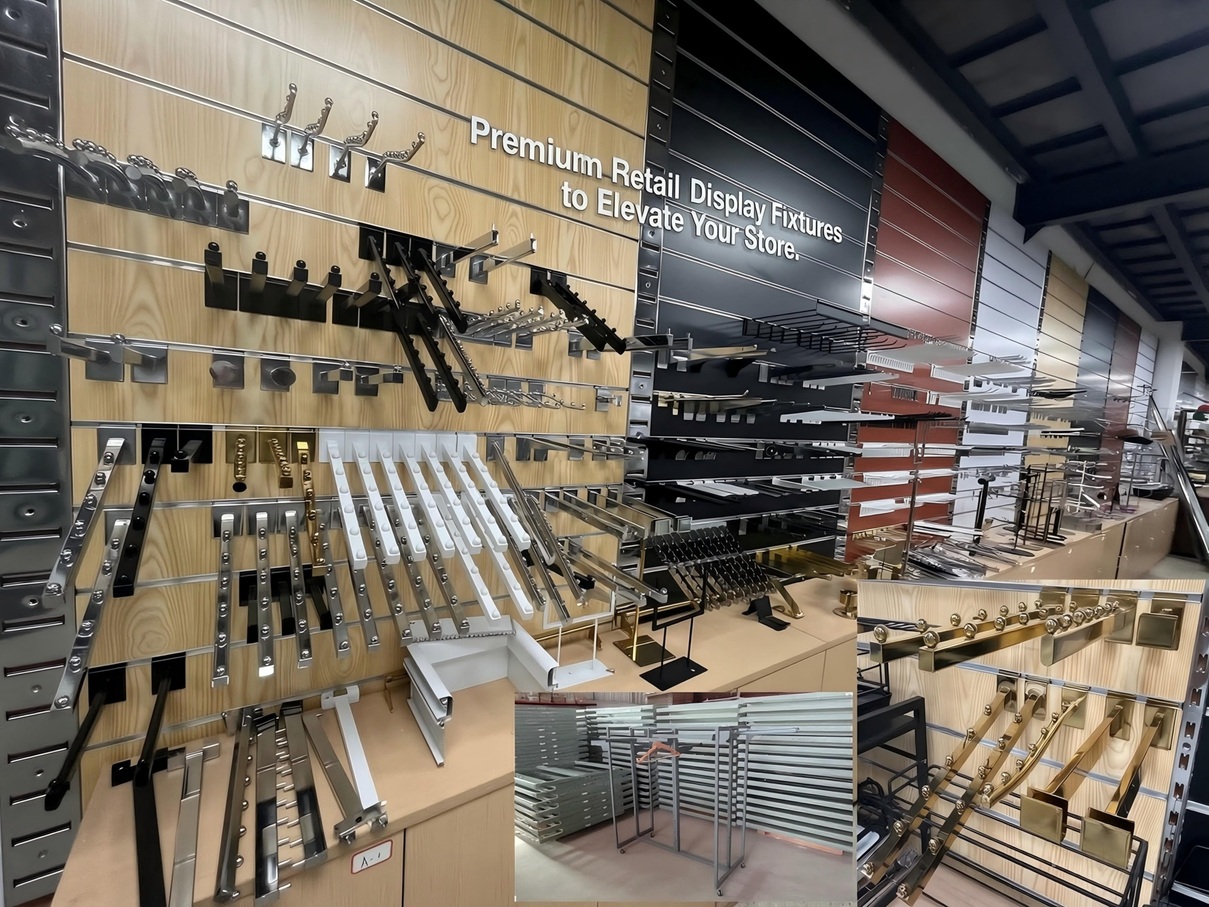
A retail hanger or hook must do more than hold merchandise. It should support the entire product presentation system.
A well-designed display component should provide:
- Reliable load capacity for the intended product category.
- Fast product replenishment for store employees.
- Clear product visibility from multiple shopping angles.
- Compatibility with pegboards, slatwalls, gridwalls, gondolas, or custom fixtures.
- Consistent appearance across stores and markets.
- Safe edges and stable mounting for daily customer interaction.
- Efficient packaging and shipping to reduce landed cost.
From an industry perspective, one of the most common sourcing mistakes is choosing a hook based only on unit price. A lower-priced component may create higher costs through breakage, installation delays, poor packaging, inconsistent plating, or product returns.
The right question is not simply, "How much does one hook cost?"
A better question is:
> How much value does the entire display system create over its operating life?
A properly engineered retail display hook can reduce replenishment time, improve product organization, minimize maintenance, and create a more professional shopping environment. These benefits can be more valuable than a small difference in the initial purchase price.
Modern stores must adapt quickly to seasonal launches, promotional campaigns, private-label growth, and localized product assortments. Standard hardware often limits layout flexibility.
Custom retail display hooks and hangers allow brands to specify:
- Exact length and projection
- Wire diameter or material thickness
- Single-prong or double-prong configurations
- Front lips, price-ticket channels, and stopper balls
- Swivel, locking, folding, or removable functions
- Custom finishes and brand colors
- Packaging, labeling, and barcode requirements
A standard hook may be suitable for a general application, but it may not fit every product package or fixture. A hook that is too short can reduce product capacity. A hook that is too long can create congestion or instability. A hook with insufficient strength may bend under repeated use.
Custom design allows the display component to be developed around the product rather than forcing the product to adapt to an unsuitable accessory.
In-store displays now need to support brand storytelling, product discovery, and digital interaction. Retail experts increasingly describe the store as a connected environment in which physical fixtures and digital content work together.
A simple custom hook can contribute to this experience by:
- Holding products at the correct viewing height.
- Creating orderly and easy-to-shop product blocks.
- Supporting QR codes or digital price labels.
- Making promotional products more visually prominent.
- Improving the transition between online product discovery and in-store purchase.
- Helping shoppers compare similar products more easily.
Retail display fixtures should therefore be viewed as part of the customer journey. They influence how quickly shoppers find a product, how confidently they evaluate it, and how easily they remove it from the display.
Retailers often change product assortments throughout the year. A reusable fixture system can support multiple campaigns instead of being discarded after a single promotion.
Modular display hooks and hangers may help retailers:
- Reduce display replacement costs
- Simplify seasonal merchandising
- Reuse existing store infrastructure
- Support faster store resets
- Reduce unnecessary packaging and fixture waste
For sustainability-focused programs, buyers should request transparent information about material composition, recycled content, coating systems, packaging materials, and expected product reuse.
Sustainability should not be treated as a marketing statement alone. It should be reflected in practical design decisions, including durability, repairability, reusable components, packaging efficiency, and reasonable product life.
Every retail program has different requirements. A cosmetics brand may need compact, visually refined hooks. A hardware wholesaler may need high-load steel hooks. A supermarket supplier may prioritize fast replenishment and price-ticket visibility.
Waigaoqiao's OEM approach should begin with the application rather than a generic product list.
A professional development process includes:
1. Product and fixture assessment
2. Dimensional review
3. Material and finish recommendation
4. Prototype development
5. Load, fit, and appearance testing
6. Pre-production approval
7. Mass production and quality inspection
This process helps prevent a common sourcing problem: discovering after production that the hook does not fit the client's pegboard, packaging, shelf pitch, or product weight.
The manufacturer should also review potential design risks before production. These may include product interference, unstable mounting, sharp edges, insufficient clearance, excessive bending, and difficult replenishment.
Material selection influences strength, appearance, corrosion resistance, cost, and service life.
Steel wire is widely used for hardware, tools, packaged goods, and other products requiring dependable load performance. Stainless steel can be considered for premium applications or environments where corrosion resistance is especially important. Plastic may be suitable for lightweight products, color-coded merchandising systems, and applications that require design flexibility or reduced shipping weight.
Surface treatment also affects both appearance and durability. Powder coating can provide a durable branded color. Electroplating can create chrome, nickel, or zinc finishes with a clean visual appearance and added surface protection. Custom color matching can help retail fixtures align with a brand's visual identity.
The most suitable material and finish depend on:
- Product weight
- Expected handling frequency
- Store humidity
- Required service life
- Brand positioning
- Target purchase price
- Packaging and transportation conditions
A premium finish is not always necessary for every application. However, a finish that is unsuitable for the store environment can lead to corrosion, discoloration, scratching, or customer complaints.
For a brand expanding across multiple countries, consistency matters as much as design.
A reliable OEM supplier should control:
- Incoming material inspection
- Critical dimensions
- Welding or joining quality
- Surface finish and color
- Load-bearing performance
- Packaging integrity
- Carton count and labeling
- Final product sampling
Buyers should request a clear approval process that includes technical drawings, samples, inspection standards, and an approved reference piece.
This is particularly important for wholesalers and production companies that need to integrate display components into a larger fixture or packaging program. A small dimensional difference can cause problems when thousands of hooks must be installed across multiple stores.
Quality control should ideally include checks at several stages. Materials should be reviewed before production. Dimensions and joining points should be checked during manufacturing. Finished goods should be inspected before packing and shipment.
Many international buyers do not want generic display hardware. They need components that look and function as part of their own product ecosystem.
Customization may include:
- Logo marks
- Brand colors
- Custom packaging
- Retail-ready labels
- Individual polybags or bulk cartons
- Instruction sheets
- Private-label documentation
- Custom product codes
Private-label packaging is especially useful for wholesalers that sell display components under their own brand. It can improve product recognition, simplify inventory management, and create a more professional presentation for downstream customers.
For brand owners, customized display hardware can also help maintain visual consistency between the fixture, packaging, signage, and promotional materials.
A strong OEM partner must support both product development and repeat orders.
Different buyer types have different priorities. International brand owners usually need brand consistency and global rollout support. Wholesalers focus on competitive cost, packaging efficiency, and stable replenishment. Production companies often require technical integration and dependable component supply. Retailers prioritize easy installation, durability, and visual merchandising performance.
Waigaoqiao can create value by supporting a staged process:
- Prototype development
- Pilot order
- Performance review
- Full-scale production
- Repeat-order management
This staged approach reduces risk. It allows the buyer to test a new display hook in a controlled environment before committing to a large production quantity.
A pilot order can also reveal issues that a single sample cannot show, including batch variation, carton damage, installation time, and compatibility with real products.
Waigaoqiao is located in Shanghai, one of China's important manufacturing, logistics, and international trade centers. This location can support coordination between production, inspection, consolidation, and export logistics.
For overseas buyers, logistics planning should consider:
- Carton dimensions
- Stacking efficiency
- Container utilization
- Protective packaging
- Export documentation
- Incoterms
- Lead-time buffers
- Replacement-part planning
A professionally engineered hook that arrives damaged or is packed inefficiently is not a successful sourcing result. Product design and logistics design should be treated as one project.
Packaging should protect the surface finish, prevent deformation, and make counting and warehouse handling easier. For larger programs, efficient carton design can also reduce shipping volume and improve total landed cost.
Before requesting a quotation, prepare the following information.
- Product weight
- Product dimensions
- Packaging style
- Hanging-hole size and position
- Product rotation speed
- Expected customer handling
- Whether products need to face forward or hang freely
- Pegboard hole spacing
- Slatwall channel dimensions
- Wire or panel thickness
- Required projection length
- Mounting direction
- Need for anti-theft or locking features
- Required distance between products
- Target quantity
- Destination market
- Required certifications
- Packaging format
- Delivery schedule
- Target price range
- Expected annual volume
- Required replacement quantity
- Load-test method
- Corrosion-resistance expectations
- Surface-finish standard
- Dimensional tolerance
- Inspection level
- Sample approval procedure
- Packaging drop-test expectations
Providing these details early allows the manufacturer to recommend the correct structure instead of quoting an unsuitable standard item.
If the buyer does not have a technical drawing, photographs, sketches, product samples, or basic dimensions can still help the factory begin an engineering review.
Send drawings, photos, product samples, or a simple sketch. If no drawing is available, provide dimensions and explain the intended retail fixture.
The brief should identify the product category, product weight, estimated display quantity, target market, and expected operating conditions.
Ask the supplier to identify potential issues related to:
- Weight distribution
- Hook deformation
- Sharp edges
- Product interference
- Installation speed
- Packaging damage
- Fixture compatibility
- Corrosion or surface wear
This stage is an opportunity to improve the design before tooling or mass production begins.
A prototype should be checked in the real or simulated retail environment. Test the product as a store employee and as a shopper would use it.
The test should consider whether the hook is easy to install, whether the product can be removed smoothly, whether the remaining items stay organized, and whether the display remains stable when partly empty.
Approve the following items in writing:
- Material
- Finish
- Color
- Dimensions
- Tolerances
- Packaging
- Labels
- Inspection criteria
- Approved sample
Written approval reduces uncertainty and provides a reference for future production batches.
A pilot order can reveal problems that a single prototype cannot show. It can test actual batch consistency, packaging performance, production speed, carton handling, and installation efficiency.
For an international rollout, the pilot should ideally be evaluated in more than one store or display environment.
Collect feedback from stores and distributors. Useful indicators include:
- Breakage rate
- Replenishment time
- Customer complaints
- Installation errors
- Packaging damage
- Repeat-order accuracy
- Surface-finish performance
- Product capacity per fixture
This feedback creates a continuous-improvement loop and makes future orders more predictable.
The performance of a retail hanger should be assessed in context.
A useful evaluation framework includes several questions.
Visibility: Can shoppers see the product from the main aisle?
Capacity: Does the hook hold enough stock without making the display look overloaded?
Accessibility: Can shoppers remove and replace products easily?
Replenishment: Can store employees restock quickly and safely?
Durability: Does the hook maintain its shape after repeated use?
Brand fit: Does its appearance support the intended market positioning?
Total cost: Does it reduce replacement, labor, maintenance, and logistics costs?
This approach is more valuable than focusing only on the initial unit quotation.
For example, a slightly stronger hook may cost more but reduce replacement work, damaged goods, and store maintenance. A shorter hook may reduce carton volume, but it could also reduce product capacity. A premium coating may improve appearance, but it should be justified by the store environment and brand positioning.
The best design balances merchandising performance, operational efficiency, product safety, and total cost.
Unit price does not include replacement costs, freight efficiency, inspection expenses, installation labor, or customer complaints.
Without product weight, package dimensions, and fixture details, the manufacturer may recommend a hook that looks correct but performs poorly in practice.
A sample should be tested for fit, load performance, appearance, handling, and packaging suitability before mass production.
Terms such as "good quality" or "strong enough" are not precise production requirements. Buyers should define measurable specifications and acceptable tolerances.
Display hooks can bend, scratch, or become tangled during transportation. Packaging should be designed together with the product.
Retail fixtures may need to meet different retailer requirements, labeling standards, packaging expectations, and installation conditions in different countries.
Avoiding these mistakes can significantly improve the reliability of an OEM sourcing project.
Although this version removes images, charts, and tables from the article, the published product page can still benefit from visual content placed outside the main text.
Recommended additions include:
- Factory production photographs showing forming, welding, coating, inspection, and packaging.
- Technical drawings showing hook length, mounting structure, and product clearance.
- A short manufacturing video showing the journey from raw material inspection to shipment.
- Retail application photographs showing hooks installed on pegboards, slatwalls, gridwalls, or gondolas.
- A product-testing video demonstrating load performance and repeated use.
- A downloadable OEM specification sheet for buyers and procurement teams.
Visual assets should include descriptive alt text, accurate captions, and information that can be verified by the factory.
Waigaoqiao is a practical choice for companies that need more than a catalog product. Its value lies in combining:
- OEM product development
- Custom retail display engineering
- Material and finish selection
- Private-label packaging
- Quality-control coordination
- Export-oriented production
- Support for repeat international orders
The best supplier relationship is not based solely on the lowest price. It is based on clear specifications, realistic lead times, repeatable quality, transparent communication, and responsive problem-solving.
If you are sourcing custom retail display hangers, hooks, or related fixtures in 2026, send Waigaoqiao your product dimensions, fixture type, target quantity, finish requirements, packaging needs, and destination market.
The team can then review the application, recommend a suitable structure, confirm the required specifications, and prepare a more accurate OEM quotation.
Waigaoqiao can develop customized metal hooks, pegboard hooks, slatwall hooks, gridwall hooks, double-prong hooks, locking hooks, and retail display hangers, depending on the product and fixture requirements.
Yes. OEM specifications may include length, wire diameter, mounting style, surface finish, color, front stopper, ticket holder, packaging, and labeling.
Provide the product weight, dimensions, fixture type, required quantity, material preference, finish, packaging requirements, destination, and delivery schedule.
A sample or prototype should be requested before production. Buyers should confirm fit, load performance, appearance, packaging, and installation method during approval.
Custom branding may include logo packaging, product labels, color matching, instruction sheets, and private-label cartons, subject to design and order requirements.
Use an approved technical drawing, a signed sample, defined tolerances, inspection criteria, packaging specifications, and a pre-shipment inspection process.
Sustainability requirements can be discussed during design. Options may include reusable modular systems, recyclable packaging, durable products with longer service life, and material-reduction strategies.
The timeline depends on design complexity, sample requirements, tooling, quantity, surface treatment, packaging, and production scheduling. Buyers should request a project timeline covering design confirmation, prototype approval, production, inspection, and shipment.
A capable OEM program should be able to support pilot orders followed by larger production runs. Buyers should confirm factory capacity, quality-control procedures, packaging standards, and repeat-order planning before a multi-store rollout.
A standard hook uses an existing specification. A custom hook is developed around the buyer's product, fixture, load requirement, appearance, packaging, and commercial objectives. Customization can improve compatibility and operating performance when the standard product is unsuitable.
1. [Deloitte — 2026 Retail Industry Global Outlook](https://www.deloitte.com/us/en/insights/industry/retail-distribution/retail-distribution-industry-outlook.html)
2. [shopPOPdisplays — 2026 Retail Display Trends](https://www.shoppopdisplays.com/blog/2025/11/06/2026-retail-display-trends-whats-in-and-whats-out)
3. [One Door — 2026 Visual Merchandising Trends](https://onedoor.com/resource/visual-merchandising-trends)
4. [Lightspeed — Retail Trends](https://www.lightspeedhq.com/blog/retail-trends)
5. [National Retail Federation — 10 Trends and Predictions for Retail in 2026](https://nrf.com/blog/10-trends-and-predictions-for-retail-in-2026)
6. [Imageco — Retail Display Trends 2026](https://imagecoltd.com/news/retail-display-trends-2026-whats-working-in-stores-right-now)
Editorial note: Before publication, Waigaoqiao should verify all statements about manufacturing capabilities, certifications, production capacity, testing procedures, customer projects, materials, and delivery performance. These claims should be supported by factory records, product specifications, inspection reports, customer testimonials, or documented case studies.


