
Views: 0 Author: waigaoqiao Publish Time: 2026-10-07 Origin: Site
Content Menu
● How the Three Pegboard Hook Designs Differ
● When to Choose Straight Pegboard Hooks
● When Angled Pegboard Hooks Make Sense
● When to Choose Locking Pegboard Hooks
● Compare Samples in a Realistic Display
● Length, Wire Diameter, and Board Fit Still Matter
● Load Testing: What Buyers Should Ask
● Pegboard Hooks, Slatwall Hooks, and Display Brackets
● OEM Manufacturing and Custom Design for Retail Display Hooks
● Quality Control for OEM Pegboard Hooks
● Common Sourcing Mistakes to Avoid
>> Are straight pegboard hooks suitable for most retail products?
>> Do angled hooks keep products from falling off?
>> What does a locking pegboard hook do?
>> Are locking hooks theft-proof?
>> Which hook style has the highest load capacity?
>> Can Waigaoqiao manufacture custom straight, angled, or locking hooks?
Retail Display Hooks help make merchandise visible, accessible, and organized. For pegboard displays, choosing between straight, angled, and locking Pegboard Hooks depends on the product, package, shopper access, and how securely the hook needs to stay in the board. The right design is not necessarily the heaviest or most complex one—it is the one that fits the board and supports the intended shopping experience.
This guide compares the three styles and explains what retail brands, wholesalers, and manufacturers should specify when sourcing custom metal Pegboard Hooks. It also covers related Slatwall Hooks and Display Brackets, plus practical considerations for OEM Manufacturing, Custom Design, Quality Control, and Load Testing.

- Straight hooks project horizontally from the board. They are a straightforward option for products that hang securely and are easy to browse.
- Angled hooks hold products at a downward angle. Depending on the item and hook design, this can change product presentation and access.
- Locking hooks include a retention feature intended to help keep the hook engaged with the board during handling.
Names and configurations can vary among manufacturers, so confirm the design with a drawing or physical sample. Suppliers offer a broad range of pegboard hook styles for retail merchandising, including standard, display, and security-oriented designs. [Thomasnet](https://www.thomasnet.com/suppliers/usa/pegboard-perforated-board-hooks-38830808) [Kinter](https://products.kinter.com)
Straight Pegboard Hooks are often a good starting point when products have compatible hang holes and sit stably on a horizontal arm. Their simple geometry can suit a wide range of packaged merchandise, subject to board fit and product requirements.
Consider a straight hook when:
- Products hang naturally without needing a special presentation angle.
- Shoppers should be able to browse and remove items easily.
- The package has a suitable hang hole or tab.
- The display plan calls for a simple, familiar arrangement.
Before selecting a length, measure the packaged product, not just the product itself. Account for package depth, the number of units on each hook, and the clearance needed to remove an item without catching adjacent merchandise.
A straight hook is not automatically the best choice for every SKU. Packages can tilt, rotate, or overlap depending on their shape and hang-hole position. Check a sample with actual products before approving production.
Angled Pegboard Hooks position merchandise at a slant rather than projecting straight out. This may suit selected products or merchandising layouts where an angled presentation is useful. Whether it improves visibility or access depends on the item, hook angle, surrounding display, and shopper interaction.
Evaluate an angled design when:
- Product packaging hangs more naturally at a slant.
- A mock-up shows that the angled presentation improves browsing.
- The display layout needs a particular visual orientation.
- The product remains secure and easy to remove at the chosen angle.
Do not select an angled hook based on appearance alone. Test whether products slide, bunch together, or obscure labels. Confirm that shoppers can remove one item without disturbing the rest.
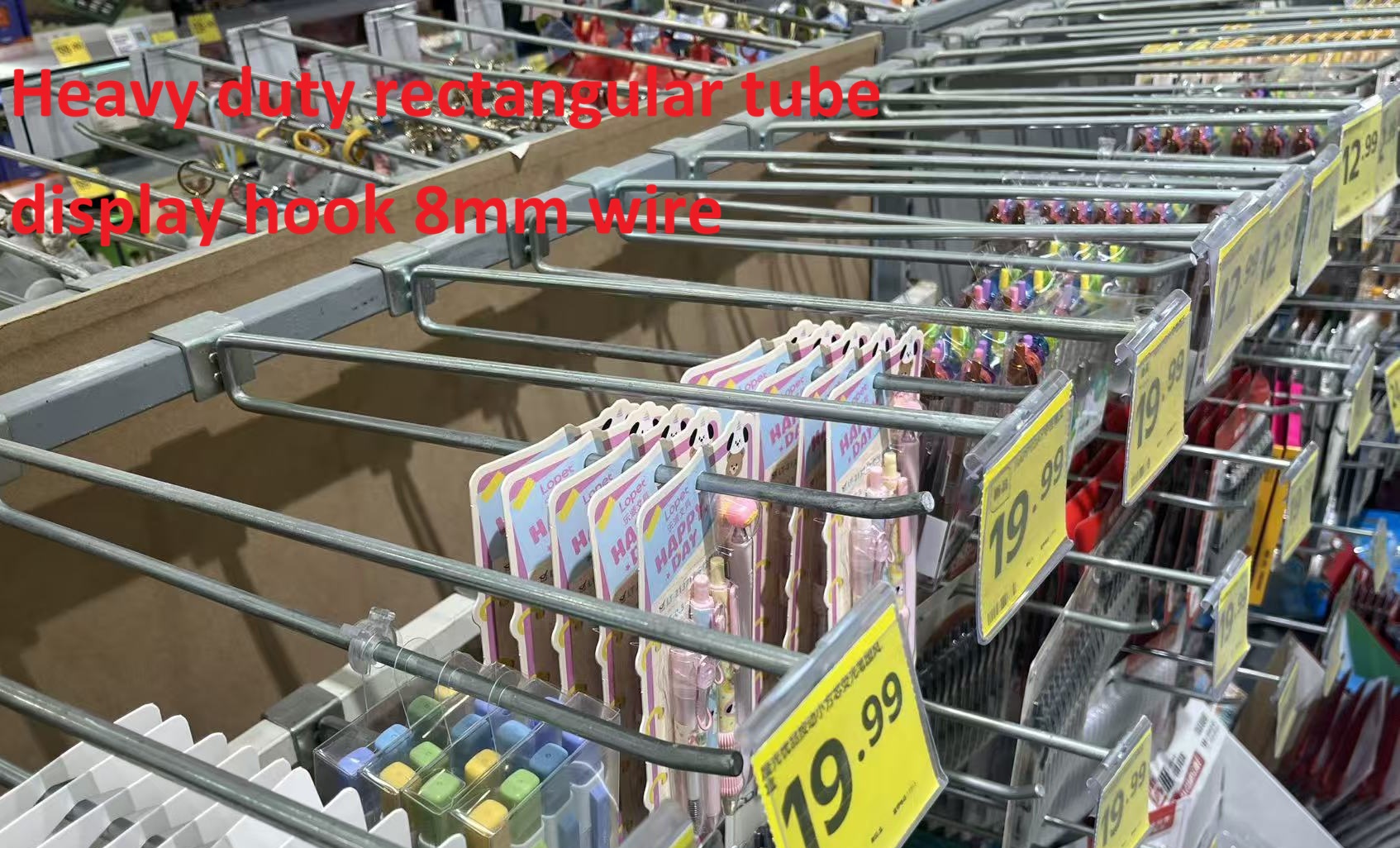
Locking Pegboard Hooks have a feature designed to help retain the hook in the board. They may be worth considering where routine product removal can dislodge a standard hook, or where the display application calls for additional retention.
Before specifying a locking design, ask:
- What mechanism locks or retains the hook?
- Does it fit the exact pegboard hole pattern and board thickness?
- Can store staff install, remove, or reposition it as needed?
- Does the lock interfere with nearby hooks, products, or replenishment?
- Has the complete hook-and-board setup been tested for the intended application?
"Locking" does not mean theft-proof, nor does it establish a load rating. It describes a retention feature, and its actual function depends on the design and compatible board.
Use the following decision path to narrow down a design:
1. Start with the product. Check its weight, package dimensions, hang-hole location, and desired orientation.
2. Consider shopper behavior. Will customers frequently pull products forward or remove them at an angle?
3. Confirm board compatibility. Verify hole size, spacing, thickness, and hook mounting geometry.
4. Choose the simplest suitable design. Begin with straight hooks unless the application gives a clear reason to use an angled or locking option.
5. Validate with samples. Test actual merchandise on the intended board and observe browsing and replenishment.
6. Document the approved setup. Record the hook type, dimensions, board specification, finish, and any agreed test conditions.
This process helps prevent over-specifying a complex hook when a standard design may work—or selecting a simple hook when the use case needs a retention feature.
A small mock-up can reveal issues that a product description or drawing will not. For each candidate style, use the intended pegboard and representative products. Include the heaviest product, the largest package, and any SKU with an unusual hang hole.
Check:
- Whether the hook seats securely and projects as expected.
- Whether products hang at the intended angle.
- Whether labels and key product information remain visible.
- Whether shoppers can remove one item without snagging nearby products.
- Whether repeated handling dislodges the hook.
- Whether staff can restock the display without excessive effort.
Record what was tested and the outcome. A successful trial applies to that specific hook, board, merchandise, and use pattern; it should not be treated as proof that every similar product will perform the same way.
Hook style is only one specification. Length, wire diameter, material, finish, and mounting geometry also affect fit and function.
When preparing an RFQ, include:
- Pegboard hole diameter and spacing
- Board thickness and construction
- Overall hook length and, where relevant, usable arm length
- Wire diameter or material section
- Product and package dimensions
- Intended quantity of products per hook
- Finish, color, tip style, and any label-holder requirement
Do not assume that one pegboard size or hook dimension is universal. For instance, retail product listings specify compatibility with particular hole sizes and spacing, so verify the actual board details for your project. [Clip Strip Corp.](https://www.clipstrip.com/product-merchandising/display-hook-systems-metal-and-plastic/peg-board-hooks-metal)
A straight, angled, or locking design cannot be assigned a reliable capacity based on its name or appearance alone. Performance depends on the hook, board, installation, and how the merchandise loads the arm.
Ask the supplier to clarify:
- Which exact hook configuration was tested?
- What pegboard type and support were used?
- How was the hook installed?
- Where and how was the load applied?
- What were the test duration and acceptance criteria?
- Does the result apply to the quoted dimensions, material, and finish?
Treat load results as specific to the tested configuration and conditions. A locking feature may help retain a hook in the board, but it does not by itself prove a particular load capacity.
Retail programs often combine several display accessories, but the mounting systems and uses differ:
- Pegboard Hooks fit a pegboard hole pattern.
- Slatwall Hooks engage with compatible slatwall grooves or inserts.
- Display Brackets support shelves or other fixture components, depending on the system.
These products are not automatically interchangeable. Specify the exact panel or board type for each item, and confirm the interface before ordering samples or production quantities.
For brands, wholesalers, and manufacturers, a detailed OEM brief helps align product design with the display application. Share:
- Hook style: straight, angled, locking, or another configuration
- Board hole size, spacing, thickness, and construction
- Product dimensions, weight, packaging, and hang-hole details
- Desired length, wire diameter, material, and finish
- Label holder, tip, branding, or other custom features
- Order quantity, packaging, and schedule
- Inspection and application-specific testing requirements
Custom Design may be appropriate when standard dimensions do not fit the product or fixture. Provide a dimensioned drawing or physical sample in addition to photos. Images communicate appearance, but they do not establish precise measurements or compatibility.
Waigaoqiao is a China-based factory focused on retail display fixtures and OEM services for international brands, wholesalers, and manufacturers. Clear application details help the factory review the design, prepare relevant samples, and align production checks with the approved requirements.
A practical Quality Control plan should compare production with an approved drawing and reference sample. Depending on the design, agreed checks may cover:
- Dimensions: Length, wire diameter, bends, and locking features
- Fit: Engagement with the specified pegboard
- Appearance: Finish, color, and visible surface defects
- Function: Installation, retention, product access, and removal
- Packaging: Protection from bending or surface damage
- Records: Sample approval and test documentation where applicable
For repeat orders, document any changes to material, dimensions, finish, or packaging. This gives the buyer and manufacturer a shared reference for production and reorders.
- Choosing by name alone: "Angled" and "locking" describe design features, not universal performance.
- Ignoring board measurements: Hole size, spacing, and thickness affect fit.
- Choosing length without testing merchandise: Package depth and hang-hole placement matter.
- Assuming locking means theft-proof or higher capacity: Confirm the feature's purpose and test evidence.
- Skipping sample approval: Validate the actual hook on the intended board.
- Using vague RFQ language: Specify measurable dimensions, materials, finish, and application.

They can be a practical option for products that hang securely from a compatible hole or tab. Confirm fit and shopper access with the actual packaged product.
Not necessarily. The result depends on the hook geometry, package, and installation. Test the product on the intended hook and board.
It has a feature intended to help retain the hook in the board. Confirm how it operates and whether it is compatible with the specific pegboard.
No. A locking feature should not be described as theft-proof unless the product has been specifically designed and validated for that purpose.
There is no universal answer. Capacity depends on the complete hook-and-board configuration and test conditions. Request documentation for the exact application.
Waigaoqiao provides OEM services for retail display fixtures. Share your board specifications, product details, drawing or sample, and requirements to assess a custom project.
- [Thomasnet: Pegboard and Perforated Board Hooks Manufacturers](https://www.thomasnet.com/suppliers/usa/pegboard-perforated-board-hooks-38830808) — Supplier category covering display, security, and other hook types.
- [Kinter: Display Hooks](https://products.kinter.com) — Retail merchandising hook product category.
- [Clip Strip Corp.: Metal Pegboard Hooks](https://www.clipstrip.com/product-merchandising/display-hook-systems-metal-and-plastic/peg-board-hooks-metal) — Example product styles and listed hook lengths.


