
Views: 170 Author: waigaoqiao Publish Time: 2026-09-09 Origin: Site
Content Menu
● Why the Lowest Display Hook Price Is Rarely the Lowest Cost
>> 1. Frequent breakage increases replacement costs
>> 2. Poor load performance can damage merchandise
>> 3. Unstable presentation reduces merchandising quality
● Quality Retail Display Hooks Support Better Store Operations
>> Faster replenishment and easier maintenance
>> Better customer interaction
● How Waigaoqiao Creates Long-Term Value Through OEM Manufacturing
>> Product development based on application requirements
>> Controlled production and repeatability
>> Finishes designed for commercial use
● A Practical Five-Step Method for Choosing Display Hooks
>> Step 1: Define the application
>> Step 2: Calculate the working load
>> Step 3: Check compatibility
>> Step 4: Inspect finish and safety
>> Step 5: Approve a production sample
● The Hidden Environmental Cost of Replacing Cheap Fixtures
● Why OEM Customization Can Reduce More Than Unit Cost
● Questions Buyers Should Ask a Retail Fixture Manufacturer
● Why Waigaoqiao Is a Long-Term OEM Partner
● Conclusion: Buy for Performance, Not Just Price
● Frequently Asked Questions About Retail Display Hooks
>> 1. What are retail display hooks used for?
>> 2. How do I choose the correct display hook?
>> 3. Are custom display hooks more expensive than standard hooks?
>> 4. What materials are commonly used for display hooks?
>> 5. Why is surface finish important?
>> 6. What should I request from an OEM supplier?
>> 7. Can Waigaoqiao support private-label or wholesale orders?
When retailers, wholesalers, and brand owners purchase cheap retail display hooks, the initial unit price can look attractive. However, low-cost hooks often create hidden expenses through breakage, product damage, poor presentation, frequent replacement, and store-level maintenance. For businesses that depend on consistent merchandising, investing in reliable retail display fixtures from an experienced OEM manufacturer can deliver a much lower total cost over time.
At Waigaoqiao, we manufacture custom retail display hooks, metal display fixtures, pegboard hooks, slatwall accessories, and OEM merchandising solutions for overseas brands, wholesalers, and manufacturers. Our experience shows that a display hook is not merely a small metal component. It affects inventory security, staff efficiency, shopper experience, and the perceived value of the products it holds.
> Important editorial note: Because no original customer-review text or verified Waigaoqiao production data was supplied, this article avoids inventing testimonials, test results, or performance guarantees. Customer comments should be added only after obtaining permission and confirming their accuracy.

The purchase price is only one part of the cost of a retail fixture. A more useful calculation is:
Total cost of ownership = purchase price + replacement cost + labor + product loss + freight + downtime + brand impact
A cheap hook may save a few cents at the purchasing stage but create costs throughout its service life.
Low-cost hooks may use thinner wire, weaker welds, inconsistent dimensions, or inadequate surface treatment. Under repeated loading, the hook can bend, detach, or fail at the welded joint.
The consequences are practical:
- More replacement orders
- Higher spare-parts inventory
- Additional international freight
- Emergency production and shipping
- Store disruption during fixture repairs
The financial impact becomes more serious when a retailer operates hundreds or thousands of locations. Even a small failure rate can become a recurring operating expense.
A hook that bends under normal product weight may cause packages to slide, fall, or become difficult to remove. In some categories, falling products can be scratched, crushed, or rendered unsellable.
This is especially important for:
- Electronics accessories
- Tools and hardware
- Beauty products
- Packaged food
- Small household goods
- High-value branded merchandise
A properly designed hook should match the product weight, package shape, hanging hole, fixture system, and expected customer interaction. One universal design is rarely appropriate for every application.
Retail shoppers notice disorder, even if they do not consciously identify the cause. Hooks that sit at inconsistent heights or angles can make a display appear poorly maintained.
A reliable retail display hook should help maintain:
- Consistent product facing
- Correct spacing
- Clear price-label visibility
- Easy product access
- Fast shelf replenishment
- A clean brand presentation
The fixture is part of the merchandising system. If it fails to support the intended layout, the brand may lose the visual consistency created through packaging and store design.
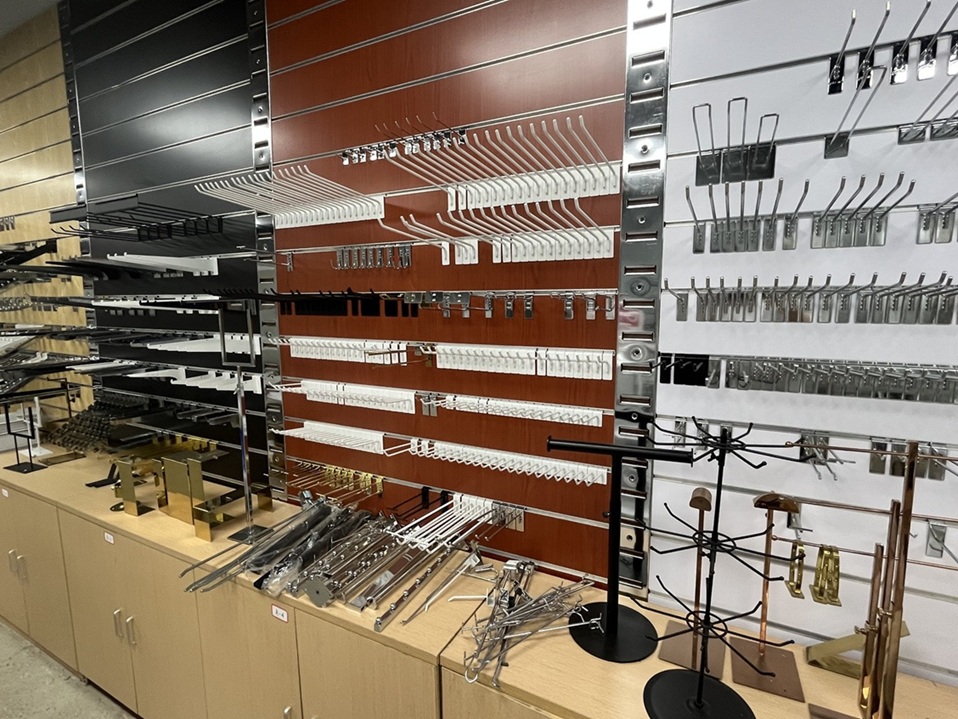
A strong display fixture is not only a merchandising tool. It is also a labor-saving tool.
Store employees often work under time pressure. A hook that is correctly sized and securely fitted allows staff to replenish products quickly without repeatedly adjusting the fixture.
Useful design details may include:
- Rounded or capped ends to reduce sharp contact points
- Label holders for price or product information
- Front stops to prevent products from sliding off
- Compatible mounting dimensions
- Appropriate projection length
- Smooth surfaces that reduce package snagging
Small design improvements can produce meaningful efficiency gains when repeated across many stores.
Customers need to remove a product without pulling an entire row forward or dislodging neighboring merchandise. A well-designed hook balances two requirements:
1. The product must remain secure during normal store activity.
2. The product must be easy for shoppers to select.
This balance requires more than choosing a cheaper material. It requires understanding product packaging, customer behavior, fixture compatibility, and retail environment.
For international buyers, the value of an OEM supplier is not limited to factory capacity. The supplier should help reduce design risk, production inconsistency, and communication problems.
At Waigaoqiao, an OEM project should begin with the intended use rather than a generic catalog item. Important questions include:
- What product will the hook carry?
- What is the loaded weight?
- Which board, shelf, pegboard, or slatwall system will receive it?
- What projection length is required?
- Does the customer need a stop, cap, label holder, or security feature?
- What finish and color match the brand environment?
- How will the product be packed for export?
This process helps avoid a common purchasing mistake: selecting a hook solely by unit price before confirming whether it is suitable for the actual retail application.
For brand owners and wholesalers, consistency is critical. A product that changes slightly between batches can create installation and presentation problems.
A dependable OEM program should control:
- Wire or tube diameter
- Cutting length
- Bending angle
- Weld position
- Surface finish
- Color consistency
- Packaging method
- Carton quantity and labeling
Repeatability is especially important for private-label products and multi-market rollouts. Buyers need the second shipment to fit and perform like the first.
Different retail environments may require different finishes, such as:
- Zinc plating
- Powder coating
- Chrome plating
- Black or white coating
- Custom color matching
- Corrosion-resistant treatments
The correct finish depends on the store environment, appearance requirements, expected handling, and target service life. A professional supplier should discuss these factors rather than treating surface treatment as a purely cosmetic choice.
Before placing a large order, buyers can use the following evaluation process.
Record the fixture type, product dimensions, package weight, hanging-hole size, and expected store conditions.
Do not evaluate a hook only when empty. Test it with the intended product load and consider repeated loading, customer removal, and replenishment.
Confirm the hook's mounting design, wire diameter, projection, spacing, and accessories. A small dimensional mismatch can create large installation problems.
Look for consistent coating, smooth welds, clean bends, and the absence of sharp edges. Packaging should also prevent scratching or deformation during transport.
A sample should be reviewed in a realistic fixture with the actual merchandise. Ideally, the buyer should assess:
- Fit
- Appearance
- Load behavior
- Product removal
- Label visibility
- Carton protection
- Installation time
This approval stage is often less expensive than correcting a problem after mass production.
Frequent replacement does not only affect purchasing budgets. It also increases material consumption, packaging waste, factory workload, and transportation requirements.
A longer-lasting fixture can support more responsible procurement by reducing the frequency of replacement. However, sustainability claims should be based on measurable information, such as:
- Material type and weight
- Expected service life
- Recyclability
- Packaging composition
- Coating process
- Repair or reuse potential
- Shipping efficiency
Buyers should request relevant documentation instead of accepting vague "eco-friendly" language. A durable product is helpful, but responsible sourcing also requires transparency across the supply chain.
Customization is sometimes viewed as an additional expense. In practice, the right customization may reduce the total project cost.
For example, a purpose-designed hook may:
- Use less material while meeting the required load
- Reduce product movement
- Improve carton utilization
- Reduce installation labor
- Fit existing fixtures without adapters
- Support a consistent planogram
- Minimize damage during shipping and handling
The goal is not to make every component complex. The goal is to ensure that the fixture is appropriate for its job.
For wholesalers and manufacturers, customized specifications can also create product differentiation. A consistent design, finish, and packaging system may help their customers standardize displays across different markets.
Before choosing a supplier, request clear answers to the following questions:
- What materials and wire diameters are available?
- How is the working load evaluated?
- What tolerances are controlled during production?
- Can the hook be customized for our fixture system?
- Which finishes are suitable for our retail environment?
- How are welds and surface quality inspected?
- What sample approval process is available?
- How are products packed for international shipment?
- Can the supplier support repeat orders and private labeling?
- What documentation can be provided for quality and compliance?
A transparent answer is often more valuable than the lowest quotation.
Waigaoqiao serves overseas brand owners, wholesalers, and manufacturers seeking dependable retail display fixture production from China. Our role is to translate a merchandising requirement into a repeatable manufactured product.
The long-term value of a supplier should be judged by more than the first invoice. It should include:
- Engineering communication
- Sample responsiveness
- Production consistency
- Quality-control discipline
- Export packaging
- Customization capability
- After-sales communication
- Ability to support future orders
When a display hook works correctly across multiple stores and replenishment cycles, it protects more than inventory. It protects the retailer's time, the brand's presentation, and the buyer's reputation.
Cheap display hooks may appear economical at the beginning, but their hidden costs can emerge through breakage, labor, product damage, inconsistent displays, and repeated freight. A reliable retail display hook should be evaluated as part of the complete merchandising system.
For international brands, wholesalers, and manufacturers, investing in an experienced OEM partner such as Waigaoqiao can provide stronger long-term value through application-based design, consistent manufacturing, suitable finishes, export-ready packaging, and repeat-order support.
Ready to reduce the hidden cost of retail fixture replacement? Contact Waigaoqiao with your product weight, fixture type, dimensions, finish requirements, and estimated order quantity. Request an OEM consultation and sample review before committing to mass production.
Retail display hooks are used to hang packaged merchandise on pegboards, slatwalls, grid panels, gondolas, and other retail fixtures. They help organize products, improve visibility, and support efficient replenishment.
Consider the fixture system, product weight, package dimensions, hanging-hole size, projection length, finish, and required accessories. Always test the hook with the actual merchandise before mass production.
The initial tooling or development cost may be higher, but customization can reduce installation labor, product movement, packaging problems, and replacement expenses. The correct comparison is total cost of ownership rather than unit price alone.
Common materials include steel wire, stainless steel, and metal tubing. The appropriate choice depends on load requirements, environment, appearance, corrosion resistance, and budget.
Surface finish affects appearance, corrosion resistance, durability, and customer safety. Smooth, consistent finishing also helps reduce package snagging and supports a professional retail presentation.
Request product drawings, material specifications, sample approval, finish options, packaging details, quality-control information, production lead times, and repeat-order support.
Waigaoqiao provides OEM-oriented support for overseas brands, wholesalers, and manufacturers. Buyers should confirm customization scope, packaging requirements, minimum order quantities, and production schedules during consultation.


