
Views: 170 Author: waigaoqiao Publish Time: 2026-08-09 Origin: Site
Content Menu
● What Makes a Retail Display Hanger and Hook Effective?
● OEM and ODM Capabilities for Retail Display Hooks
● Step 2: Design and Engineering Confirmation
● Step 3: Prototype or Pre-Production Sample
● Step 4: Quality and Production Approval
● Step 5: Mass Production and Shipment
● Why Quality Consistency Affects Retail Profitability
● Common Material Considerations
● 1. Customization Instead of One-Size-Fits-All Products
● 2. Manufacturing-Oriented Recommendations
● 3. Support for International B2B Projects
● 4. Suitable for Repeat Orders and Product Variations
● 5. Practical Focus on Retail Performance
● Request Your Custom Retail Display Hook Solution
● 1. What products can Waigaoqiao manufacture?
● 2. Can you manufacture according to our drawings?
● 3. Can the retail hooks include our logo or brand color?
● 4. How do we confirm whether a hook is strong enough?
● 5. Can you provide samples before bulk production?
● 6. What information is needed for an accurate quotation?
● 7. Do you support wholesale and repeat orders?
For brands, wholesalers, and manufacturers searching for a custom retail display hanger and hook manufacturer, choosing the right OEM partner is about more than price. The right supplier must understand merchandising, product protection, store execution, packaging, quality control, and international delivery.
Waigaoqiao is a China-based factory specializing in retail display fixtures, including custom display hangers, hooks, racks, and related merchandising products. We support overseas customers with OEM manufacturing, product customization, and production coordination designed for real retail environments.
> Note: This article is written from a practical manufacturing and merchandising perspective. Product specifications, certifications, lead times, and testing requirements should be confirmed for each individual project.
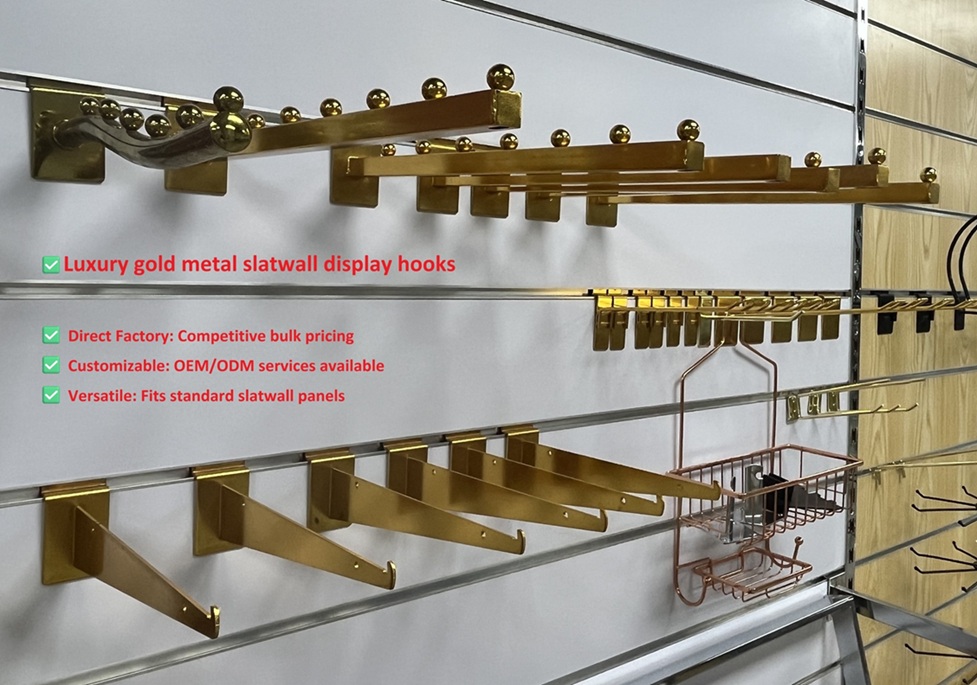
A retail hanger or hook is not simply a piece of metal or plastic. It is a functional merchandising tool that must help retailers:
- Present products clearly
- Maximize vertical display space
- Support fast replenishment
- Protect products from damage
- Maintain consistent brand presentation
- Reduce installation and labor time
A poorly designed hook may bend under load, damage packaging, create safety concerns, or make products difficult to remove. A well-engineered custom display fixture can improve product visibility while making store operations more efficient.
For this reason, we evaluate each project according to the product's weight, dimensions, packaging format, display environment, installation method, and expected usage frequency.
## A Custom Retail Display Fixture Manufacturer for Global B2B Customers
Waigaoqiao works with several types of international buyers:
| Customer type | Typical requirement | How OEM support helps |
|---|---|---|
| Retail brands | Consistent branded fixtures | Match colors, finishes, logos, and packaging |
| Wholesalers | Flexible product ranges | Develop multiple sizes and configurations |
| Manufacturers | Fixtures integrated with products | Align hook dimensions with packaging and cartons |
| Distributors | Reliable repeat supply | Standardize specifications and reorder processes |
| Store fixture companies | Project-based production | Support drawings, samples, and bulk manufacturing |
Our role is not limited to producing a standard catalog item. We help convert a merchandising requirement into a manufacturable product.
This may involve:
- Reviewing drawings or reference samples
- Recommending suitable materials
- Optimizing dimensions and load capacity
- Selecting surface treatments
- Developing prototypes
- Confirming packaging and carton requirements
- Coordinating mass production and inspection
Depending on the project, custom retail display hooks and hangers may be developed with:
- Different wire diameters
- Various hook lengths and angles
- Single, double, or multi-prong structures
- Metal, plastic, or combined-material construction
- Black, white, chrome, zinc, brass, or custom finishes
- Price-tag channels and label holders
- Screw-in, slatwall, pegboard, gridwall, or panel-mounted formats
- Custom logos, colors, and packaging
The best design is not always the most complicated design. In many cases, a simple structure with the right dimensions provides better durability, easier production, and lower total cost.
## Why Product-Specific Engineering Matters in Retail Displays
Every product behaves differently on a retail fixture. A lightweight accessory, packaged tool, garment, toy, or hardware item may require a completely different hanger or hook design.
Before production, our engineering review focuses on five practical questions:
1. What is the actual product weight?
2. How is the product packaged and loaded?
3. How often will shoppers remove and replace it?
4. What type of store fixture will support it?
5. What visual and branding requirements must the fixture meet?
A hook should be designed for the product's working load, not merely its average weight. Repeated loading, accidental impact, transport vibration, and uneven product placement can all affect performance.
For that reason, buyers should request confirmation of:
- Material and wire or sheet thickness
- Load-bearing design
- Weld or joint quality
- Surface treatment
- Dimensional tolerances
- Applicable testing requirements
Important: Load capacity should be validated through project-specific testing. It should not be assumed from appearance alone.
A fixture that works on a pegboard may not fit a slatwall system. Small differences in mounting geometry can create installation problems across an entire store rollout.
We therefore recommend confirming:
- Mounting hole size
- Hook insertion depth
- Backplate dimensions
- Spacing between prongs
- Product clearance
- Label-holder position
- Compatibility with existing retail systems
## Waigaoqiao's OEM Process: From Idea to Mass Production
A clear development process reduces misunderstandings and helps control cost.
The buyer provides drawings, photos, samples, product dimensions, estimated order quantity, and target market requirements. If the design is incomplete, our team can identify key manufacturing questions.
We review:
- Material selection
- Dimensions
- Structural strength
- Mounting method
- Finish
- Packaging
- Production feasibility
At this stage, it is often possible to identify unnecessary features that increase cost without improving store performance.
A sample allows the buyer to check:
- Fit
- Appearance
- Product loading
- Removal and replenishment
- Stability
- Brand consistency
For retail products, a physical sample is especially valuable because drawings cannot fully demonstrate how the fixture performs in a real merchandising environment.
After sample approval, specifications should be documented clearly. This may include approved drawings, color references, packaging instructions, inspection criteria, and acceptable tolerances.
During production, quality control should focus on both appearance and function. A fixture may look acceptable but still fail because of deformation, sharp edges, weak joints, poor coating, or incorrect dimensions.
## Quality Control for Custom Retail Display Hangers and Hooks
For international B2B buyers, quality consistency is often more important than receiving one perfect sample.
A professional inspection plan may cover:
- Material verification
- Dimensions and tolerances
- Welding or assembly quality
- Surface finish and coating
- Sharp-edge inspection
- Load or functional testing
- Color consistency
- Logo placement
- Packaging integrity
- Carton quantity and labeling
Retail display fixtures are used repeatedly across many stores. If dimensions vary from batch to batch, products may hang unevenly, labels may not fit, or installation may require additional labor.
Consistent production helps retailers reduce:
- Store setup time
- Fixture replacement
- Product damage
- Repacking work
- Customer complaints
- Delays during rollout
Our manufacturing objective is not only to produce the requested quantity, but to produce repeatable fixtures that perform consistently in the field.
## New Insight: Calculate Total Cost, Not Just Unit Price
A lower unit price does not always mean a lower project cost.
Buyers should evaluate the total cost of ownership, including:
| Cost factor | Potential impact |
| Unit price | Direct purchasing cost |
| Tooling | One-time development investment |
| Packaging volume | Container utilization and freight |
| Defect rate | Rework, replacement, and delays |
| Installation time | Store labor cost |
| Durability | Replacement frequency |
| Lead time | Inventory and launch risk |
A slightly more durable hook may cost more per piece but reduce replacement and maintenance expenses. Likewise, a packaging redesign may increase packaging cost while lowering shipping damage and improving container efficiency.
The most useful OEM discussion therefore compares performance, logistics, and lifecycle cost—not price alone.
## New Insight: Design Fixtures for Omnichannel Retail Operations
Retail display fixtures are increasingly connected to broader inventory and fulfillment strategies. Even when a product is sold in a physical store, its packaging and display position may affect:
- In-store pickup
- Click-and-collect operations
- Inventory scanning
- Shelf replenishment
- Product photography
- Promotional resets
A useful design should make the product easy to identify and replenish. Label holders, consistent spacing, and standardized fixture dimensions can support better store execution.
When developing a new display hook, consider:
1. Can staff replenish it quickly?
2. Can shoppers remove one item without disturbing others?
3. Is the product information visible from the aisle?
4. Will the fixture work during promotional changes?
5. Can the same design support multiple product SKUs?
These operational details are easy to overlook during the initial design stage, but they can strongly influence the success of a retail rollout.
## Materials and Finishes for Custom Display Hangers
Material selection should reflect the product load, store environment, appearance requirements, and budget.

- Steel: Suitable for strong, durable wire and sheet-metal fixtures.
- Stainless steel: Useful when corrosion resistance and premium appearance are priorities.
- Plastic: Suitable for lightweight applications and color customization.
- Combined materials: Useful when a metal structure requires a protective or branded plastic component.
Depending on the specification, finishes may include:
- Powder coating
- Electroplating
- Zinc coating
- Chrome plating
- Brushed or polished effects
- Custom color matching
The finish should be evaluated for appearance, adhesion, wear resistance, corrosion exposure, and compatibility with the target market. Specific testing should be agreed upon before mass production.
## Packaging and Export Readiness
A retail fixture can be manufactured correctly and still create problems if it is packaged poorly.
For export orders, packaging should protect against:
- Scratches
- Bending
- Moisture
- Abrasion
- Carton collapse
- Incorrect counting
- Mixed models
Effective packaging may include individual bags, separators, protective sleeves, inner cartons, master cartons, palletization, and clear shipping labels.
We encourage buyers to confirm:
- Carton dimensions
- Gross and net weight
- Quantity per carton
- Pallet requirements
- Barcode or label format
- Retail-ready packaging needs
- Drop or transport testing requirements
[Image suggestion: Insert a factory photo showing packaging and carton inspection.]
[Video suggestion: Add a short video demonstrating production, inspection, and packing steps.]
## Why Choose Waigaoqiao as Your Retail Display Fixture OEM Partner?
Your products, packaging, fixtures, and brand standards are unique. We support custom dimensions, structures, finishes, and packaging rather than forcing every project into a standard model.
A design must be attractive, but it must also be stable, repeatable, and cost-effective to manufacture. Our approach balances visual presentation with production feasibility.
Overseas buyers typically need clear communication, approved samples, stable specifications, export packaging, and reliable production coordination. These requirements are central to a successful OEM relationship.
Once a specification is approved, it can support future replenishment and related SKU development. This helps brands build a consistent fixture family across products and stores.
Our goal is to help your products look organized, accessible, and brand-consistent in the selling environment—not simply to manufacture an isolated component.
---
## How to Request a Custom Quote
To receive a more accurate quotation, send the following information:
1. Product photos or technical drawings
2. Product dimensions and weight
3. Preferred material and finish
4. Mounting system
5. Estimated order quantity
6. Target delivery country
7. Packaging requirements
8. Required testing or compliance documents
9. Desired sample date and production date
The more complete the information, the faster the factory can evaluate feasibility and provide a meaningful proposal.
If you are developing a new retail product, expanding into new stores, or replacing an existing display fixture, contact Waigaoqiao with your drawings, sample, or product photos.
Our team can help review the design, identify manufacturing considerations, develop a sample, and prepare an OEM production plan for your market.
Request a custom quote today and turn your retail display concept into a production-ready fixture.
## Frequently Asked Questions
Waigaoqiao focuses on custom retail display fixtures, including display hangers, hooks, racks, and related merchandising components. The final product range depends on the required structure, material, finish, and application.
Yes. Buyers can provide CAD drawings, sketches, photos, physical samples, or product specifications. The factory can then review dimensions, materials, production feasibility, and sample requirements.
Custom finishes, colors, labels, packaging, and logo-related requirements may be available depending on the design and production method. The exact process should be confirmed during quotation and sample development.
Strength depends on material, dimensions, structure, mounting system, and load conditions. Buyers should provide the product weight and usage scenario so that the fixture can be evaluated and, when necessary, tested.
Sample availability depends on product complexity and tooling requirements. A pre-production sample is recommended for checking fit, appearance, loading, mounting, and packaging before mass production.
Provide the product dimensions, weight, material preference, finish, estimated quantity, packaging requirements, delivery destination, and drawings or reference images whenever possible.
Yes. An approved specification can be used as the basis for repeat production and related product variations. Buyers should maintain an approved drawing and inspection standard for consistent reordering.
## References
The following sources informed the general retail, usability, sustainability, and search-quality principles discussed in this article:
1. Google Search Central — Creating helpful, reliable, people-first content
https://developers.google.com/search/docs/fundamentals/creating-helpful-content
2. Google Search Central — E-E-A-T and quality guidance
https://developers.google.com/search/docs/fundamentals/eeat
3. Google Search Central — Product structured data documentation
https://developers.google.com/search/docs/appearance/structured-data/product
4. U.S. Federal Trade Commission — Guides for the Use of Environmental Marketing Claims
https://www.ftc.gov/legal-library/browse/rules/green-guides
5. ISO — ISO 9001 Quality Management Systems
https://www.iso.org/iso-9001-quality-management.html
6. GS1 — Standards for product identification and barcodes
https://www.gs1.org/standards
7. Waigaoqiao — Company-specific product, capability, process, and customer information
*Internal company materials and customer feedback supplied for this content project. Product claims should be verified against current factory records, approved samples, certifications, and inspection documents.*


